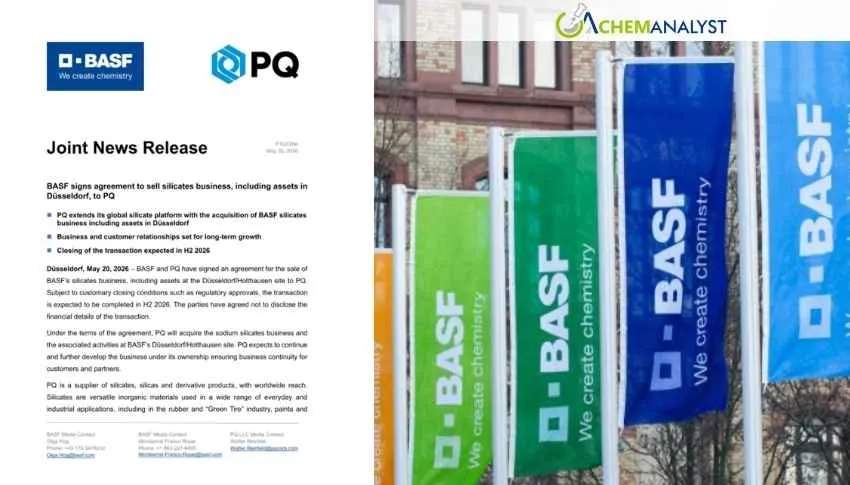
BASF has entered into an agreement with PQ for the sale of BASF’s silicates business, including related assets at the Düsseldorf/Holthausen production site in Germany. The transaction, which remains subject to customary regulatory approvals and closing conditions, is expected to be finalized during the second half of 2026. Financial terms of the agreement have not been disclosed by either company.
As part of the arrangement, PQ will acquire BASF’s sodium silicates business along with associated operations and activities located at the Düsseldorf/Holthausen facility. The acquisition represents a strategic expansion for PQ, which already operates a broad global network supplying silicates, silicas, and derivative products to a wide range of industries. PQ stated that it intends to maintain and further strengthen the acquired business under its ownership while ensuring continuity for customers, suppliers, and other business partners during the transition period.
Silicates are widely used inorganic materials with applications across numerous industrial and consumer sectors. They play a critical role in industries such as rubber manufacturing and the “Green Tire” segment, where they help improve tire performance and fuel efficiency. In addition, silicates are commonly utilized in paints and coatings, geotechnical engineering solutions, detergents, and household cleaning products. Their broad industrial relevance has made the business an important part of BASF’s specialty chemicals portfolio over the years.
According to BASF, the decision to divest the silicates business followed an extensive strategic evaluation conducted within the company’s Care Chemicals division. Jordi Tormo Blasco, Vice President Business Management Industrial Formulators Europe at BASF, explained that the company sought a buyer capable of providing long-term stability and growth opportunities for the business. He noted that PQ’s deep expertise and established presence in silicate manufacturing made it a suitable strategic partner for the acquisition.
Blasco further emphasized that securing a sustainable future for the business and its employees was a key consideration throughout the process. He added that BASF expects to maintain a close cooperative relationship with PQ going forward, particularly because BASF will continue to operate activities at the Düsseldorf site even after the transaction is completed.
For PQ, the acquisition is expected to strengthen its global manufacturing footprint and expand its customer reach in Europe and other international markets. Al Beninati, President and CEO of PQ, described BASF’s silicates operations as a strong strategic fit within PQ’s existing business network. He highlighted the Düsseldorf/Holthausen facility’s advantageous geographic location, highly experienced workforce, and established customer relationships as important assets supporting future growth opportunities.
Beninati also noted that the acquisition would enhance PQ’s ability to provide customers worldwide with dependable product quality and cost-efficient solutions. The company sees the addition of BASF’s silicates operations as a way to further reinforce its position in the global silicates market while expanding operational capabilities and supply chain reliability.
Until the transaction officially closes, BASF confirmed that day-to-day operations within the silicates business will continue without changes. Following completion, both companies anticipate a smooth and seamless transition process designed to minimize disruption for employees, customers, and commercial partners.







 About ChemAnalyst
Leave a Comment
Comments (0)