Benton Resources Inc. and its 50% joint venture partner, Metals Creek Resources Corp., have commenced an extensive regional soil gas sampling program at their Smoking Gun and Parson’s Pond hydrogen-helium exploration projects in Newfoundland. The initiative marks a significant step in assessing the natural hydrogen and helium potential of the two prospective basins and follows exploration plans announced earlier this year.
The companies have appointed Rudy Willick of Rudiger Re-Chem, a Saskatchewan-based specialist recognized for his expertise in hydrogen and helium exploration, to oversee the field program. Willick has previously contributed to exploration targeting for several companies operating in the emerging natural hydrogen sector, bringing considerable technical experience to the project.
The survey is expected to collect between 650 and 750 soil gas samples over a period of approximately two to three weeks. Once the fieldwork is completed, all samples will be analyzed at Rudiger Re-Chem’s laboratory in Saskatoon for hydrogen, helium, neon, carbon dioxide, and light hydrocarbons ranging from methane to butane (C1-C4). The analytical results will be compiled into a comprehensive report that will guide the companies’ future exploration strategies.
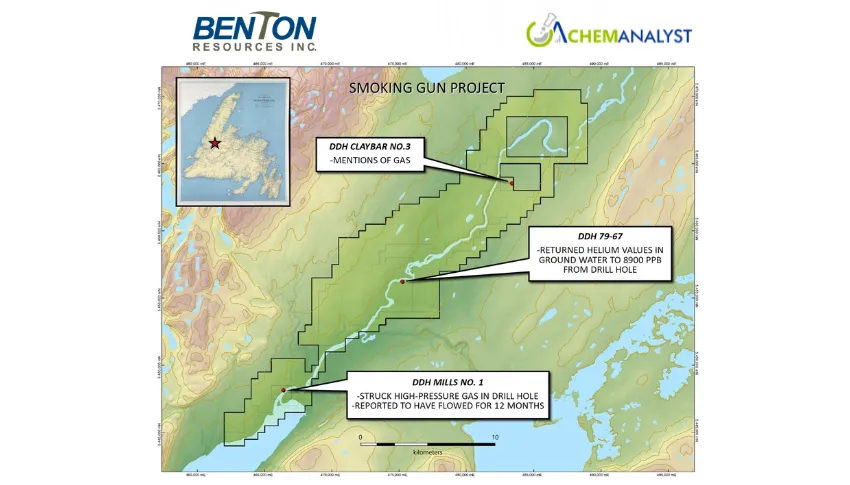
At the Smoking Gun project within the Deer Lake Basin, recent evaluations of historical exploration records have identified encouraging helium anomalies. Historic water sampling from drill hole 79-67 recorded helium concentrations reaching as high as 8,900 parts per billion. The site lies roughly 11.8 kilometers from the Mills No. 1 drill hole, where high-pressure gas reportedly flowed continuously for at least one year. Additional evidence of gas occurrences has also been documented at the Claybar No. 3 drill hole, approximately 32 kilometers away. Collectively, these findings suggest the possibility of a large regional gas system associated with favorable uranium-thorium geological settings.
The Parson’s Pond project also presents promising geological characteristics. Historical drilling across the basin identified multiple gas occurrences over a distance of more than 14 kilometers, with methane concentrations reaching up to 72% in certain intervals. The basin is underlain by thrust-faulted rocks of the Humber Arm Supergroup and contains shale and sandstone formations enriched with serpentine, chrome fragments, and glauconite. These geological features are considered favorable for the natural generation of white hydrogen. Surface gas seepage observed within the project boundaries further supports the presence of an active subsurface gas system, although additional work is required to confirm commercial concentrations of hydrogen or helium.
The soil gas survey follows strict sampling procedures designed to ensure high-quality results. Stainless steel probes are inserted to depths of approximately one meter to minimize atmospheric interference. Vacuum-sealed sample vials are used to prevent contamination, while proprietary sampling equipment developed by Rudiger Re-Chem helps reduce analytical errors associated with hydrogen measurements. GPS coordinates and detailed field observations are recorded for every sample location before the samples are shipped for laboratory analysis using advanced gas chromatography.
The exploration campaign comes amid growing global interest in hydrogen and helium resources. Hydrogen is increasingly viewed as a key clean-energy fuel and an essential industrial feedstock used in fertilizer production, petroleum refining, and transportation applications. Helium remains indispensable for MRI systems, semiconductor manufacturing, aerospace technologies, and other high-tech industries, with demand rising alongside artificial intelligence-driven chip production.
The companies emphasized that while historical gas occurrences and nearby exploration successes provide encouraging indicators, the presence of methane or gas anomalies does not confirm economically recoverable hydrogen or helium resources. Additional exploration and scientific evaluation will be necessary to determine the true potential of both Newfoundland projects.
Impact on Products and Chemical Commodity Prices
The commencement of large-scale soil gas sampling by Benton Resources and Metals Creek is primarily an exploration milestone and does not have an immediate impact on the supply of hydrogen or helium. If commercially viable resources are eventually discovered, it could strengthen future availability of natural hydrogen as a clean energy feedstock and helium for semiconductor manufacturing, healthcare, and aerospace applications. However, since the project remains in the early exploration stage, there is no near-term effect on the prices of hydrogen, helium, methane, or related industrial gases tracked by ChemAnalyst. Commodity prices are expected to remain largely stable until confirmed discoveries and commercial production plans emerge.






Leave a Comment
Comments (0)