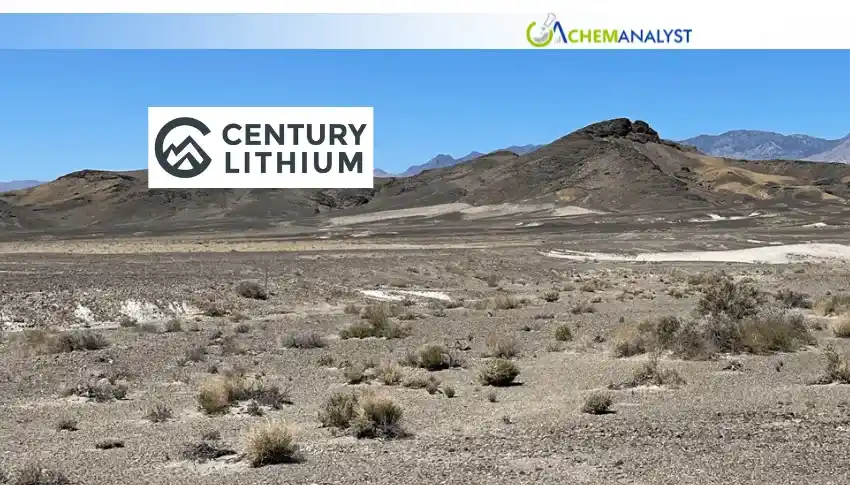
Century Lithium Corp. has reached a significant permitting milestone for its 100%-owned Angel Island Lithium Project in Esmeralda County, Nevada, by submitting its Mine Plan of Operations (PoO) and Nevada Reclamation Permit Application to the U.S. Bureau of Land Management (BLM). The company submitted the plan on September 3, 2026, to the BLM’s Battle Mountain District, Tonopah Field Office.
The Mine Plan of Operations establishes the proposed scope of the Angel Island project and provides the foundation for the BLM’s environmental review under the National Environmental Policy Act (NEPA). According to Century Lithium, the submission follows several years of baseline environmental data collection, engineering work and coordination with regulatory authorities.
The company said the filing marks an important step toward securing final project approval. Following submission, Century Lithium will focus on supporting the BLM and its third-party NEPA contractor throughout the environmental assessment process, with the ultimate objective of obtaining a Record of Decision (ROD).
The proposed Angel Island operation would encompass a 5,379-acre area of BLM-administered land covered by federal mining claims. Approximately 2,364 acres are expected to be disturbed by the planned development. The project is located in Clayton Valley, roughly six miles east of Silver Peak and 41 road miles southwest of Tonopah.
Mining would involve shallow surface extraction of lithium-bearing claystones through six pit phases. Because the deposits are relatively shallow and require limited overburden removal, the company does not anticipate drilling or blasting. Instead, ore would be ripped, loaded and transported to the processing facility.
Development is planned in two stages. Initial production is expected to reach approximately 8,300 tons per day during the first four years, before increasing to as much as 16,500 tons per day from years five through 40.
The proposed processing facility would produce battery-grade lithium carbonate through agitated tank leaching, solid-liquid separation, Direct Lithium Extraction (DLE) and crystallization. Century Lithium plans to operate a closed-loop processing system incorporating water recycling.
A chlor-alkali facility would manufacture hydrochloric acid and sodium hydroxide required for processing, with excess sodium hydroxide potentially sold commercially. Infrastructure would also include waste-rock storage areas, low-grade ore stockpiles, dry-stack tailings, access roads and administrative and laboratory facilities.
The project is expected to require 53 MW of electricity during Phase 1 and 106 MW during Phase 2. Water would be sourced through the company’s existing water rights and transported approximately 11 miles to the project through a buried pipeline.
Angel Island is being advanced under the federal FAST-41 framework, which provides coordinated oversight and publicly tracked permitting milestones. The current federal dashboard estimates completion of environmental review and permitting by February 4, 2028, although the timeline could change as regulatory review progresses.
Following submission, the BLM will conduct a 30-day completeness review. Once accepted, environmental analysis, supplemental reports and an Environmental Impact Statement will progress toward public consultation and ultimately a Record of Decision. Century Lithium is simultaneously advancing state and local Nevada permits, water-pollution-control requirements and metallurgical testing for its proposed flowsheet.
Product and Chemical Commodity Price Impact
The filing strengthens Century Lithium’s pathway toward developing a new domestic source of battery-grade lithium carbonate, potentially improving long-term supply visibility for the lithium-ion battery sector. However, the project remains in permitting and environmental review, with potential production several years away, so its immediate effect on physical lithium supply is limited. If development progresses successfully, Angel Island’s planned large-scale output could add future lithium carbonate availability and exert modest downward pressure on prices by improving supply fundamentals. Increased lithium production could also support downstream demand for processing chemicals such as hydrochloric acid and sodium hydroxide, while the project’s chlor-alkali facility could add localized sodium hydroxide supply.








 About ChemAnalyst
Leave a Comment
Comments (0)