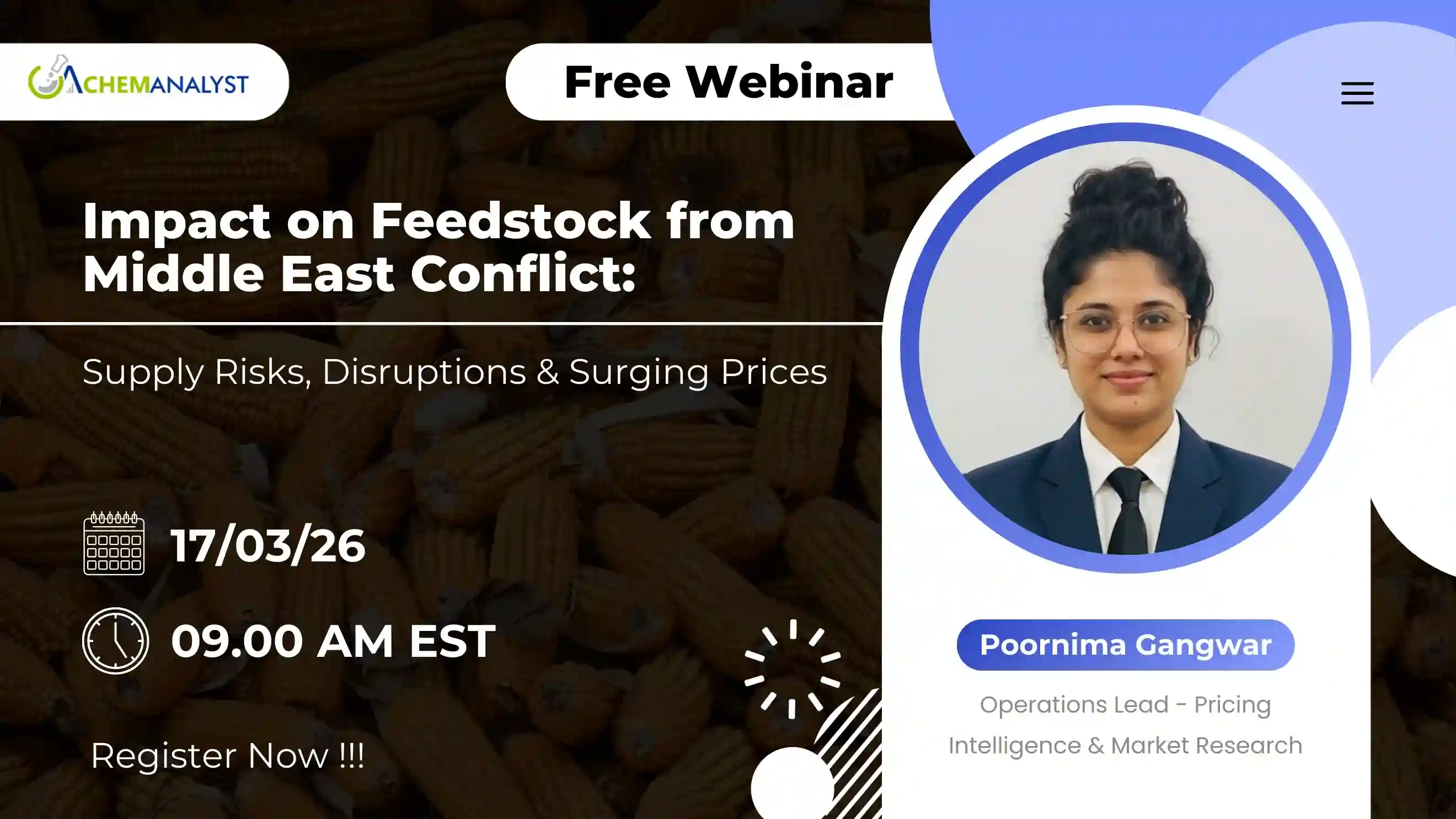
The session will feature Poornima Gangwar, Operations Lead – Pricing Intelligence & Market Research at ChemAnalyst, who will provide in-depth insights into how escalating geopolitical tensions in the Middle East are influencing global feedstock markets and supply chains.
The Middle East plays a critical role in the global energy and petrochemical landscape, acting as a major supplier of crude oil, natural gas, and key petrochemical feedstocks that support industrial production worldwide. However, ongoing geopolitical tensions in the region have heightened uncertainty across global markets. These developments have raised concerns among industry stakeholders about potential supply disruptions, trade route risks, and rising volatility in feedstock prices. In this webinar, Gangwar will analyze how such geopolitical dynamics could reshape supply-demand balances and influence procurement strategies across industries dependent on petrochemical and energy feedstocks.
One of the central themes of the session will be the potential risks to the global supply chain. Feedstocks such as naphtha, ethane, propane, and other hydrocarbon derivatives form the backbone of the petrochemical value chain. Any disruption in the production or transportation of these materials can create ripple effects across multiple sectors including plastics, chemicals, fertilizers, and manufacturing. The webinar will examine how tensions in key Middle Eastern regions could affect supply flows, refinery operations, and export capacities. Additionally, Gangwar will discuss the vulnerabilities of critical shipping routes and infrastructure that support global energy trade.
Another important focus of the webinar will be possible disruptions in production and transportation networks. Political instability and conflict can influence energy production levels, logistics operations, and shipping movements through strategic maritime corridors. Disruptions in these areas may result in delays, shortages, or sudden shifts in trade patterns, which can quickly translate into price fluctuations in feedstock markets. By evaluating these risks, the session aims to provide participants with a clearer understanding of how geopolitical events can influence the operational stability of global supply chains.
In addition to supply chain risks, the webinar will also explore the potential impact on global feedstock pricing trends. Historically, geopolitical instability in energy-producing regions has been closely linked with volatility in oil, gas, and petrochemical markets. Price surges driven by uncertainty, speculation, or supply shortages can affect downstream industries that rely on stable feedstock availability. Gangwar will highlight how shifting geopolitical conditions can impact price benchmarks, market sentiment, and procurement decisions for businesses operating in the chemical and energy sectors.
A key aspect of the discussion will be the interconnection between political instability, energy markets, and the petrochemical industry. Energy markets often react quickly to geopolitical developments, and these changes can cascade through the petrochemical value chain. For example, fluctuations in crude oil prices can alter the economics of feedstocks like naphtha and LPG, influencing production costs for petrochemical manufacturers. Understanding these linkages is essential for businesses aiming to anticipate market changes and maintain operational resilience.
Beyond analyzing current market conditions, the webinar will also provide strategic insights for businesses and market participants. Companies operating in procurement, trading, and supply chain management are increasingly required to adapt to a rapidly evolving geopolitical environment. Gangwar will discuss how organizations can prepare for volatility by adopting proactive risk management strategies, diversifying supply sources, and closely monitoring geopolitical developments that may impact market fundamentals.
Participants will gain practical perspectives on how to navigate uncertainty and strengthen supply chain resilience. With increasing globalization and interdependence among markets, disruptions in one region can quickly affect industries across continents. The webinar will highlight the importance of data-driven decision-making, real-time market intelligence, and strategic planning in mitigating the risks associated with geopolitical instability.
The session will be particularly valuable for procurement professionals, supply chain managers, petrochemical industry stakeholders, and market analysts seeking to better understand the evolving dynamics of global feedstock markets. By combining market intelligence with geopolitical analysis, the webinar aims to equip participants with actionable insights that can support more informed decision-making in a volatile environment.
The live webinar will be streamed simultaneously on ChemAnalyst’s YouTube and LinkedIn platforms, allowing global participants to join the discussion and engage with the insights presented. Attendees will also have the opportunity to learn from ChemAnalyst’s expertise in pricing intelligence and market research, which has been widely recognized for delivering actionable insights across the chemical and energy sectors.
As geopolitical tensions continue to shape global energy and petrochemical markets, understanding their potential impact on feedstock supply and pricing has become increasingly important for industry stakeholders. Through this webinar, ChemAnalyst aims to provide a comprehensive overview of these developments while helping businesses prepare for the challenges and opportunities emerging from the evolving geopolitical landscape.






Leave a Comment
Comments (0)