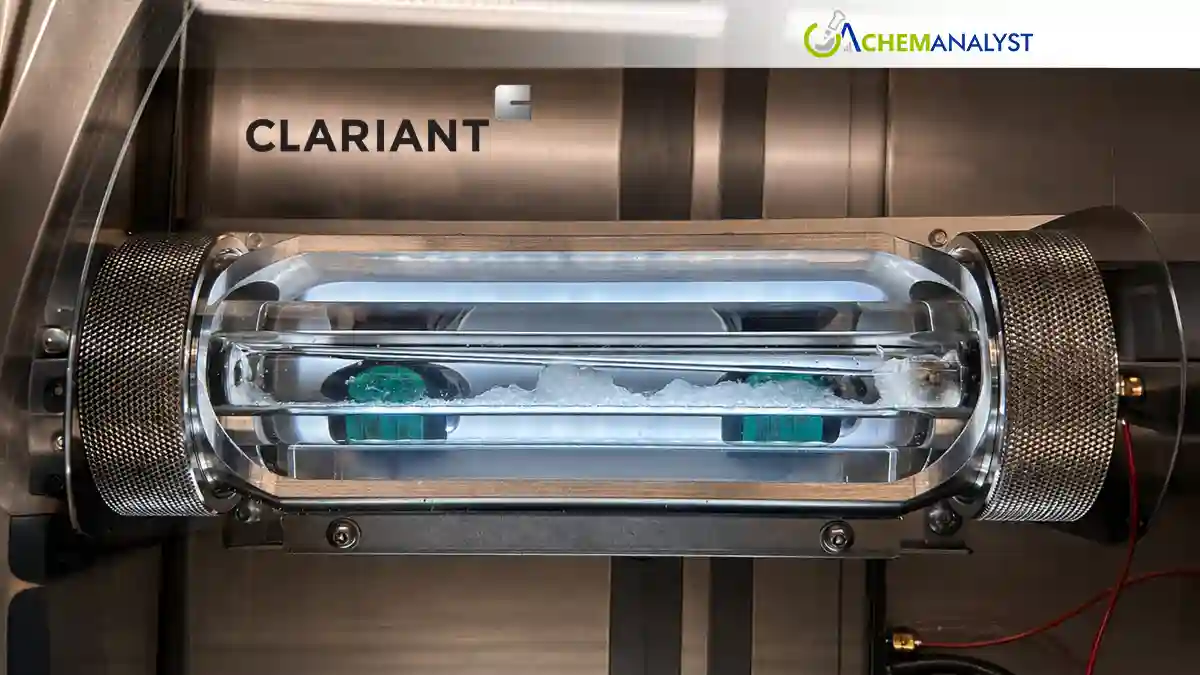
Clariant Oil Services has announced a major achievement in offshore flow assurance with the successful deployment of its HYTREAT™ ECO technology in North Sea operations. The innovative solution is an anti-agglomerant low-dosage hydrate inhibitor (LDHI-AA) designed to meet the dual challenge of maintaining effective hydrate control while complying with the stringent environmental standards established by OSPAR for the North-East Atlantic region. Following successful field applications in offshore assets located in both Norway and the United Kingdom, HYTREAT ECO has demonstrated its capability to deliver reliable hydrate management while significantly reducing chemical consumption.
Hydrate formation remains one of the most complex operational issues in offshore oil and gas production. Gas hydrates are ice-like crystalline structures that form when water and hydrocarbons combine under high-pressure and low-temperature conditions commonly found in subsea environments. These hydrates can obstruct pipelines and production systems, causing flow interruptions, equipment damage, and substantial operational risks. Traditionally, operators have relied on thermodynamic inhibitors such as methanol and monoethylene glycol (MEG) to prevent hydrate formation. However, these solutions require large treatment volumes, resulting in higher transportation, storage, and environmental management costs.
HYTREAT ECO offers a different approach by preventing hydrate particles from agglomerating and forming blockages, allowing them to remain dispersed within the production stream. During North Sea field trials, the product delivered effective hydrate control at dosage levels ranging from less than 1% to 2% by volume of produced water. This represents a dramatic reduction compared to conventional methanol or MEG treatment programs, which typically require significantly higher chemical volumes. Lower dosage requirements translate into reduced chemical logistics, lower storage demands offshore, and a smaller overall environmental footprint.
A key distinguishing factor of HYTREAT ECO is its compliance with OSPAR environmental regulations. The technology is the first low-dosage hydrate inhibitor solution to achieve this level of environmental acceptance while maintaining commercial-scale operational performance. This milestone is particularly important as offshore operators increasingly face regulatory pressure to improve sustainability and reduce environmental impacts without compromising production efficiency.
According to George Nunes, Head of Clariant Oil Services, the industry is increasingly seeking technologies that enhance both operational reliability and environmental performance. He emphasized that HYTREAT ECO is the result of extensive research and close collaboration with major offshore operators, demonstrating how innovation can help maintain energy security while aligning with modern environmental standards.
The technology delivered particularly impressive results during offshore trials in Norway. There, it was utilized in a mature producing asset experiencing increasing water production challenges. HYTREAT ECO helped operators manage hydrate risks while reducing dependence on glycol regeneration infrastructure. One of the most significant achievements occurred during a well restart after a 24-hour shutdown conducted entirely within the hydrate stability zone—a highly demanding scenario in subsea operations. The technology successfully enabled production restart while maintaining produced-water quality within approved discharge limits. As a result of these successful field demonstrations, HYTREAT ECO received a Technology Readiness Level (TRL) 7 rating, indicating proven performance under real-world commercial operating conditions.
In the United Kingdom, HYTREAT ECO replaced conventional subsea methanol injection in a gas-condensate field characterized by severe subcooling conditions. During testing, shut-in subcooling levels reached as high as 25°C at pressures of 130 barg, conditions considered among the harshest encountered for low-dosage hydrate inhibitor applications. Despite these challenges, the technology maintained effective hydrate control during both routine operations and cold-start scenarios.
Beyond hydrate prevention, HYTREAT ECO delivers broader operational and sustainability benefits. Reduced chemical requirements lower transportation and handling needs, which can contribute to decreased emissions associated with offshore supply operations. As the offshore energy sector focuses on maximizing production from existing assets while reducing environmental impact, Clariant's HYTREAT ECO technology establishes a new benchmark for sustainable and efficient hydrate management in offshore oil and gas production.
Market Impact: The successful deployment of HYTREAT™ ECO is expected to primarily impact Methanol and Monoethylene Glycol (MEG), which are widely used as conventional hydrate inhibitors in offshore oil and gas operations. By providing effective hydrate control at significantly lower dosage rates while complying with stringent OSPAR environmental regulations, the technology offers operators a more sustainable and cost-efficient alternative. As adoption of HYTREAT™ ECO expands across offshore fields, particularly in environmentally sensitive regions such as the North Sea, demand for Methanol and MEG in hydrate management applications could gradually decline. However, the impact on prices of these commodities tracked by ChemAnalyst is expected to remain largely neutral in the short term, as offshore hydrate inhibition accounts for only a limited share of overall global Methanol and MEG consumption. Any downward pressure on demand and prices is therefore likely to be modest and become noticeable only over the longer term if the technology achieves widespread commercial adoption.







Leave a Comment
Comments (0)