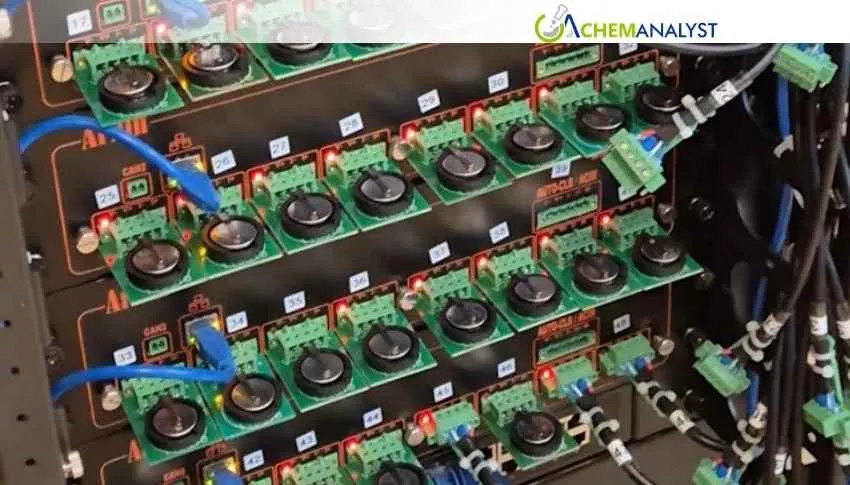
Critical Resources Ltd has announced a significant breakthrough in battery technology with its development of a sulphur-free amorphous solid-state electrolyte, achieving performance benchmarks comparable to leading sulphide-class materials. This innovation represents a crucial step forward in addressing long-standing challenges in solid-state battery commercialization.
The key event is the successful validation of a non-sulphide amorphous solid-state electrolyte, which demonstrated room-temperature ionic conductivity of 3.2 mS/cm and an activation energy of 0.27 eV. These performance metrics are on par with high-performing sulphide-based electrolytes, but without the inherent drawbacks of sulphur chemistry. The results were generated under a peer-reviewed benchmarking framework at the South Dakota School of Mines & Technology.
The primary cause for pursuing this sulphur-free approach stems from the significant hurdles associated with sulphide-based solid-state electrolytes. Sulphides react with moisture to release toxic hydrogen sulphide gas, necessitating expensive inert-atmosphere manufacturing environments. This requirement has been a major barrier to scaling solid-state lithium-ion batteries affordably. By eliminating sulphur, Critical Resources' new electrolyte sidesteps these toxic-gas risks and the need for costly manufacturing processes, thereby simplifying production and improving safety. Furthermore, traditional liquid electrolytes in lithium-ion batteries pose flammability risks, while other solid-state alternatives like oxides often exhibit slower ion transport at room temperature and require high-temperature sintering. The amorphous structure of Critical Resources' electrolyte also offers superior ion transport by avoiding grain boundaries, ensuring uniform conductivity, and being more formable than rigid ceramics.
The consequences and benefits of this breakthrough are far-reaching. Industrially, it promises to reduce manufacturing costs and process risks through a capital-light strategy, making solid-state batteries more viable for mass production. The technology also enhances battery safety by removing hazardous components and manufacturing requirements. Performance-wise, the material's low activation energy ensures stable operation across a wide temperature range, making it suitable for demanding applications. Critical Resources is integrating this electrolyte development with its Dry Supersonic Deposition (DSD) manufacturing program, a solvent-free method for producing mechanically robust and electrochemically active cathodes, further streamlining the battery production process.
From an industry-specific perspective, this breakthrough could accelerate the adoption of solid-state batteries in various sectors, including defense, aerospace, industrial, and high-density computing. Solid-state batteries are considered the "next evolution" of energy storage, offering higher energy density and improved safety over conventional lithium-ion batteries.
Economically and geopolitically, the development of sulphur-free, more easily manufactured solid-state batteries could have significant impacts. The global shift towards electrification has intensified the demand for critical minerals like lithium, cobalt, and nickel, with concerns about supply chain vulnerabilities and geopolitical dependencies, particularly given China's dominance in mineral processing. A more efficient, safer, and less resource-intensive battery manufacturing pathway, as offered by Critical Resources' technology, could contribute to diversifying supply chains, reducing reliance on specific critical materials or complex processing techniques, and fostering greater energy independence for nations. This innovation supports the broader clean energy transition by providing a more sustainable and cost-effective energy storage solution.








 About ChemAnalyst
Leave a Comment
Comments (0)