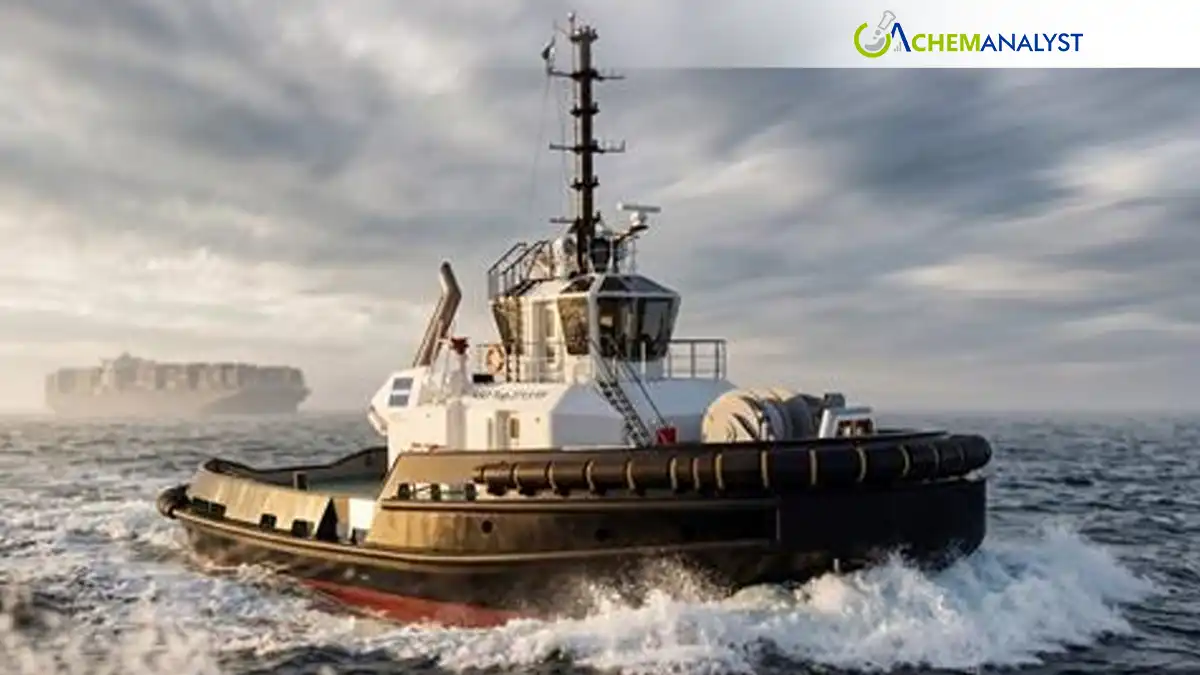
Damen Shipyards Group has achieved a significant milestone in maritime decarbonization by securing class and flag state approval for its methanol-ready tug design, the ASD Tug 2713 Fuel Flexible (FF). This approval, granted by Bureau Veritas and the Netherlands flag state, marks a crucial step towards the wider adoption of alternative fuels in harbor and coastal operations.
The approval follows an Approval in Principle (AiP) received in 2023 for Damen's broader range of methanol-powered compact vessel designs, which encompasses tugs, dredgers, and various high-speed vessels. The ASD Tug 2713 FF is a 27.25-meter multi-purpose vessel designed for duties such as ship handling, terminal support, firefighting, and oil pollution response.
This development is driven by the increasing global focus on reducing emissions in the shipping industry and the need for operators to meet future compliance requirements. Methanol has emerged as a promising alternative marine fuel due to its relatively high energy density and existing infrastructure, offering a pathway to lower emissions
A key challenge in gaining this approval was adapting existing regulatory frameworks, which were primarily developed for larger vessels like chemical tankers, to compact tug designs. Damen collaborated closely with Bureau Veritas and Dutch authorities, employing a risk-based assessment process to ensure the safety standards of methanol systems in smaller vessels. This approach involved comprehensive risk assessments and the implementation of mitigation steps, ensuring the design's safety is comparable to prescriptive, class-approved designs.
The ASD Tug 2713 FF is designed for immediate operation on diesel propulsion and can also utilize hydrotreated vegetable oil (HVO). Critically, it is built with future conversion in mind, prepared for later retrofitting to methanol or hybrid-electric propulsion. Vessels will be delivered with methanol tanks already installed and dedicated space reserved for the additional propulsion systems, allowing operators to invest in alternative propulsion when it becomes commercially viable or mandatory. Damen emphasizes that these fuel-flexible tugs are price-comparable with conventional vessels.
Economic, Geopolitical, and Industry-Specific Impacts: Economically, this approval provides shipowners with a viable "future-proof" solution, enabling them to transition to greener operations without immediate, high-risk investments. The ability to retrofit later minimizes upfront costs and allows for flexibility as fuel availability and pricing evolve. This could stimulate new orders for Damen and potentially lead to cost savings for operators in the long run through reduced emissions penalties or incentives.
From an industry-specific perspective, this move accelerates the adoption of methanol as a marine fuel, particularly for smaller vessels where regulatory clarity has been lacking. It sets a precedent for other shipbuilding companies and could influence the design and construction trends across the workboat sector, pushing the industry closer to its decarbonization goals. Geopolitically, by enabling the introduction of fully methanol-fueled vessels, this contributes significantly to the European Union's zero-emission waterborne targets and global efforts to combat climate change, aligning with international environmental commitments.







 About ChemAnalyst
Leave a Comment
Comments (0)