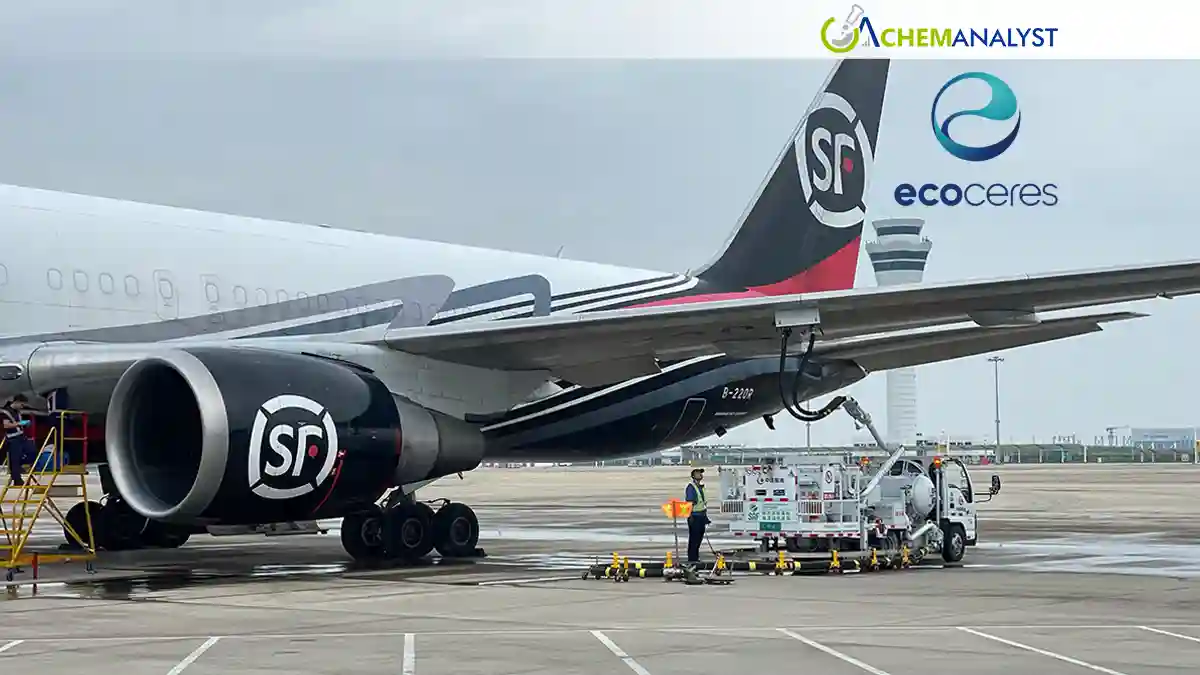
EcoCeres, SF Group, and China National Aviation Fuel Group (CNAF) have joined forces to accelerate the adoption of Sustainable Aviation Fuel (SAF) in China’s air cargo sector. The companies have launched a customized commercial SAF fueling program in collaboration with the Second Research Institute of the Civil Aviation Administration of China (CASRI). The initiative aims to reduce carbon emissions from freight aviation while establishing a scalable model for low-carbon logistics.
Under the program, EcoCeres will supply SAF, which CNAF will blend and distribute for outbound freighter flights operated by SF Airlines. The SAF can deliver up to a 90% reduction in greenhouse gas emissions compared with conventional jet fuel, supporting China’s broader efforts to decarbonize hard-to-abate transportation sectors.
Ezhou Huahu International Airport in Hubei, the main cargo hub of SF Airlines, will serve as a key location for SAF fueling and related operations. The airport is also an important aviation gateway under China’s 14th Five-Year Plan for Port Development. The initiative brings together renewable fuel production, aviation fuel infrastructure, freight operations, and cargo demand, creating a practical framework for wider SAF deployment across China’s logistics industry.
The collaboration builds on EcoCeres’ earlier SAF initiative in China, known as “Project Spark.” During the pilot, SAF produced at EcoCeres’ Zhangjiagang facility was blended by CNAF and used for commercial flights at Chengdu Shuangliu International Airport. The project helped validate the complete SAF value chain, covering production, transportation, blending, and aviation use.
The latest program also incorporates AnchorTrace, an environmental attributes platform jointly developed by CNAF and CASRI. The platform enables lifecycle tracking, registration, and retirement of SAF environmental attributes, improving transparency and traceability across the fuel supply chain.
According to EcoCeres Co-Chairman James Tam, integrating SAF into existing aviation fuel infrastructure can provide a practical and scalable pathway toward lower-emission air cargo operations. SF Airlines Chairman Li Sheng said the initiative strengthens the company’s capabilities across SAF sourcing, blending, customized fueling, and freighter operations.
EcoCeres plans to expand its SAF network across Hong Kong and Mainland China. The company intends to connect regional feedstock availability, SAF production, and demand from both passenger and cargo aviation, potentially supporting broader commercial adoption of renewable aviation fuels.
The initiative represents a significant step toward integrating SAF into China’s air freight ecosystem and could encourage additional investments in renewable fuel production, infrastructure, certification, and low-carbon logistics.
Product and Chemical Commodity Price Impact
The move is positive for Sustainable Aviation Fuel (SAF) demand and could strengthen long-term consumption of renewable aviation fuel in China. Increased commercial SAF deployment may encourage higher production, feedstock procurement, blending, certification, and related infrastructure investment. For conventional jet fuel, broader SAF substitution could create mild downward demand pressure over the longer term, although the near-term impact is likely limited because SAF volumes remain relatively small compared with conventional aviation fuel consumption. For chemical commodities tracked by ChemAnalyst, renewable feedstocks, bio-based intermediates, and fuel-related chemicals could experience firmer demand and price support if SAF adoption expands. However, increased production capacity and feedstock availability could moderate price gains.







Leave a Comment
Comments (0)