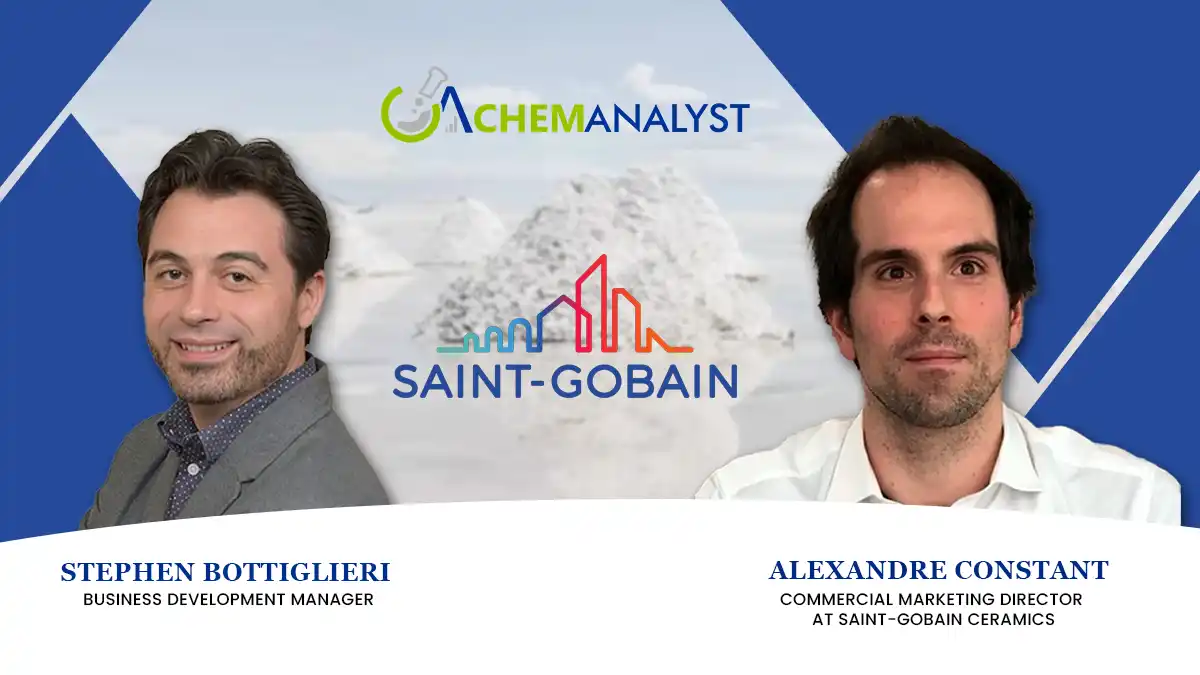
ChemAnalyst Talks with Alexandre Constant, Commercial Marketing Director at Saint-Gobain Ceramics, and Stephen Bottiglieri, Business Development Manager
Saint-Gobain Group With origins tracing back to the Royal Glass Manufactory established in France in 1665, the Saint-Gobain Group builds on a centuries-old heritage. Saint-Gobain designs, manufactures, and supplies innovative materials and solutions that contribute to improved quality of life and a more sustainable future. Throughout the world , the company is engaged in the sales of building solutions as well as the production and commercialization of high-performance materials, including ceramics, plastics, and abrasive products. ChemAnalyst recently interviewed Alexander Constant, Commercial Marketing Director at Saint-Gobain Ceramics, and Stephen Bottiglieri, Business Development Manager, on their partnership with Eurodia for Direct Lithium Extraction (DLE) technologies. This article captures key insights from the discussion on DLE—a process that selectively extracts lithium directly from brines using advanced materials and engineering.
Complete Interview with Alexander Constant and Stephen Bottiglieri
Q: Can you explain Saint-Gobain and Eurodia's roles in this DLE partnership?
Answer: Saint-Gobain manufactures advanced lithium-selective absorbent materials used in DLE, while Eurodia, as an engineering firm, designs proprietary systems leveraging unique process expertise. Constant noted this creates a matched, high-value offering for efficient lithium recovery from brines.
Q: What is Direct Lithium Extraction (DLE), and how does it differ from traditional methods?
Answer: DLE pumps brine through columns with selective materials for fast lithium capture, unlike solar evaporation (12-18 months in ponds) or hard-rock/clay mining requiring heavy machinery, chemicals, and leaching. Bottiglieri emphasized DLE's smaller footprint, lower water use, and reduced environmental impact on local areas.
Q: Is solar evaporation cheaper than DLE?
Answer: Not necessarily—DLE's dramatically higher throughput and speed make it economically competitive, based on market articles and insights.
Q: What are the main technical and commercial hurdles for DLE adoption?
Answer: Proving economic feasibility at full scale and constructing operations near lithium deposits top the list, amid varied DLE processes from different players. Bottiglieri stressed scaling up starts now, with post-interview notes highlighting limited data in early stages.
Q: Which regions are poised as hubs for DLE and lithium extraction?
Answer: Europe's Critical Raw Materials Act fosters sovereign supply from geothermal reservoirs in France, Germany, England, and Italy. South America boasts vast reserves; US and Canada access new sources like geothermal wells and oilfields previously untappable without DLE.
Q: How does U.S. geopolitics, like President Trump's critical minerals push, play in?
Answer: Any administration prioritizes reliable integrated supply chains, making North American and European lithium vital amid China's refining dominance—DLE enables domestic diversification.
Q: Can DLE challenge China's control of lithium refining?
Answer: DLE will help to unlock regional supplies in North America , Europe, and South America, spurring innovation and global competition to increase overall lithium availability.
Q: With current lithium oversupply, how does this impact DLE investments?
Answer: Constant and Bottiglieri believe oversupply is temporary; battery demand from automotive, consumer electronics, defense, and aerospace signals deficits soon, accelerating DLE in the decade's latter half per recent reports.
Q: What about competition from hydrogen fuel cells?
Answer: Lithium-ion batteries remain a mainstay for energy storage; fuel cells suit heavy trucks and fleets—both technologies coexist in optimal applications.
Q: How does DLE improve sustainability in lithium production?
Answer: It minimizes water use, carbon footprint, land needs, and local ecosystem harm versus evaporation or mining. Bottiglieri noted ongoing global studies will quantify benefits further, with water and environmental impacts as perpetual focus areas for innovation.
Q: What does the next generation of DLE look like in materials and engineering?
Answer: Proprietary roadmaps advance these, driven by downstream needs in automotive, aerospace, medical, and storage—updates promised as inventions emerge.
Q: What's Saint-Gobain and Eurodia's timeline for pilots or commercial DLE?
Answer: Strategy is evolving; specifics on pilot-scale or full deployment withheld for now, but they'll share progress down the road, as Constant indicated.







Leave a Comment
Comments (0)