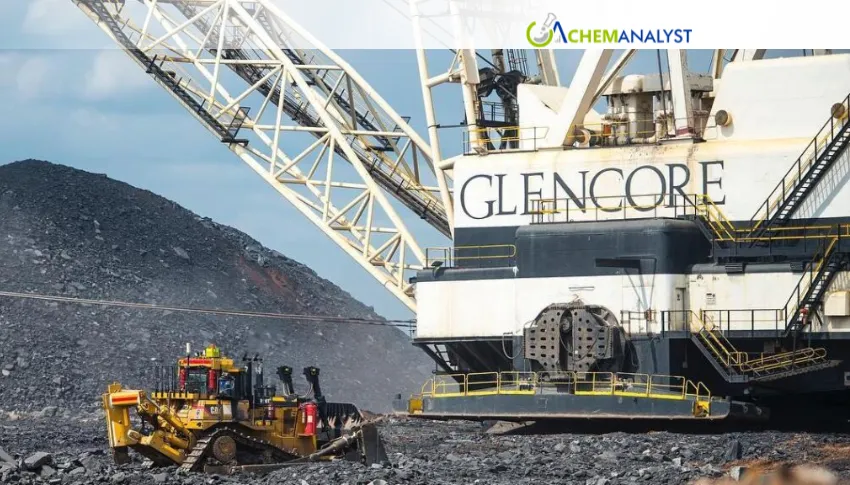
Glencore has reported a strong operational performance for the first half of the year, with copper production increasing by 15% year-on-year, supported by improved ore grades at several of its major mining operations. The Swiss-based mining and commodity trading company also announced that its marketing division is on course for another exceptional year, with adjusted earnings before interest and taxes (EBIT) expected to reach approximately $3.3 billion during the first six months alone.
The company produced 397,000 metric tons of copper during the first half of the year, compared with 343,900 metric tons in the corresponding period of 2025. The increase was mainly driven by stronger ore grades at Glencore’s African mining assets and the Antamina copper mine in Peru, enabling higher production levels. Despite the stronger first-half performance, Glencore maintained its full-year copper production guidance at 810,000 to 870,000 metric tons, indicating confidence in meeting its annual targets.
Glencore’s marketing business, which plays a vital role in trading metals, minerals, and energy commodities, continued to deliver outstanding financial results. The division generated approximately $3.3 billion in adjusted EBIT during the first half of the year. This figure is already close to the upper limit of the company's full-year earnings guidance, which ranges from $2.3 billion to $3.5 billion, highlighting the resilience and profitability of its trading operations despite volatile commodity markets.
In contrast, the company experienced a significant decline in cobalt production. First-half cobalt output dropped 46% year-on-year to 10,200 metric tons. The decline resulted primarily from export quota restrictions imposed by the Democratic Republic of Congo (DRC), the world's largest cobalt producer. Glencore stated that it strategically prioritized copper production during this period, postponing part of its cobalt processing and sales until export restrictions are relaxed.
The DRC initially suspended cobalt exports in 2025 to stabilize prices after the battery metal had fallen to its lowest level in nearly a decade. Later, authorities replaced the complete export ban with a quota-based export system in October, continuing to limit shipments from producers.
Looking ahead, Glencore is scheduled to release its complete first-half financial results on August 5. The announcement also comes as the expiration of a six-month standstill agreement related to merger discussions with Rio Tinto approaches. Although Glencore has repeatedly expressed interest in pursuing large-scale strategic acquisitions, previous attempts to advance discussions with the global mining company have not resulted in a transaction.
Impact on Products and Chemical Commodity Prices
Higher copper production from Glencore is expected to improve global copper concentrate availability, supporting downstream industries such as electrical equipment, construction, renewable energy, and electronics. Increased supply could moderate copper price volatility if sustained through the second half. However, reduced cobalt production due to DRC export quotas may keep cobalt markets relatively tight, supporting elevated prices for battery materials. For chemical commodities tracked by ChemAnalyst, improved copper availability may stabilize costs for copper-based chemicals, catalysts, cables, and industrial components. Meanwhile, cobalt-related specialty chemicals and battery material prices are likely to remain firm until export restrictions ease and global supply improves.






Leave a Comment
Comments (0)