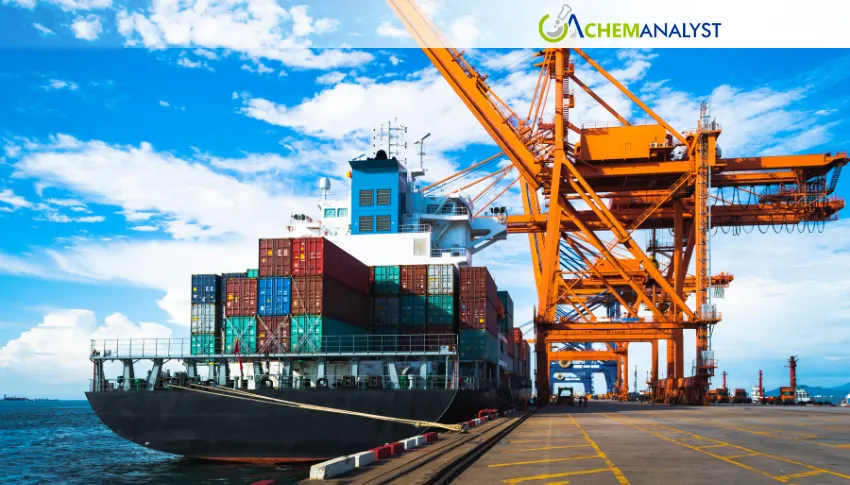
The first week of June closed with global freight markets in a state of controlled turbulence. The Strait of Hormuz — now approaching 100 days of near-total shutdown since the Iran war erupted on 28 February — recorded just 10 commercial transits per day against a pre-crisis baseline of 95. Diplomats are engaged in talks to extend a ceasefire framework, but with Hezbollah rejecting the latest agreement and US jobless claims hitting their highest since February, confidence in a clean resolution is fraying on multiple fronts. On the commercial side, peak season GRIs and fresh carrier losses published this week have sharpened urgency for shippers heading into mid-June.
June GRIs bite hard — Asia-Europe daily rates cross 2025 peak highs
The 1 June general rate increases, combined with peak season surcharges activated across major carriers, drove daily spot rates up by $1,000–$1,800 per FEU on Asia–Europe and transpacific lanes in the days that followed. By 4 June, Asia to North Europe rates had already surpassed the peak season highs recorded in June–July 2025. Transpacific to the US East Coast held around $5,000 per FEU, with West Coast at $3,200 per FEU. A second wave of GRIs announced by Maersk and MSC for 10–15 June is expected to push levels further. Contracted shippers report allocations being cut without advance notice, forcing bookings onto higher-cost spot market.
Hezbollah ceasefire rejection compounds Hormuz reopening uncertainty
On 4 June, Hezbollah formally rejected the latest ceasefire agreement even as Israeli strikes continued killing in Lebanon. The refusal matters for shipping because any durable Hormuz reopening is tied to a broader regional settlement — and Hezbollah's participation is a key variable in that equation. The UK Parliament's research service confirmed this week that the Hormuz strait remains effectively closed, with the US counter-blockade on Iranian ports still active and BIMCO continuing to urge maximum caution. Mine-clearance protocols and formal rules of engagement for commercial transit remain unresolved.
US rail network reports worst bottlenecks of 2026 as inland cargo piles up
Inland transport networks in the US are showing signs of severe strain heading into the week of 4 June. Rail carriers, forwarders, and intermodal operators reported the most significant rail bottlenecks of the year, driven by early peak season demand arriving simultaneously with rerouted cargo flows from diverted ocean services. The Journal of Commerce flagged the congestion across the rail network as a compounding factor for shippers already absorbing longer ocean transit times. Importers relying on intermodal moves from West Coast ports face additional 3–7 day delays beyond the extended ocean transit already caused by Cape of Good Hope diversions.
US Navy shifts to covert Hormuz escort strategy; confidence still absent
With "Project Freedom" officially shelved, US Central Command is coordinating limited, quiet vessel movements through the southern edge of the strait — hugging the Omani coast with AIS transponders turned off. The approach, confirmed by Bloomberg and reported on 4–5 June, has facilitated only a handful of transits. Maersk, MSC, Hapag-Lloyd, and CMA CGM remain on full Cape of Good Hope deviation. BIMCO's chief safety officer has repeatedly warned that without formalized security protocols, mine-clearance confirmation, and insurance cover restoration, no mass return of commercial shipping can be expected regardless of diplomatic progress.
Short-Term Outlook
The week of 4–5 June crystallised a widening gap between diplomatic noise and operational reality. Carrier losses confirm that the industry cannot sustain another quarter at pre-GRI rate levels, meaning further surcharge rounds are inevitable regardless of geopolitical developments. With Hezbollah rejecting ceasefire terms, the Hormuz blockade showing no credible exit path, and US rail congestion adding inland delay on top of extended sea transit, shippers face a compounding cost and time burden through Q3. Lock in capacity for July–August sailings before mid-June GRI announcements take effect, and model for Cape of Good Hope routing as the baseline — not a contingency — for all Gulf and Asia–Europe cargo.








 About ChemAnalyst
Leave a Comment
Comments (0)