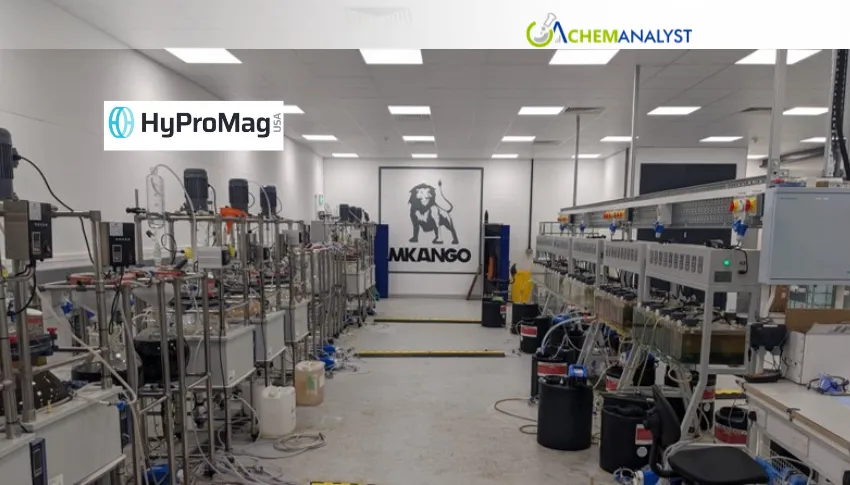
Mkango Resources Ltd. has announced that its subsidiary, HyProMag USA LLC, is accelerating the development of its Texas Hub in the Dallas-Fort Worth region through a phased strategy that prioritizes early magnet finishing operations before the completion of its integrated recycling facility. The move is intended to establish customer relationships, generate early revenues, and support the expansion of domestic rare earth magnet manufacturing in the United States.
Under the revised timeline, HyProMag USA plans to commission its first neodymium-iron-boron (NdFeB) magnet finishing equipment during the first half of 2027. Initially, the facility will process up to 20 tonnes of NdFeB magnet blocks supplied by HyProMag’s existing operations in the United Kingdom and Germany. These blocks will be cut, coated, machined, and finished into customer-specific magnets for the U.S. market, while European customer supplies from the UK and Germany will continue without disruption.
The company expects to commission the Hydrogen Processing of Magnet Scrap (HPMS) section of the Texas Hub in the second quarter of 2028. Once operational, the facility will begin processing magnet-bearing scrap sourced within the United States, enabling domestic recycling and manufacturing of rare earth magnets. The integrated plant is projected to initially produce around 400 metric tonnes of recycled sintered NdFeB magnets and approximately 278 metric tonnes of NdFeB co-products annually, with gradual expansion toward a total annual capacity of nearly 1,526 metric tonnes of magnetic products.
HyProMag believes that establishing finishing capabilities ahead of the full recycling operation will allow it to work closely with customers on product specifications, qualification programs, and customized magnet solutions. The finishing line will manufacture magnets according to precise dimensions, coatings, tolerances, and performance requirements, helping reduce downstream production risks while strengthening commercial partnerships.
Company executives emphasized that the strategy complements HyProMag’s proprietary HPMS technology, which recovers rare earth magnets from end-of-life products through an energy-efficient short-loop recycling process. The company views this approach as a competitive advantage, enabling valuable rare earth materials to be returned to productive use with lower processing requirements.
HyProMag USA has already ordered long-lead equipment, including HPMS vessels and magnet finishing systems tailored to U.S. customer requirements. It is also progressing engineering work, project financing, customer offtake agreements, and feedstock sourcing. The company has supplied initial magnet samples to prospective customers across North America and is expanding discussions with recyclers to secure magnet-bearing materials from hard disk drives, electric motor rotors, MRI machines, actuators, and other industrial equipment. Through this phased development strategy, HyProMag aims to establish a fully integrated U.S. waste-to-magnet supply chain while supporting domestic rare earth recycling and manufacturing.
Impact on Chemical Commodity Prices Tracked by ChemAnalyst
HyProMag's phased Texas expansion is unlikely to have an immediate impact on rare earth magnet prices because initial production will rely on imported NdFeB magnet blocks from Europe. However, the project is expected to gradually improve the North American supply of recycled neodymium-iron-boron (NdFeB) magnets and reduce dependence on virgin rare earth materials over the medium term. As domestic recycling capacity expands after 2028, demand growth for newly mined rare earth oxides such as neodymium (Nd), praseodymium (Pr), dysprosium (Dy), and terbium (Tb) may moderate slightly, helping stabilize prices while improving long-term supply security and reducing raw material price volatility.








 About ChemAnalyst
Leave a Comment
Comments (0)