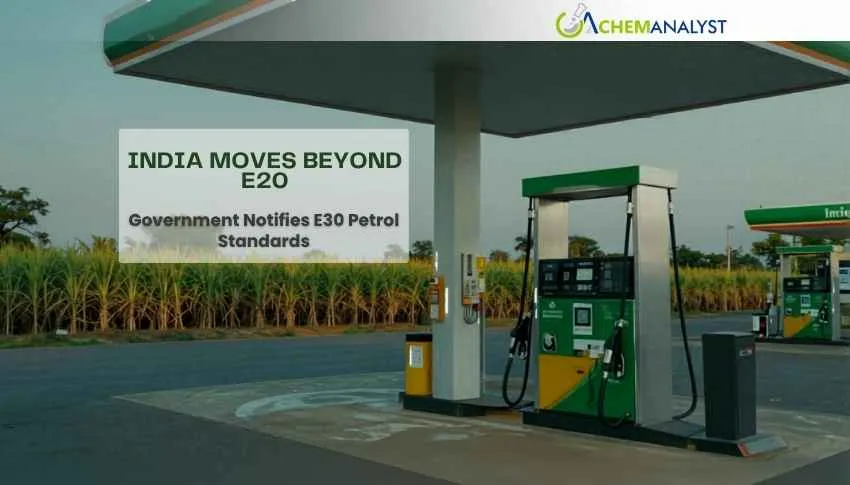
India has formally taken the next step in its biofuel transition after the government notified fuel standards for petrol blended with up to 30% ethanol, signalling a significant expansion beyond the current E20 programme. The new standards, issued by the Bureau of Indian Standards (BIS), cover E22, E25, E27, and E30 fuel grades and establish the technical framework for higher ethanol blending in petrol-powered vehicles.
India Crude Oil Import Data (2025–2026)
During FY2025–26, India’s crude oil imports are estimated at around 5.5–5.7 million barrels per day, translating to more than 2 billion barrels annually. Russia has emerged as the largest supplier, followed by Iraq, Saudi Arabia, UAE, and the United States. This high import dependency exposes India to geopolitical disruptions, freight cost spikes, and exchange-rate volatility, making energy diversification a strategic necessity.
Global conflicts such as the, Russia-Ukraine war, OPEC supply discipline, and Middle East conflict U.S – Iran create shipping risks and have accelerated India’s push toward sustainable fuels. Price shocks in crude oil directly affect Indian retail fuel prices and logistics costs. In response, the government has prioritized fuel security through ethanol blending, strategic petroleum reserves, and renewable transport fuels. The objective is to lower vulnerability to imported fossil fuels while building a more resilient domestic energy ecosystem.

India’s E20 ethanol blending program has been one of the most successful biofuel initiatives globally. The country achieved 20% ethanol blending in petrol in 2025, reducing gasoline dependence with domestically produced ethanol, India has effectively saved approximately ?1.65 lakh crore ($19.8 billion approx.) and creating new demand for sugarcane and grain-based ethanol. Benefits include lower carbon emissions, reduced crude imports, improved farmer income, and fresh investment in distillery infrastructure. However, concerns remain around lower mileage, water-intensive feedstocks, and compatibility issues in older vehicles.
Under the newly notified BIS standard IS 19850:2026, the government has laid out specifications for ethanol-petrol blends ranging from 22% to 30%. While the notification does not mandate an immediate nationwide rollout of E30 petrol, it creates the regulatory groundwork for future implementation as India expands its ethanol blending roadmap beyond E20.
Industry stakeholders have largely welcomed the development, particularly biofuel manufacturers and sugar producers who see higher ethanol blending as an opportunity to absorb surplus ethanol production and strengthen domestic demand. Automakers, meanwhile, indicated readiness to comply with future standards if higher blends become mandatory. However, vehicle compatibility and fuel-efficiency concerns continue to remain key challenges for consumers and manufacturers alike.
Globally, countries such as Brazil have successfully operated on higher ethanol blends for decades, with regular usage of E25 and above in mainstream vehicles. India’s latest notification indicates that the country is now preparing for a similar long-term transition toward higher biofuel integration in the transportation sector.
India Ethanol Market Future Outlook (2026–2030): Demand, Price Drivers, Manufacturing & Sustainability
|
Factor |
Current Status (2026) |
Future Forecast (2027–2030) |
Impact on India |
|
Ethanol Demand |
India reached E20 blending target; OMC tenders 1,050 crore litres for 2025–26. Eligible supply reportedly exceeded 1,700 crore litres. |
Demand likely to rise further if E85/E100 and flex-fuel vehicles scale. Could create a second wave of domestic demand beyond E20. |
Reduces petrol demand and lowers crude import dependence. |
|
Government Policy Push |
Draft rules proposed to formally allow E85 and E100 fuels under vehicle rules. Public consultation opened. |
Higher-blend fuels may gradually launch in selected markets first, especially commercial fleets and flex-fuel passenger vehicles. |
Strong long-term policy certainty for investors. |
|
Manufacturing Capacity |
Industry capacity has expanded rapidly; some reports indicate installed capacity exceeds current E20 needs, creating surplus utilization pressure. |
New investments may slow temporarily unless higher blending mandates or exports expand. Plants may shift to multi-feedstock flexibility. |
Better economies of scale but risk of oversupply. |
|
Feedstock Mix |
Sugarcane/molasses remain major sources; grain-based ethanol (maize, surplus rice) rising strongly. |
Shift expected toward maize, agricultural residue, 2G ethanol, waste-to-fuel pathways. |
More diversified and resilient supply chain. |
|
Ethanol Prices |
Prices in India are influenced by government procurement formulas linked to feedstock categories. Producers seek better realizations when grain/sugar costs rise. |
Prices likely to remain supported if demand grows; volatility tied to crop prices, MSP, monsoon, and energy prices. |
Important for fuel inflation and producer margins. |
|
Crude Oil Savings |
Ethanol blending already helping reduce gasoline imports and foreign exchange outflows. |
Larger savings possible if E85/E100 adoption increases. |
Strengthens energy security and trade balance. |
|
Automotive Transition |
E20 compatible vehicles increasing; concerns remain for older vehicles and higher blends. |
Flex-fuel vehicles (FFVs) likely to expand first; legacy fleet transition slower. |
Creates new auto component demand. |
|
Sustainability Benefits |
Lower tailpipe emissions vs fossil fuels; supports cleaner mobility goals. |
Greater emissions reduction if advanced biofuels replace food-crop heavy sources. |
Helps climate targets. |
|
Sustainability Risks |
Water stress and food-vs-fuel concerns remain, especially rice/sugarcane-heavy routes. |
Policy may increasingly favor maize, residues, 2G ethanol, efficient irrigation. |
Critical to long-term viability. |
|
Export/Global Positioning |
India emerging as one of the fastest-growing ethanol markets globally. |
Could become a regional technology and biofuel hub by 2030. |
Boosts investment, jobs, and rural income |







 About ChemAnalyst
Leave a Comment
Comments (0)