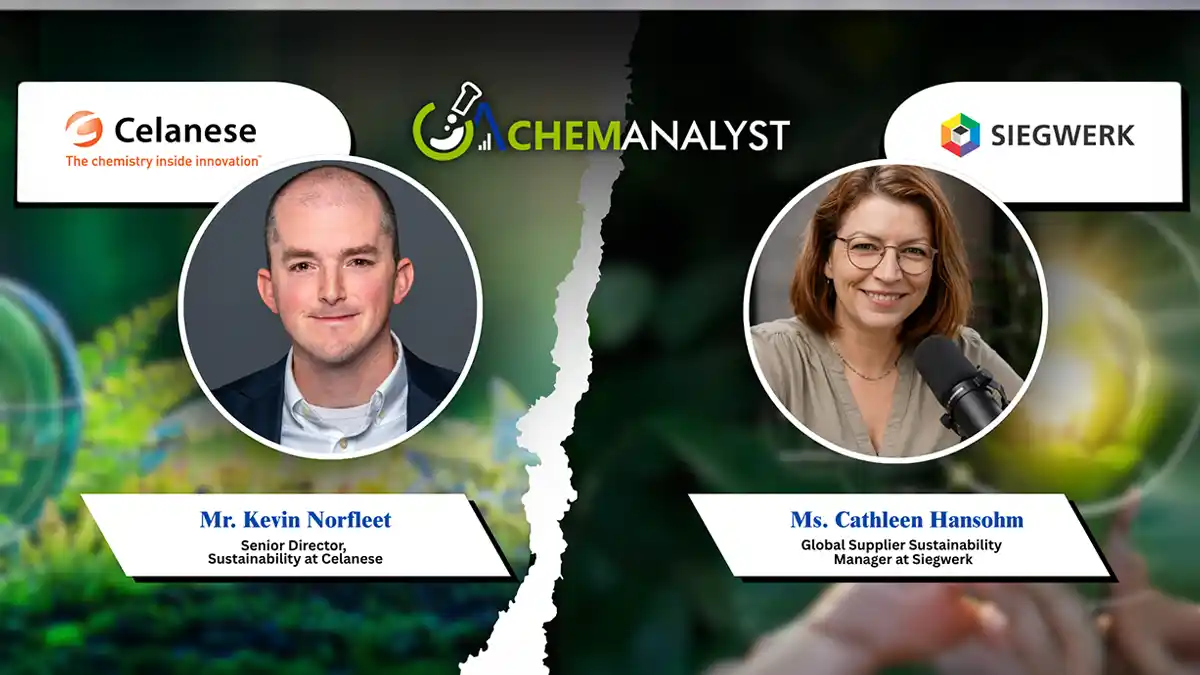
ChemAnalyst Talks with Mr. Kevin Norfleet, Senior Director, Sustainability at Celanese, and Ms. Cathleen Hansohm, Global Supplier Sustainability Manager at Siegwerk
ChemAnalyst spoke with Mr. Kevin Norfleet, Senior Director, Sustainability at Celanese, and Ms. Cathleen Hansohm, Global Supplier Sustainability Manager at Siegwerk, about their collaboration to introduce 50% bio-based ethyl acetate into the printing ink value chain and its implications for sustainable packaging. Celanese, a global specialty materials and chemical company, leverages its expertise in engineered materials, acetyl products, and sustainable chemistry to deliver lower-carbon solutions across industries. Siegwerk, one of the world's leading providers of printing inks and coatings for packaging applications, focuses on advancing circular packaging through responsible sourcing, innovative formulations, and sustainable technologies. Drawing on their extensive leadership experience, Norfleet and Hansohm discussed the strategic importance of renewable feedstocks, the commercialization of bio-based solvents, evolving sustainability regulations, supply chain resilience, and the growing role of customer collaboration in accelerating the transition toward circular, low-carbon packaging solutions. They also highlighted the need to balance sustainability with performance, supply reliability, and cost competitiveness while enabling practical, scalable innovations that support the future of the global packaging and specialty chemicals industries.
Complete Joint Interview with Mr. Kevin Norfleet and Ms. Cathleen Hansohm
Q1: Please provide an overview of your professional journey and leadership experience in sustainability and specialty chemicals, and explain how these experiences have influenced your vision for Celanese’s role in advancing lower-carbon, renewable, and high-performance chemical solutions across global industries.
Kevin Norfleet (Celanese): I’ve been with Celanese for over 18 years and have worked across all of our businesses in a variety of roles, from technical assignments to sales and business management. That mix has been helpful because sustainability is not just a technical topic and it is not just a market topic, it has to connect both. My view is that Celanese is at its best when we translate our chemistry into practical choices customers can actually use. If a solution helps customers lower impact, maintain performance and stay competitive, then sustainability becomes part of how business gets done rather than a separate conversation.
Cathleen Hansohm (Siegwerk): I've spent more than 20 years at Siegwerk in a variety of roles across supply chain management, operational excellence, international leadership, and sustainability. That journey has given me a practical understanding of how products are developed, sourced, manufactured, and brought to market. Today, I am responsible for Global Supplier Sustainability and Human Rights, working closely with suppliers and internal stakeholders to drive decarbonization and responsible sourcing. What has shaped my perspective most is that sustainability only works when it is connected to business reality. It is not enough for a solution to be more sustainable—it also needs to be scalable, available, and economically viable.
Q2: What is the strategic rationale behind Celanese’s collaboration with Siegwerk to introduce bio-based ethyl acetate into the printing ink value chain, and why do you believe this partnership represents an important milestone for the transition toward more sustainable packaging solutions?
Kevin Norfleet (Celanese): There are a few pathways for making ethyl acetate, and we use one where 50% of the carbon comes from bio-based feedstocks. We see that as a meaningful option versus fully fossil-based alternatives, especially because ethyl acetate is already widely used in the printing ink value chain. Working with Siegwerk helps bring more awareness to that option and shows how it can move further downstream into commercial packaging applications. That is why the collaboration matters, it helps connect an existing Celanese capability with a real market need.
Q3: From a sustainability and market perspective, how does Celanese’s 50% bio-based ethyl acetate differentiate itself from conventional fossil-based grades in terms of performance, lifecycle benefits, scalability, and commercial competitiveness?
Kevin Norfleet (Celanese): The important point is that customers are not being asked to choose between sustainability and performance. Our ethyl acetate has the same physical properties customers expect from conventional material, while also carrying 50% bio-based carbon content due to the way it is produced. That makes the sustainability benefit easier to evaluate because it does not require a major change in how the product is used. From a market perspective, that is a real differentiator, it gives customers a way to improve the renewable content of their formulations without introducing technical changes.
Q4: The global printing ink and packaging sectors are witnessing rapid changes driven by sustainability commitments and regulatory developments. How are these trends influencing solvent selection, formulation strategies, and the future demand outlook for sustainable ink technologies?
Kevin Norfleet (Celanese): What is changing is that sustainability is moving closer to the specification process. In the past, the focus may have been mainly on whether a solvent performed, whether it was available and whether it was cost-effective. Those factors still matter, but customers are increasingly asking what role a material plays in the broader environmental profile of the final product. That does not mean every formulation changes overnight, it just means that solvent selection is becoming more multi-dimensional, and suppliers need to provide credible options that formulation teams can confidently work with.
Cathleen Hansohm (Siegwerk): Sustainability commitments and regulations such as the EU Packaging and Packaging Waste Regulation (PPWR), California’s SB 54, and India’s Extended Producer Responsibility (EPR) framework are reshaping expectations for packaging across global markets.
As a result, the discussion is shifting from individual raw materials towards the overall environmental performance of packaging systems. In our industry, this means increasing focus on solutions that enable recyclability, reduce material complexity, support resource efficiency, and help brand owners meet their regulatory obligations. For Siegwerk, this creates demand for technologies that make packaging more compatible with circular economy requirements, for example by enabling recyclable packaging structures or reducing the number of functional layers required. We therefore expect sustainability considerations to become an increasingly important driver of formulation development, alongside traditional requirements such as product functionality, processability, and cost.
Q5: As demand for sustainable materials grows, what are the major challenges in scaling up the production and commercial availability of bio-based ethyl acetate, particularly with respect to renewable feedstock availability, production economics, and supply chain development?
Kevin Norfleet (Celanese): Scale is always where sustainability becomes ‘real’. A material can sound really attractive on paper, but customers need to know whether it can be supplied consistently, whether the feedstock position is understood and whether the economics make sense over time. For Celanese, sourcing bio-based ethanol for ethyl acetate is not new. Volatility is certainly an important topic in any supply chain, but we have a proven track record of being a highly reliable supplier of partially bio-based ethyl acetate to our customers. As interest grows, the focus is on continuing to support dependable availability, clear feedstock understanding and economics that make sense over time.
Q6: The packaging industry remains one of the largest consumers of printing inks and specialty coatings. How do changing consumption patterns in flexible packaging, food packaging, and e-commerce influence the demand outlook for solvents such as ethyl acetate?
Kevin Norfleet (Celanese): As a solvent producer, we recognize there is a lot of noise and many competing trends in packaging. Our aim is to stay focused on the things we can control: being known a reliable supplier and offering products that help our customers be successful and meet their sustainability goals. Packaging has to balance performance, efficiency, regulatory needs and brand expectations, so practical options matter. End consumers are becoming more conscious of sustainability and carbon footprint, and our mission is to continue supplying products that help our customers respond to that demand.
Q7: How is Celanese balancing sustainability goals with the industry’s requirement for cost-effective, high-performance solutions, especially when bio-based materials may involve different production costs compared with conventional petrochemical alternatives?
Kevin Norfleet (Celanese): We try to be very pragmatic about that balance. Customers are under pressure to improve sustainability, but they also have to run their businesses every day. They cannot compromise on performance, quality or reliability. So the question for us is this: how do we make the more sustainable choice easier to choose? With bio-based ethyl acetate, the answer is partly that customers can gain bio-based content in a product that behaves like the ethyl acetate they already know and use. That helps reduce the feeling that sustainability has to come with a complicated trade-off.
Q8: What role do customer collaborations, such as the partnership between Celanese and Siegwerk, play in accelerating the commercialization and wider acceptance of sustainable solvents within the broader chemical value chain?
Kevin Norfleet (Celanese): Awareness is a big first step, and collaborations are an important part of building that awareness. It is one thing for Celanese to explain the sustainability attribute of a product, but it is more powerful when a leading company like Siegwerk can show how that option works in an ink system and further into packaging applications. Partnerships like this help take these options deeper into the value chain, so companies further downstream can start to ask for them and understand what is possible.
Q9: As sustainability targets become more ambitious among global brands and packaging manufacturers, how do you expect procurement strategies for printing inks, coatings, and chemical ingredients to evolve over the next decade?
Kevin Norfleet (Celanese): We believe sustainability will start to factor into procurement decisions in a more fundamental way. Cost, quality and reliable supply will always be important, but companies that want to make progress on their goals will need systems that recognize sustainable content and carbon footprint as part of the total value equation. If a material is only a tiny bit cheaper but has a much higher carbon footprint, that may not be the best answer over time. The key is making cost-effective, lower-impact options easy for procurement teams to identify and use.
Cathleen Hansohm (Siegwerk): Over the next decade, procurement strategies for chemical ingredients will increasingly go beyond cost, quality, and supply security. Expectations around carbon footprint transparency, circularity, responsible sourcing, human rights due diligence, and compliance with increasingly stringent regulations will become standard requirements across global supply chains. At the same time, customers will increasingly expect suppliers to translate sustainability into tangible business benefits, for example lower energy costs through renewable electricity generation. The last decades have shown that premium pricing for sustainable products—while often necessary initially to fund innovation and build scale—does not drive widespread adoption. Ultimately, sustainable solutions need to compete on both sustainability and economics. Procurement decisions will therefore increasingly favor suppliers that can demonstrate measurable environmental and social benefits while also helping customers remain competitive and profitable.
Q10: The transition from fossil-derived chemicals to renewable alternatives requires significant investment and technological innovation. What advancements in process technology, feedstock optimization, and manufacturing efficiency do you believe will be most crucial for improving the affordability and availability of bio-based solvents?
Kevin Norfleet (Celanese): I’m probably not the right person to speak in detail about every technology pathway, but what I can say with conviction is that our commercial ethyl acetate today is, and has been, 50% bio-based, available to the market and competitive while maintaining the properties needed for a drop-in solution. Continued improvements in feedstock optimization, process efficiency and manufacturing will matter because they can help make sustainable materials more affordable and available. But ultimately the goal is practical: providing solutions customers can work with right away.
Q11: Global chemical markets are increasingly affected by geopolitical developments, trade policies, and changing manufacturing footprints. How do you see these factors influencing the supply chains and regional competitiveness of ethyl acetate and other sustainable solvent solutions?
Kevin Norfleet (Celanese): These factors remind us that customers are not only buying a product; they are also relying on a supply model. Geopolitical developments, trade policies and changing manufacturing footprints can all affect how comfortable customers feel about sourcing decisions. For sustainable solvents, that makes reliability even more important. A lower-impact material has to come with confidence that it can be supported through market cycles. At Celanese, our integrated value chain and global manufacturing footprint are important because they help us stay close to customers and manage volatility in a disciplined way. We pride ourselves on being a highly reliable supplier to our customers, and our bio-based ethyl acetate is part of that promise.
Q12: Looking at the broader specialty chemicals sector, which emerging trends—such as circular economy practices, renewable feedstocks, and low-carbon manufacturing—do you believe will have the greatest impact on future product innovation and market demand?
Kevin Norfleet (Celanese): I would view all of those trends as playing a part, but renewable feedstocks are probably one of the most critical components in specialty chemicals. More broadly, the biggest driver I see is that sustainability properties, such as sustainable content and carbon footprint, are becoming more important in how downstream products are bought, sold and marketed. Customer demand will ultimately determine which trends gain traction, and the solutions that combine credible sustainability benefits with practical and commercial value will be the ones that succeed.
Cathleen Hansohm (Siegwerk): I agree with Kevin's perspective and see many of the same factors as relevant. One aspect I would add is the human side of the transition. As companies increase the use of bio-based feedstocks, sourcing patterns may shift towards agricultural raw materials from different regions of the world. While this creates opportunities, it can also bring challenges. In some regions, agricultural supply chains may be exposed to risks such as child labor, forced labor, or poor working conditions. As we move towards lower-carbon and more bio-based solutions, it is important that we do not solve one problem while creating another. For us, the transition needs to consider both environmental and social impacts. Reducing carbon emissions is important, but so is ensuring that the raw materials behind these solutions are sourced responsibly and that risks are identified and addressed throughout the supply chain.
Q13: As Celanese continues to expand its sustainability portfolio, how does the company’s innovation roadmap align with evolving customer expectations regarding performance, environmental impact, supply reliability, and cost optimization?
Kevin Norfleet (Celanese): Our roadmap starts with the customer problem, not with a technology label. Customers are asking for lower-impact materials, but they are also asking for performance, supply reliability and cost discipline. So our innovation has to bring those pieces together. In ethyl acetate, that means offering bio-based content in a product that can fit existing uses. In other areas, it includes approaches such as Carbon Capture and Utilization (CCU), where waste CO2 can become a building block for chemistry. The bigger picture is that Celanese wants to make sustainable chemistry practical enough to scale.
Complete Interview with Siegwerk
Q1: The global ethyl acetate market remains highly exposed to feedstock volatility, particularly acetic acid and ethanol. As Siegwerk increases its reliance on bio-based ethyl acetate, do you expect this shift to fundamentally alter your raw material cost structure, or can sustainable sourcing eventually become cost-competitive with conventional alternatives?
Cathleen Hansohm: We do not expect bio-based ethyl acetate to fundamentally change our cost structure. Other bio-based feedstocks such as bio-ethanol are already produced at significant scale and can often compete with conventional alternatives. Celanese’s bio-based ethyl acetate offers the same quality and performance as conventional material, meaning it does not materially change our exposure to feedstock volatility. For us, the main advantage is the ability to increase renewable content and reduce dependence on fossil resources without compromising performance or manufacturing efficiency.
Q2: Bio-based ethyl acetate currently represents only a small share of the overall ethyl acetate market. What are the biggest barriers preventing its large-scale adoption across the printing ink industry—limited production capacity, pricing, customer acceptance, or regulatory uncertainty?
Cathleen Hansohm: We cannot speak for the overall market dynamics, as they are complex and influenced by many factors. From Siegwerk's perspective, we continuously evaluate more sustainable raw materials, whether through increased bio-based content, recycled content, or other sustainability benefits. In our experience, the first barrier is often availability, as many sustainable alternatives are not yet produced at sufficient scale to support our demand. The second major hurdle is the price premium that frequently accompanies more sustainable materials. For solutions based on recycled content, food safety is also a top priority, particularly in packaging applications. Any alternative must meet stringent safety and regulatory requirements before it can be widely adopted. As production volumes grow and supply chains mature, we expect both availability and competitiveness to further improve.
Q3: The printing ink industry is under increasing pressure to reduce Scope 3 emissions while maintaining competitive pricing. How does Siegwerk balance sustainability targets with the commercial reality that customers often remain highly price-sensitive?
Cathleen Hansohm: At Siegwerk, we believe sustainability and cost competitiveness must be addressed together. Rather than treating them as conflicting objectives, we work closely with suppliers and customers to identify solutions that deliver both environmental benefits and commercial value. This includes improving formulations, increasing the use of scalable sustainable raw materials, and leveraging innovation across the value chain.
For us, the conversation goes beyond raw materials. Many of our products help customers reduce both environmental impact and operating costs. LED-curing technologies, for example, can significantly reduce energy consumption during printing, while solutions such as CIRKIT OXYBAR White combine oxygen barrier functionality and white ink in a single printable layer. This can simplify packaging structures, reduce material use, and improve production efficiency. ;Most importantly, this enables the transition to mono-material packaging that is recyclable and compliant to emerging regulations such as the European Packaging & Packaging Waste Regulation.
Ultimately, sustainable solutions achieve the greatest impact when they contribute not only to sustainability targets, but also to lower energy use, improved productivity, and overall cost efficiency.
Q4: If demand for bio-based ethyl acetate accelerates faster than production capacity, do you foresee supply tightness creating a premium market similar to what has been observed for other renewable chemicals? How is Siegwerk preparing for such a scenario?
Cathleen Hansohm: We do not currently expect a significant long-term supply constraint for bio-based ethyl acetate. As sustainability becomes increasingly important across industries, we expect continued innovation, investment, and capacity expansion for renewable feedstocks and chemicals. While temporary market imbalances can occur, the overall direction is clear: demand and supply are likely to grow together. Recent geopolitical disruptions, supply chain shocks, and energy market volatility have also highlighted that reliance on fossil-based resources poses risks not only to climate goals, but also to business continuity and cost stability.
Q5: Do you believe growing adoption of renewable solvents by the printing and packaging industries could eventually reduce demand growth for conventional ethyl acetate, or will both markets continue to coexist over the next decade?
Cathleen Hansohm: We cannot predict how the overall ethyl acetate market will evolve over the next decade, as market dynamics are influenced by many factors across industries and regions. What we can say is that sustainability is becoming an increasingly important consideration for customers, regulators, and society as a whole. At the same time, conventional ethyl acetate is produced in large-scale, established assets that are expected to remain in operation for many years. Therefore, we do not anticipate a disruptive overnight shift from conventional to renewable solutions. A more gradual transition appears likely. Of course, that assessment could change if someone develops a breakthrough sustainable alternative that dramatically outperforms existing solutions on both cost and sustainability— although we are not aware of such a ‘magic bullet’ today—this would be a question best addressed by Celanese.
Q6: Ethyl acetate prices have historically been influenced by fluctuations in upstream feedstocks and regional supply-demand imbalances. Does incorporating bio-based ethyl acetate improve Siegwerk's resilience against these market cycles, or does it introduce a new set of procurement risks?
Cathleen Hansohm: Bio-based ethyl acetate is not a risk mitigation tool on its own, nor do we see it introducing significant new procurement risks. As a drop-in solution with the same quality and performance as conventional ethyl acetate, it remains exposed to similar market dynamics. However, increasing the share of renewable feedstocks can contribute to a more diversified and resilient supply base over time. At Siegwerk, we manage procurement risks through close supplier partnerships, market monitoring, and a balanced sourcing strategy focused on supply security, quality, and competitiveness.
Q7: Beyond sustainability, does bio-based ethyl acetate provide Siegwerk with a strategic competitive advantage in winning business from global FMCG brands that are increasingly demanding lower-carbon packaging solutions? How significant could this advantage become over the next five years?
Cathleen Hansohm: Sustainability is increasingly becoming an entry requirement rather than a differentiator. However, Siegwerk's role goes beyond supplying inks and coatings—we help enable more sustainable and economically viable packaging solutions globally. For example, we develop barrier coatings that support the shift towards mono-material packaging structures, helping improve recyclability in line with regulations such as the PPWR. At the same time, inks and coatings can drive cost and carbon savings during production. Technologies such as LED-curing help reduce energy consumption, while solutions like CIRKIR OXYBAR WHITE OxyBar White combine multiple functions in a single layer, an oxygen barrier and a white ink, simplifying packaging structures and production processes. The real advantage comes from helping customers achieve sustainability targets while also improving manufacturing efficiency and total system cost, usually not by a single change of raw material.
Q8: With sustainability regulations becoming more stringent across Europe and other major packaging markets, do you expect renewable solvents such as bio-based ethyl acetate to transition from being a premium offering to an industry necessity? What market signals are you watching most closely?
Cathleen Hansohm: One important point is that sustainable solutions will only achieve broad adoption if they are also economically viable. Businesses cannot absorb sustainability premiums at every step of the value chain indefinitely. Consumer research consistently shows that while sustainability is valued, customers are often unwilling to pay significantly more for it. We observe a similar reality in B2B markets. Therefore, the challenge is not to choose between sustainability and competitiveness, but to achieve both. The market signals we watch most closely are regulatory developments such as the PPWR in Europe, customer sustainability targets, and investments in renewable feedstock capacity as well as emerging legislation on human rights due diligence. At Siegwerk, we are already demonstrating that sustainability and economics can go hand in hand through solutions that improve recyclability, reduce energy consumption, and support more efficient packaging production. Those are the types of solutions we believe will drive large-scale adoption in the future.
Q9: How do you expect wider commercialization of bio-based ethyl acetate to influence regional pricing dynamics in Asia, Europe, and North America? Could increased renewable capacity eventually stabilize ethyl acetate prices, or might it create a two-tier pricing market between conventional and bio-based grades?
Cathleen Hansohm: If I had a reliable crystal ball for raw material prices, I would probably be in a different business. The reality is that future pricing will depend on many factors, including feedstock costs, regulations, regional supply-demand balances, and investments in production capacity. What I do believe is that sustainable solutions will only achieve broad adoption if they become economically competitive. If bio-based and conventional solutions offer comparable quality and supply reliability, I see little reason for a permanent two-tier pricing model. In the end, if a more sustainable option delivers the same result at a competitive price, sustainability becomes an additional benefit rather than a trade-off—and that is usually a compelling proposition for customers.
Q10: Looking ahead, do you see collaborations like the one with Celanese evolving into long-term strategic partnerships focused on securing renewable feedstocks, or will Siegwerk continue to diversify its sourcing strategy to mitigate supply concentration risks as demand for sustainable solvents grows?
Cathleen Hansohm: Collaborations like the one with Celanese are important because they help accelerate innovation and bring scalable sustainable solutions to the market. However, sustainability and supply security both benefit from strong partnerships and a diversified sourcing approach. We therefore do not see these as mutually exclusive. As demand for renewable feedstocks grows, strategic collaborations will remain essential, while supplier diversification continues to be an important principle of responsible procurement.







Leave a Comment
Comments (0)