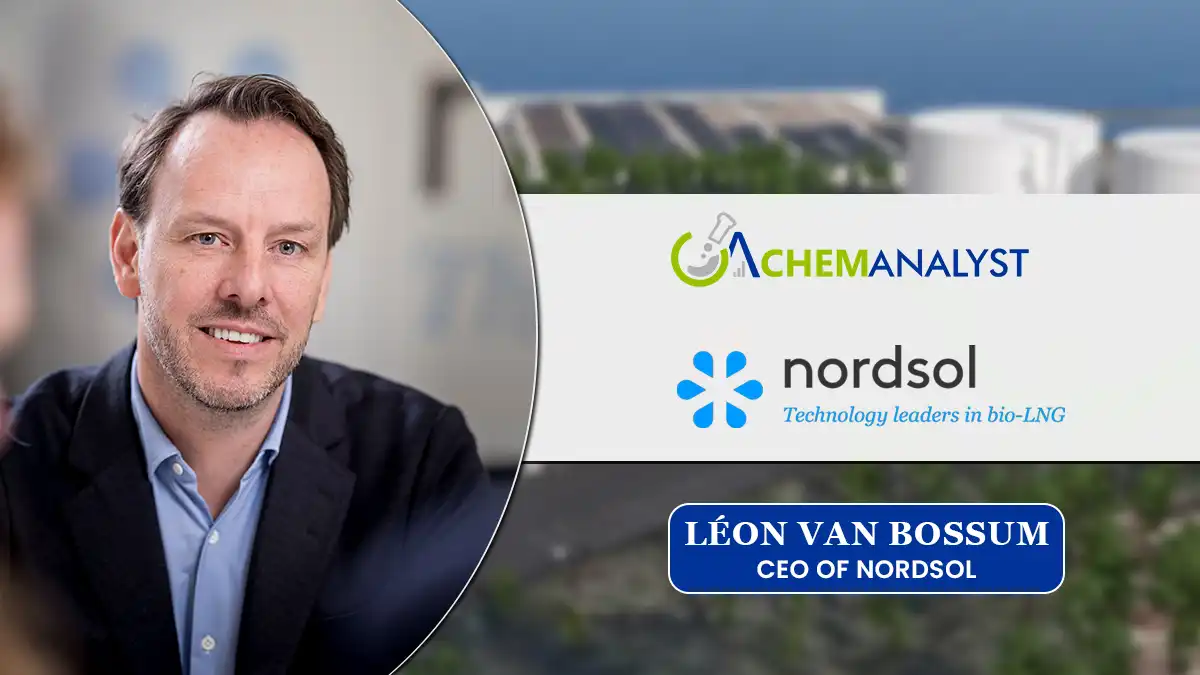
ChemAnalyst Talks with Mr. Léon van Bossum, CEO of Nordsol
Nordsol is a European technology pioneer in the on-site production of fossil-free bio-LNG, focused on converting biogas derived from advanced organic waste streams into high-purity renewable fuel for heavy road transport and maritime applications. With proprietary, fully integrated upgrading and liquefaction systems, the company emphasizes energy efficiency, operational reliability, and ease of deployment. Nordsol’s modular and decentralized production model enables scalable solutions tailored to local feedstock availability, supporting the development of regional circular energy ecosystems. Its installations are operational across multiple European markets, and the company also owns and operates two production facilities in the Netherlands, reinforcing its position as both a technology provider and project developer in the renewable gas value chain. ChemAnalyst spoke with Léon van Bossum, who shared insights into the company’s strategic role in advancing the bio-LNG market and enabling decarbonisation in hard-to-abate sectors. Drawing on his cross-industry experience in telecom and oil & gas, van Bossum highlighted the importance of navigating market cycles, fostering strong teams, and scaling integrated technologies to accelerate the energy transition. He emphasised Nordsol’s differentiated approach through on-site liquefaction, which enhances system efficiency and reduces total cost of ownership, while enabling flexible and replicable deployment across Europe. He also pointed to the growing importance of strategic partnerships and long-term offtake agreements in strengthening project bankability and market confidence. Looking ahead, Nordsol aims to further standardise its technology, reduce costs through innovation and scale, and expand its footprint in key regions where bio-LNG can play a critical role in delivering fossil-free energy solutions.
Complete Interview with Mr. Léon van Bossum
Q: Please provide an overview of your professional journey and how your leadership at Nordsol is shaping the company’s strategic positioning in the evolving renewable gas and bio-LNG market.
Mr. Léon van Bossum: I started my career in telecom and later moved into oil & gas. Both fast-evolving industries marked by cycles of growth, crisis, and moments of real disruption. Experiencing those cycles early on taught me how to navigate uncertainty, recognise opportunities for growth, and, above all, the importance of building strong teams and giving people the space to thrive.
The drive to be impactful led me to the energy transition. At Nordsol, I’ve had the opportunity to combine those early lessons with a clear purpose: scaling innovative technologies that accelerate the shift to renewable energy. Together with a talented team and our unique bio-LNG technology, we’ve not only built a company, but also helped shape an entirely new market within the renewable gas space.
Q: Vireo’s selection of Nordsol for the Lista Biogass project marks a repeat collaboration. From a strategic standpoint, how does this project strengthen Nordsol’s credibility and positioning in the European LBG infrastructure build-out?
Mr. Léon van Bossum: Repeat collaboration is extremely important, not only for Nordsol but also for the LBG (or bio-LNG) production industry as a whole. Vireo is the second customer to expand its collaboration with us, after Reneco in the UK. This shows that these biogas entrepreneurs have confidence in on-site biogas liquefaction technology, in the LBG business case, and in Nordsol’s technical expertise, Nordsol’s team and project approach.
Q: The Lista Biogass plant is designed to convert diverse waste streams into bio-LNG. How do you evaluate the commercial viability of such projects, given the variability in feedstock quality, availability, and long-term supply security?
Mr. Léon van Bossum: With recent announcements of new LBG production in Norway—such as Lista Biogass—we see growing demand for locally produced LBG made from locally sourced feedstock. Studies show that there is a significant amount of feedstock available ready to be transferred into biogas. Currently, only a small amount of the potential feedstock is utilised. Lista Biogass processes a diversified mix of manure, fish silage, and food fats. This feedstock is collected from local, established agricultural and aquaculture sectors in which Norway is a global leader.
Q: Nordsol’s decentralized, on-site liquefaction model differs from traditional centralized LNG infrastructure. How does this approach compare in terms of cost efficiency, emissions reduction, and scalability under real market conditions?
Mr. Léon van Bossum: Comparing business models only in terms of cost and scalability tells only part of the story. The more fundamental question is what price society pays for continuing to extract low-cost fossil resources from the ground while adding greenhouse gases to the atmosphere. In the short term, converting waste into renewable energy is generally more expensive than extracting and processing fossil fuels, which means bio-LNG typically carries a higher production cost than fossil LNG. However, when the environmental value of bio-LNG is properly recognised and monetised — for example, through renewable certificates or similar regulatory and market mechanisms — that cost gap can narrow substantially. Under those conditions, bio-LNG can achieve cost parity with, or in some cases outperform, fossil LNG under real market conditions.
A more meaningful comparison is between solutions that do not add additional greenhouse gases to the atmosphere—such as electrification, green methanol, renewable diesel, and bio-LNG. We believe bio-LNG is one of the most cost-effective ways to decarbonise hard-to-abate sectors such as shipping and long-haul road transport.
Q: Your integrated upgrading and liquefaction technology is positioned as energy-efficient and cost-effective. Can you quantify the efficiency gains and operational cost advantages compared to conventional multi-step bio-LNG production systems?
Mr. Léon van Bossum: Biogas upgrading and cryogenic liquefaction are fundamentally different processes and are typically supplied by different technology providers. But the interface between those two worlds is critical. Gas quality must continuously meet liquefaction specifications. Control systems need to communicate with each other. Energy flows must be optimised across the entire chain. And the plant must run reliably with minimal manual intervention, because continuous uptime determines profitability.
Poor integration leads to operational issues: unplanned downtime, lower output, higher energy consumption, and higher maintenance costs. Good integration delivers the opposite: stable production, predictable performance, and a system that does what it is supposed to do. The strength of our patented technology is that integration between upgrading and liquefaction. It eliminates extra steps and makes the system more robust and easier to operate. This results in a total cost of ownership (TCO) that is roughly 30% lower compared to other liquefaction technologies.
Q: Nordsol’s modular and multi-string plant design enables scalability. How does this flexibility impact project economics, uptime reliability, and risk mitigation for investors and operators?
Mr. Léon van Bossum: A multi-string plant may require a higher upfront investment, but calculations for different customers show that lifetime TCO can be significantly lower. That comes from higher availability, flexibility with capacity swings, the option to implement in phases, and strong energy efficiency at partial load. In addition, the ability to operate under a low-voltage directive makes power grid connection easier and reduces the strictness of personnel qualification requirements.
Q: The Lista project is expected to produce around 90 GWh of fossil-free bio-LNG annually. In your view, how significant is this scale in addressing regional demand for low-carbon fuels in transport and industry?
Mr. Léon van Bossum: 90 GWh of bio-LNG enables roughly 30 million kilometres of heavy-duty truck transport. It avoids around 30 kilotonnes of fossil CO2 emissions. That is significant. Most importantly, these plants are modular and standardised and can be replicated quickly at other sites. That is exactly what we are now seeing in Norway.
Q: Bio-LNG is increasingly seen as a solution for hard-to-abate sectors. Do you view it as a transitional fuel or a long-term cornerstone of decarbonisation, particularly in heavy transport and maritime applications?
Mr. Léon van Bossum: The amount of renewable energy required for a net-zero society is so large that we should not rule out any solution in advance. Bio-LNG can defossilise long-haul transport today and in the future. At the same time, other energy carriers will also play a role, such as e-fuels, electricity, and potentially nuclear energy. Most newly built vessels with alternative propulsion are equipped with an LNG engine. These ships have a lifetime of roughly 25 years, so the availability of renewable LNG is necessary for that fleet.
Q: Long-term offtake agreements, such as the one with Gasum, are central to project viability. How do such agreements influence financing structures, risk allocation, and overall market confidence?
Mr. Léon van Bossum: Although the bio-LNG market is maturing, it is still a relatively young market in development. Financing plants becomes much easier when you can show banks and other financiers that there is a long-term offtake agreement.
Q: Bio-LNG often carries a price premium compared to fossil LNG. What are the primary drivers of this cost gap, and what conditions are required for bio-LNG to achieve price parity or competitiveness?
Mr. Léon van Bossum: Today, producing fossil molecules is cheaper than converting waste into renewable molecules. But the true cost of adding greenhouse gases to the atmosphere is not reflected in the product price. Mechanisms such as the European Emissions Trading System can change this, because they put a price on emissions and give additional value to green molecules.
Q: From a demand perspective, how sensitive are end-use sectors like long-haul transport and shipping to bio-LNG pricing, particularly in the absence of strong regulatory incentives?
Mr. Léon van Bossum: These end-use sectors are highly price-sensitive. At the same time, we see large companies driving sustainability voluntarily through their own corporate sustainability targets.
Q: Looking at supply dynamics, do you see the market currently constrained more by limited availability of sustainable feedstocks or by insufficient downstream demand and infrastructure?
Mr. Léon van Bossum: Market reports indicate that Europe has sufficient organic waste availability to scale bio-LNG production and meet growing demand. The market is more constrained by less-than-ideal conditions for scaling on-site bio-LNG production: labour and material costs, permitting timelines, and mixed signals from policymakers.
Q: As more bio-LNG capacity comes online across Europe, how do you expect pricing dynamics to evolve—will scale drive cost reductions, or will constraints such as feedstock availability keep prices elevated?
Mr. Léon van Bossum: The innovation cycle plays a huge role. With maturing technology, scale and standardisation, both CAPEX and OPEX will be reduced over time.
Using operational data from our own plants, we have been able to optimise our technology and reduce costs per unit of bio-LNG produced. Other suppliers are doing the same. Feedstock prices will, of course, influence the price of bio-LNG, but as noted earlier, scaling can happen faster if the boundary conditions become more favourable.
Q: The industry is witnessing the rise of “mass-balanced” and “greened” LNG pathways. How do these alternatives impact price signals, market integrity, and investment decisions for truly fossil-free bio-LNG?
Mr. Léon van Bossum: During the transition to a fossil-free society, multiple pathways can and will coexist, but only if their true carbon intensity is transparently recognised and reflected in pricing. Clear rules and robust administration are essential to ensure market integrity and to prevent double-counting. When done right, mechanisms like mass balancing can play a role in accelerating market development.
However, we should not lose sight of the ultimate goal: full independence from fossil energy. Mass-balanced solutions, particularly those relying on terminal liquefaction, offer cost advantages and scalability today, but they remain structurally dependent on fossil LNG.
If we want to achieve a truly fossil-free future, we must continue to create space for dedicated renewable technologies to develop and scale. That means making conscious investment choices that support long-term impact, not just short-term efficiency.
In the end, it’s about balance: enabling transition mechanisms that help the market grow, while avoiding a lock-in to fossil-based systems and ensuring that fully renewable solutions like fossil-free bio-LNG production can reach their full potential.
Q: From a regulatory standpoint, what policy mechanisms are most critical to ensure a level playing field between fossil-derived LNG and genuinely renewable bio-LNG solutions?
Mr. Léon van Bossum: From a regulatory standpoint, clarity is fundamental. Clarity on the long-term vision and the pathway to a truly fossil-free energy system. Policymakers need to provide a stable and transparent framework that guides investment decisions and gives confidence to scale renewable solutions.
Mass balancing can play a role as a transition or supporting mechanism, but it should be clearly positioned as such. At the same time, policies must actively incentivise the development and deployment of fully renewable technologies like biogas liquefaction.
Crucially, this requires transparency and consistency in how carbon intensity is measured across the entire value chain, from production to transport. Whether based on fossil molecules through mass balancing or on fully green molecules via on-site liquefaction, the differences must be clearly defined and reflected in regulation.
Only with that level of clarity can we ensure a true level playing field, one that rewards real emissions reductions and accelerates the shift to genuinely renewable energy solutions.
Q: Looking ahead, what are Nordsol’s key priorities in terms of project pipeline expansion, geographic focus, and partnerships—particularly with developers like Vireo?
Mr. Léon van Bossum: Our main priority is to make bio-LNG producers using Nordsol technology successful by continuously reducing the TCO of on-site bio-LNG production. We do this through better technology integration and further improvements in energy efficiency and uptime. Our focus will be on areas where bio-LNG can be used as a biofuel, virtual pipeline or as a renewable energy source for the industry.
Q: As a concluding perspective, what structural changes—across industry, policy, and investment—are required over the next decade to ensure fossil-free bio-LNG becomes a scalable and competitive pillar of the global energy transition?
Mr. Léon van Bossum: The most important step is to move from ambition to action. To make fossil-free bio-LNG a scalable and competitive solution, we need alignment across policy, industry, and technology.
Policymakers play a critical role by providing long-term clarity through stable incentives and protection mechanisms. This reduces investment risk in what is still a developing market, both for end users and biogas producers, and creates the confidence needed to scale.
At the same time, transport companies need to take a long-term perspective, looking beyond short-term volatility in policies and energy prices and recognising the strategic value of transitioning to renewable fuels.
Technology providers, in turn, must focus on standardisation and scalability. By industrialising solutions, we can accelerate deployment and steadily reduce both CAPEX and OPEX.
For Nordsol, this is exactly where we are focused: turning proven technology into standardised, scalable solutions that help make fossil-free bio-LNG a cornerstone of the energy transition.







Leave a Comment
Comments (0)