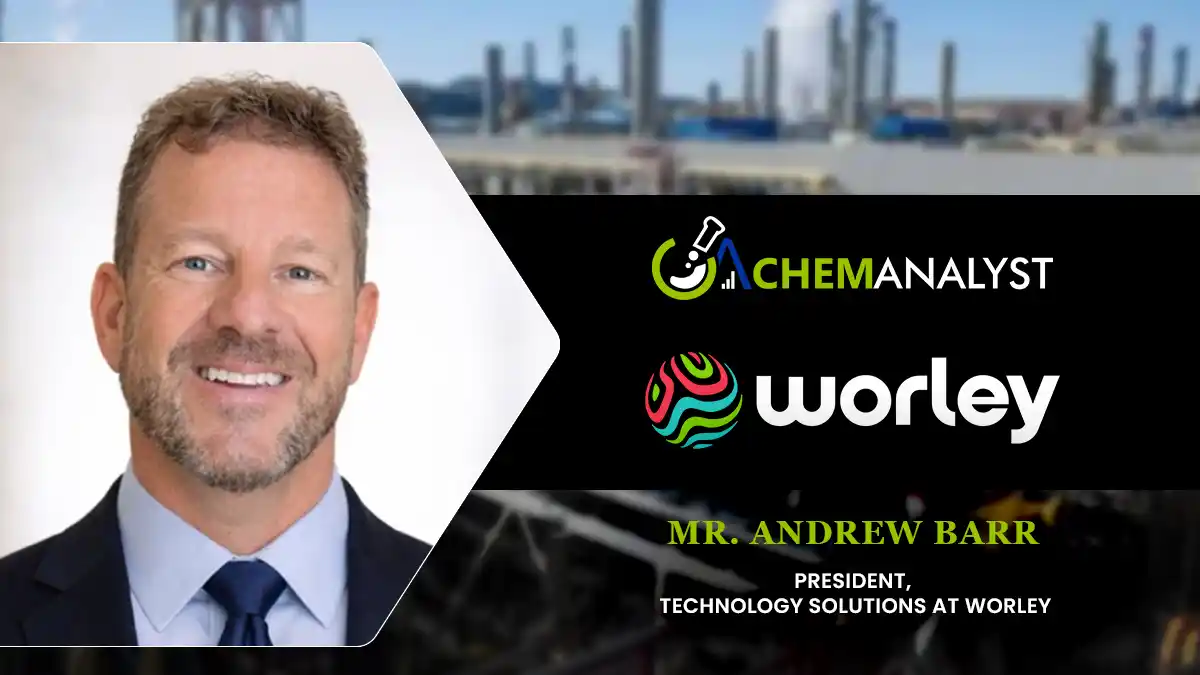
ChemAnalyst Talks with Mr. Andrew Barr, President, Technology Solutions at Worley
Worley Chemetics is Worley’s global technology, solutions, and equipment fabrication provider for sulphuric acid, chlorine chemicals, and other specialty chemical facilities, helping customers increase capacity and reliability while reducing operating costs, emissions, and safety risks. ChemAnalyst spoke with Mr. Andrew Barr, President, Technology Solutions at Worley, about the company’s approach to technology commercialization and the development of next-generation battery-material manufacturing solutions. Drawing on his more than three decades of experience across process engineering, technology development, commercialization, business development, project delivery, and executive leadership, Barr highlighted the importance of scaling innovative technologies from demonstration to commercial deployment. He discussed Worley’s collaboration with Nano One on the One-Pot™ LFP Cathode Active Material (CAM) Package, emphasizing its potential to simplify production, reduce capital and operating costs, and support more sustainable and resilient battery-material supply chains. Looking ahead, Barr underscored opportunities in LMFP, sodium-ion technologies, battery recycling, lithium extraction and refining, and advanced graphite production, while emphasizing engineering excellence, digitalization, and reliable commercialization pathways as critical to the energy transition.
Complete Interview with Mr. Andrew Barr
Q1: Please provide an overview of your professional journey in engineering, technology commercialization, and the global energy and chemicals sector. How have these experiences shaped your vision for Worley's role in accelerating next-generation clean technologies?
Mr. Andrew Barr: Over more than three decades with Worley and Chemetics, my career has progressed from process engineering through technology development and commercialization, proposals and estimating, business development, project delivery, and executive leadership. As President, Technology Solutions, I now lead a global process-technology business that develops proprietary technologies and specialized equipment, supports fabrication capability, and serves customers across six continents. This experience has given me a practical perspective on how to move technologies from concept to commercial reality—grounded in strong technical fundamentals, credible scale-up engineering, global project execution, and commercial models that create value for customers and investors.
Q2: The successful completion of the One-Pot™ LFP Cathode Active Material (CAM) Package with Nano One marks a significant milestone. What strategic objectives drove this collaboration, and why is it important for the future of battery materials manufacturing?
Mr. Andrew Barr: Worley recognized some years ago the challenges that sulphate based processing routes faced in this industry (cathode material, lithium refining, recycling), particularly when conceived in jurisdictions that either do not have local markets for sodium sulphate (the major waste stream), and/or for which discharge options to water bodies are difficult to permit.
We set strategic objectives to identify next generation technologies across the value chain that offered step change improvements in a combination of CAPEX, OPEX and ESG outcomes and reviewed dozens of emerging technologies. Nano One´s One-Pot™ process was top of the list in terms of novel cathode approaches. Combined with the fact that they had existing technology demonstration facilities in Canada and a long history in LFP production meant we could see a lower risk profile than for many other earlier stage technologies.
The coming together of our two organizations generates an opportunity to develop and deploy novel cathode technology utilizing the strengths of both – Nano One’s IP in cathode formulation through the One-Pot™ process, and Worley´s heritage is technology commercialization and licensing in adjacent markets. Ultimately, what we were looking for, and found, was a “1+1=3” scenario, wherein the combined offering is greater than either company could develop alone.
This is especially important today where technology export restrictions are in place and novel technology across the battery value chain has struggled to effectively scale all the way from lab to commercial scale outside of the major Asian jurisdictions. It´s a long journey, it requires a diverse skill set of capabilities and capacity to be effective, and the industry needs success stories in order to unlock global ambitions for diversified value chains.
Battery materials manufacturing has entered a period where cost competitiveness, supply-chain resilience, regional production, and environmental performance all matter at the same time. LFP cathode material is taking an increasing market share for electric vehicles, energy storage, and strategic supply security, yet production remains heavily concentrated in China. By helping create a de-risked, commercial scale CAM Package, Worley and Nano One are supporting a pathway for localized LFP production that can reduce execution risk, improve investment confidence, and accelerate the development of more sustainable battery-materials supply chains outside of traditional production centers.
Q3: The CAM Package has been engineered to a Class 3 cost estimate and integrates technology licensing, process engineering, equipment selection, and cost estimation into a single solution. How does this integrated approach reduce project risk and improve investment confidence for customers?
Mr. Andrew Barr: Final Investment Decisions are typically taken on a Class 3 estimate basis. The integrated CAM Package reduces project risk by giving customers a more complete and commercially actionable project basis. It combines the technology license, process design, equipment specifications, vendor input, and Class 3 cost estimate into one coherent package, helping customers understand plant performance, cost, schedule, scope of supply, interfaces, and execution responsibilities much earlier in the decision process.
This improves investment confidence because customers and investors can evaluate the One-Pot™ solution against conventional alternatives using a clearer technical and commercial basis, including better-defined costs for the technology-specific and most critical components, which we can supply at a fixed price. Combining Nano One’s process technology with Worley Chemetics’ commercialization, engineering, and specialized equipment experience shortens the path from technology selection to final investment decision and commercial deployment.
Q4: The One-Pot™ process has demonstrated the potential to reduce capital investment, operating costs, and energy consumption compared to conventional LFP production. Which engineering innovations have contributed most significantly to these improvements?
Mr. Andrew Barr: The key innovation is the One-Pot™ process, which simplifies conventional LFP production by reducing process steps, intermediate handling, wastewater treatment, by-products, and equipment requirements. This simplification is a major driver of lower capital cost, operating cost, and energy consumption.
Equally important is the translation of the process into a practical pre-engineered package that can be built, operated and maintained effectively. Optimized equipment selection, plant layout, vendor qualification, materials of construction, impurity control, and operability considerations help convert the process advantage into a reliable commercial facility.
Beyond Nano One´s process, Worley has overlaid a standardized approach to the plant layout and design, a methodology that still enables some flexibility to adapt to local conditions/plot size - but ultimately reduces the amount of bespoke engineering – a benefit that compounds when multiple or subsequent plants/expansions are contemplated.
Q5: Battery manufacturers are increasingly seeking localized supply chains outside China. How do you see engineering companies like Worley enabling regional battery material manufacturing while strengthening supply chain resilience?
Mr. Andrew Barr: The key point to consider is that this is a global industry, and whilst there are ambitions to strengthen the value chain in certain regions, ultimately technology, skills sets, and key equipment will need to be sourced on a global basis to enable successful asset delivery.
Worley has both the depth of technical expertise in battery materials manufacturing, combined with broad global coverage across our over 40 operating countries, bringing assets to bear in just about any part of the world.
We convert technology platforms into executable projects. This includes process design, supplier qualification (often suppliers that are globally diverse), cost estimating, specialized equipment specification, procurement support, expediting and logistics, project execution planning, compliance with local codes, and integration with regional EPC or EPCM delivery models.
This role is increasingly important as customers seek alternatives to concentrated, higher-risk supply chains. Worley can help customers localize production while managing cost, execution risk, intellectual-property protection, and regional policy requirements, creating a more resilient path to LFP supply outside traditional production centers.
Q6: Scaling innovative technologies from demonstration to commercial production presents significant challenges. What are the biggest engineering hurdles during commercialization, and how can they be effectively addressed?
Mr. Andrew Barr: The biggest commercialization hurdles are scale-up, process integration, equipment reliability, product quality and consistency, and cost certainty. Battery-materials projects must move from laboratory or demonstration scale to continuous commercial production while maintaining product quality, safety, environmental performance, and operating efficiency.
These risks are best addressed through a staged commercialization model. Demonstration testing, equipment validation, vendor engagement, progressive engineering, cost estimating, and customer qualification all help reduce uncertainty before major capital is committed.
We apply a rigorous stage gate approach to scale up applications – in a similar manner as you would do for delivery of any large-scale asset. This approach ensures that key parameters are confirmed before moving in further design detail, that risks are clearly articulated and addressed, and that validation and revalidation of the underlying economics in undertaken at each gate to ensure the final outcome remains viable and achievable. This is experience we bring from our work across more than a hundred “first-of-a-kind” technology scale assignments in recent years across the energy, chemicals and resources sectors.
Q7: Governments worldwide are promoting localized critical minerals processing and battery manufacturing through supportive policies. How are these evolving policy frameworks influencing engineering design, project execution, and investment decisions?
Mr. Andrew Barr: Policy frameworks are increasingly shaping where projects are built and how supply chains are designed. Incentives for critical minerals processing, domestic manufacturing, low-carbon production, and supply security influence plant location, sourcing strategy, equipment selection, permitting, and execution planning.
For engineering teams, this means early project definition must consider not only technical and economic feasibility, but also incentive eligibility, local-content requirements, trade exposure, and regional supply-chain resilience. Our well-defined CAM Package helps customers evaluate these factors earlier and more clearly.
What is probably more important than anything else is the stability and predictability of policy settings. First of a kind technology development, and major asset development are years-long processes and require a stable policy environment to ensure the underlying project economics can be estimated early with high levels of confidence. Changes to policy frameworks generally incur delay and cause uncertainty, as proponents and investors must digest their impact on projects in flight.
Geopolitics is a backdrop that we and other companies need to live with and adapt to. Currently we see technology export restrictions from China, environmental limitations in Europe and elsewhere and a strong domestic supply focus in the US. All of these work very much in our favor at the moment.
Q8: Sustainability, digital engineering, and automation are transforming industrial project development. How is Worley leveraging these capabilities to improve efficiency, reduce emissions, and accelerate commercialization of next-generation battery material facilities?
Mr. Andrew Barr: Worley is adapting its digital, automation, and AI-enabled delivery strategies as part of our growth strategy with a focus on improving speed, quality, predictability, and cost outcomes across project delivery. These tools can support project teams in concept development, layout optimization, estimating, procurement planning, vendor evaluation, constructability reviews, scheduling, interface management, and predictive project controls. The objective is to strengthen engineering judgment through better data, more consistent workflows, higher efficiency, and more repeatable execution models.
For next-generation battery-material facilities, these capabilities are highly relevant because customers need faster commercialization, lower execution risk, and stronger lifecycle performance. As Worley continues to adapt digital engineering, automation, and responsible AI across its global project-delivery platform, these strategies can help improve how complex industrial projects are defined, engineered, procured, built, and operated. Combined with process innovations such as Nano One’s One-Pot™ technology, they point toward a more efficient, lower-emission, and scalable pathway for sustainable battery-materials manufacturing.
Q9: Beyond lithium iron phosphate, what emerging battery materials or advanced process technologies do you believe will drive the next wave of innovation in the global battery value chain?
Mr. Andrew Barr: There is still a lot of innovation left in LFP including in its supply chain, but beyond LFP, the next wave of innovation across cathode materials will likely include manganese-rich materials like LMFP and lithium free sodium-ion type chemistries. All with significantly improved precursor and cathode manufacturing routes.
More broadly across the value chain we see significant technology opportunities in the recycling of battery materials with numerous innovations coming through and starting their scale up journey. We also believe further innovations in the extraction and refining of key minerals will continue to unlock more competitive feedstocks – particularly for lithium from both brine and hard rock forms. Finally, synthetic graphite production for anode material seems less than ideal at the moment, but with a number of technology companies making great strides to improve it. The strongest technologies will combine performance with manufacturability, scalability, cost competitiveness, and supply-chain resilience. Advanced process technologies that reduce steps, waste, water use, energy consumption, and dependence on constrained feedstocks will also be important. Success will depend on pairing strong materials science with practical engineering, reliable equipment, credible costs, and a clear path to commercial deployment.
Q10: Finally, what message would you like to share with ChemAnalyst's global audience regarding Worley's long-term vision for engineering innovation, technology commercialization, and the future of sustainable battery materials manufacturing?
Mr. Andrew Barr: My message is that the energy transition will require not only breakthrough technologies, but also the ability to commercialize and scale those breakthroughs into reliable industrial assets. This aligns closely with Worley’s growth strategy to be globally recognized as the partner delivering projects that matter to the world. Battery materials are exactly that kind of opportunity, where technology, sustainability, supply-chain resilience, and execution certainty all need to come together.
For Worley and Worley Chemetics, the Nano One collaboration is a practical example of this vision in action. Through technology commercialization, specialized engineering and equipment fabrication, global technology delivery capability, and tailored business models, we can help customers move from innovation to deployment while building more sustainable, resilient, and cost-effective battery-materials supply chains.







 About ChemAnalyst
Leave a Comment
Comments (0)