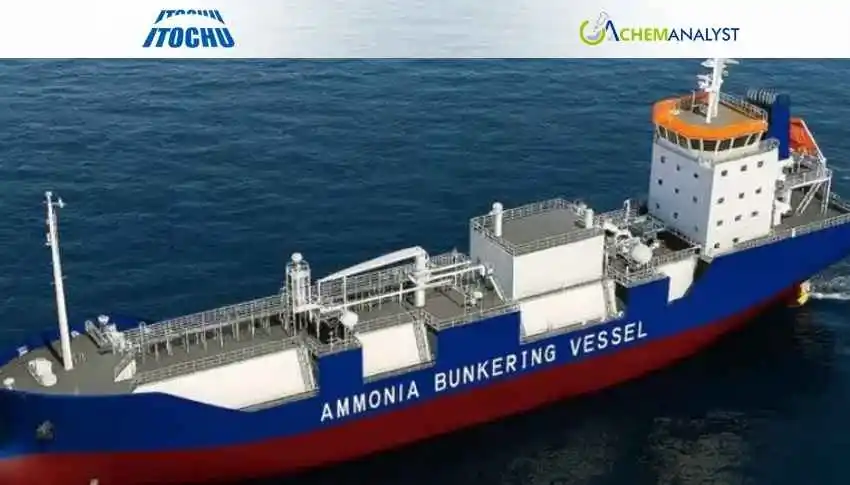
Itochu's subsidiary, ZETA Bunkering Pte. Ltd., has received crucial authorization from the Maritime and Port Authority of Singapore (MPA) to commence ammonia bunkering trials in Singapore. This landmark approval, granted on April 27, 2026, and effective from May 15, 2026, for a trial period of up to two years, marks a significant stride towards decarbonizing the global shipping industry. The trials are poised to verify the technical readiness, operational protocols, infrastructure, and technologies essential for safe and environmentally sustainable ammonia bunkering practices in the world's busiest port.
The impetus behind this initiative is the urgent need to meet the shipping industry's decarbonization targets, particularly the International Maritime Organization's (IMO) ambitious goals for reducing greenhouse gas emissions. Ammonia is emerging as a promising alternative marine fuel due to its potential for zero-carbon emissions at the point of combustion. Itochu's strategic move reflects a "market-in" approach, anticipating future demand for clean fuels and proactively building the necessary supply chain and infrastructure.
For the trials, Itochu plans to collaborate with Mitsui O.S.K. Lines (MOL) and CMB.TECH NV. This partnership involves supplying ammonia fuel from a newly constructed 5,000 cubic meter ammonia bunker vessel, ordered by Itochu from Sasaki Shipbuilding, to MOL's dual-fuel Capesize bulkers. These demonstration trials are scheduled to take place within Singapore's port during the last quarter of 2027, with commercial ammonia bunkering operations anticipated to commence by 2028.
The economic implications of this development are substantial. Itochu's project involves significant investments in new shipbuilding and bunkering infrastructure, partially financed by agreements with institutions like Hiroshima Bank and supported by the Japanese Ministry of Economy, Trade and Industry (METI) under its "Global South Future-oriented Co-Creation Project." If successful, this initiative will not only establish new markets for ammonia as a marine fuel but also foster job creation in related sectors.
Geopolitically and industry-specifically, Singapore is solidifying its position as a leading global bunkering hub by embracing and pioneering the adoption of new, greener fuels. This move by Itochu, a major Japanese trading house, also aims to enhance the competitiveness of Japan's shipbuilding industry, particularly in the construction of ammonia-bunkering vessels and tanks. Beyond Singapore, Itochu has ambitions to expand its ammonia bunkering business to other critical maritime transportation points globally, including Spain (Strait of Gibraltar), the Suez Canal in Egypt, and Japan, thereby creating a worldwide network for clean ammonia supply.
The environmental impact is a primary driver, with the project directly contributing to the decarbonization of international shipping and helping the maritime industry achieve its net-zero greenhouse gas emission goals by 2050. However, the successful implementation hinges on developing robust safety studies, risk assessments, and operational standards to manage the inherent challenges associated with handling ammonia as a fuel.







 About ChemAnalyst
Leave a Comment
Comments (0)