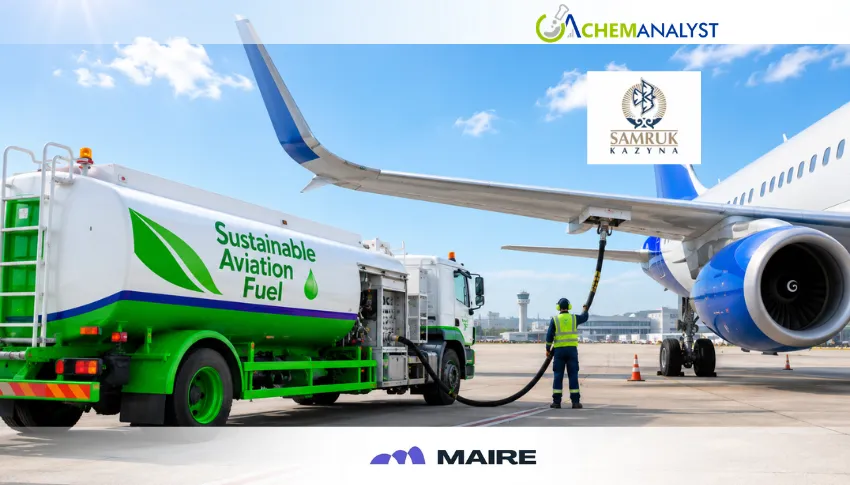
MAIRE has announced the signing of a Memorandum of Understanding (MoU) with Kazakhstan’s sovereign wealth fund, Samruk-Kazyna, and the Italo-Kazakh Trade Association (ACIK) to jointly explore the development of a Sustainable Aviation Fuel (SAF) production platform in Kazakhstan. The initiative aims to capitalize on Nextchem’s advanced technology portfolio and MAIRE Group’s project execution expertise to support the growth of a sustainable aviation fuel industry in the country.
The collaboration is designed to evaluate the feasibility of producing SAF using Hydroprocessed Esters and Fatty Acids (HEFA) technology, which converts renewable feedstocks such as vegetable oils, waste oils, and animal fats into aviation fuel. Kazakhstan possesses significant agricultural and industrial resources that could serve as potential feedstocks for SAF production, making it an attractive location for such an initiative.
As part of the agreement, the three parties will work together to assess technical, commercial, and financial aspects of establishing a SAF value chain in Kazakhstan. The study will include an evaluation of available feedstocks, logistics networks, infrastructure requirements, and market opportunities. The partners will also engage with key stakeholders, including government agencies, investors, and industry participants, to create a supportive framework for project development.
An important component of the initiative involves examining suitable investment structures that could facilitate project financing. The parties may consider leveraging the Astana International Financial Centre (AIFC) as a platform to attract domestic and international investors interested in sustainable energy and low-carbon aviation projects.
Nextchem, MAIRE’s technology-focused subsidiary, will play a central role in identifying and advancing the most viable technology pathways for SAF production. The company will contribute its expertise in renewable fuel technologies, process optimization, and sustainability solutions while evaluating the overall economic viability of the proposed platform.
The initiative aligns with Kazakhstan’s broader strategy of diversifying its economy, reducing carbon emissions, and strengthening its position in global energy markets. Given Kazakhstan’s strategic geographical location between Europe and Asia, the country is well-positioned to become a regional hub for SAF production and distribution. The development of a local SAF industry could support growing demand from airlines seeking lower-carbon fuel alternatives while enhancing the nation’s industrial capabilities.
Commenting on the agreement, MAIRE Chief Executive Officer Alessandro Bernini stated that the partnership marks an important milestone in advancing sustainable aviation fuel production in Kazakhstan. He emphasized that the country’s location along major Europe-Asia transportation corridors provides strong opportunities for developing SAF supply chains. Bernini added that MAIRE, through Nextchem, will contribute its technological expertise to help identify efficient and commercially viable solutions, supporting Kazakhstan’s ambition to become a leading regional center for sustainable aviation fuel production.
Market Impact: The collaboration between MAIRE, Samruk-Kazyna, and ACIK to evaluate sustainable aviation fuel (SAF) production in Kazakhstan is expected to have a positive long-term impact on the SAF market and the broader renewable fuels industry. By leveraging HEFA (Hydroprocessed Esters and Fatty Acids) technology, the initiative aims to convert renewable feedstocks such as vegetable oils, used cooking oil, and animal fats into low-carbon aviation fuel, supporting the aviation sector's transition toward sustainability.
If successfully implemented, the project could establish Kazakhstan as a significant regional producer and supplier of SAF, particularly due to its strategic location between Europe and Asia. Increased SAF production capacity would help airlines secure access to cleaner fuel alternatives and meet increasingly stringent environmental regulations and carbon reduction targets. The initiative may also stimulate investments in feedstock collection systems, bio-refining infrastructure, storage facilities, and transportation networks, strengthening the overall renewable energy ecosystem.
Furthermore, the project could create new revenue streams for agricultural and waste-processing industries by increasing demand for renewable feedstocks. While the agreement is currently focused on feasibility assessment, its successful commercialization could enhance regional energy diversification, improve supply chain resilience, and accelerate the adoption of sustainable aviation fuels across international aviation markets.







Leave a Comment
Comments (0)