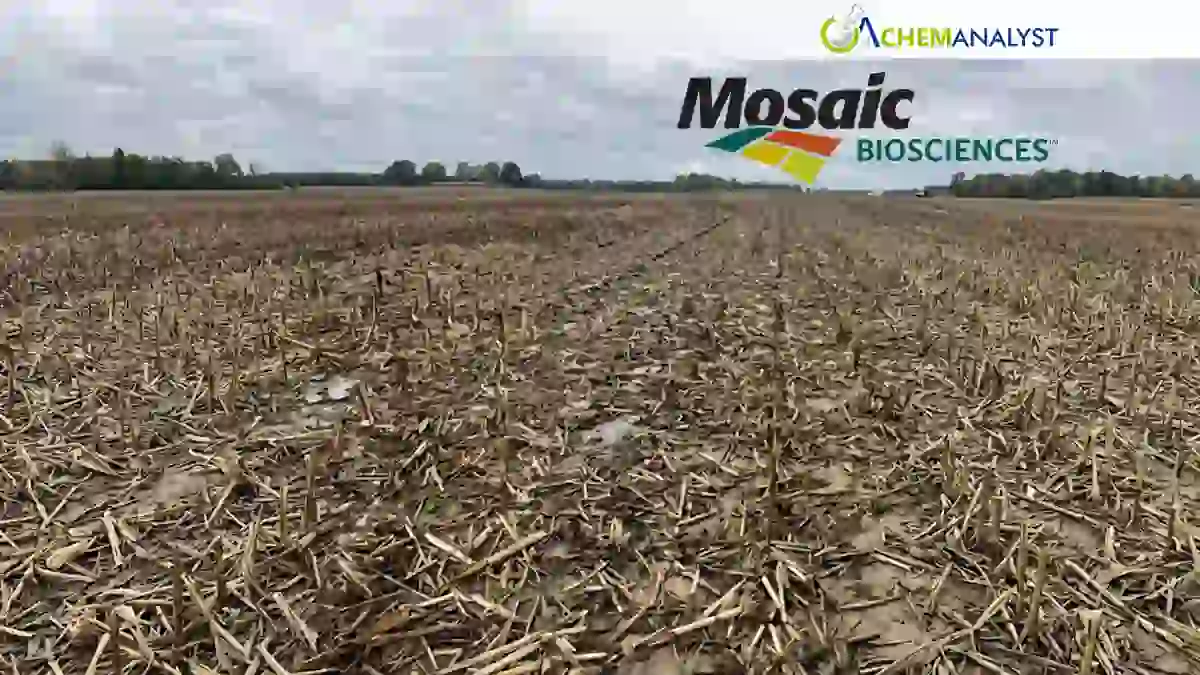
Mosaic Biosciences has launched Renuvis Enzara, a new residue management solution designed to accelerate the natural decomposition of crop residue and help farmers achieve more consistent, plant-ready field conditions ahead of the spring planting season.
The product addresses increasing residue management challenges linked to higher-yielding crop hybrids, continuous corn production, no-till farming and reduced-tillage practices. As residue accumulates, farmers can face shorter planting windows, additional tillage requirements, slower machinery operations and uneven crop emergence. These issues can increase operating costs and potentially affect yields.
Renuvis Enzara uses targeted endoglucanase enzyme technology to accelerate the breakdown of tough structural fibers in crop residue. By opening up the residue structure, the treatment creates more access points for naturally occurring soil microorganisms, which can then continue the decomposition process.
A key feature of the product is its ability to begin working under cold conditions, including temperatures as low as 32 degrees Fahrenheit. This could provide growers with greater flexibility during early-season field preparation when temperatures may limit biological activity.
According to Mosaic, faster residue decomposition can improve seed-to-soil contact, support more uniform seed depth and emergence, and create better conditions for early crop establishment. The solution may also help farmers begin planting sooner by improving field conditions and widening the available planting window.
The product can complement existing residue management practices and is designed for application in either fall or spring. It is also tank-mix compatible with existing fertilizer and herbicide applications, allowing growers to incorporate it without requiring an additional field pass.
Mosaic said Renuvis Enzara is suitable for several production systems, including corn-on-corn fields, no-till and reduced-tillage operations, heavy-residue areas and conventional tillage following high-yield crops.
The company has supported the product with laboratory research and on-farm trials. During 2025 field trials, Renuvis Enzara reportedly improved residue decomposition in both corn-on-corn and soybean-after-corn systems. Spring applications also showed improvements in crop emergence, stand counts and uniformity in corn and soybeans.
By reducing the amount of persistent residue, the solution could also improve tillage efficiency and reduce equipment wear. Lower tillage intensity may potentially decrease fuel consumption while supporting soil conservation and erosion-control efforts.
Overall, Mosaic expects Renuvis Enzara to provide growers with a practical tool for managing heavy residue, improving field readiness and supporting more efficient planting and crop establishment.
Product Impact and Chemical Commodity Price Impact
Renuvis Enzara could strengthen demand for enzyme-based agricultural inputs by offering growers an efficient alternative to intensive mechanical residue management. Faster residue decomposition may reduce tillage passes, equipment wear and fuel consumption while improving planting conditions and crop establishment. For Mosaic, the product expands its agricultural solutions portfolio and could create an additional specialty-input revenue stream. From a chemical commodity perspective, the immediate impact on prices tracked by ChemAnalyst is likely to remain limited because Enzara targets a specialized agricultural application rather than large-volume commodity chemicals. Over time, stronger adoption could modestly support demand for specialty enzymes and related agricultural chemicals, while having a broadly neutral effect on major commodity prices.







 About ChemAnalyst
Leave a Comment
Comments (0)