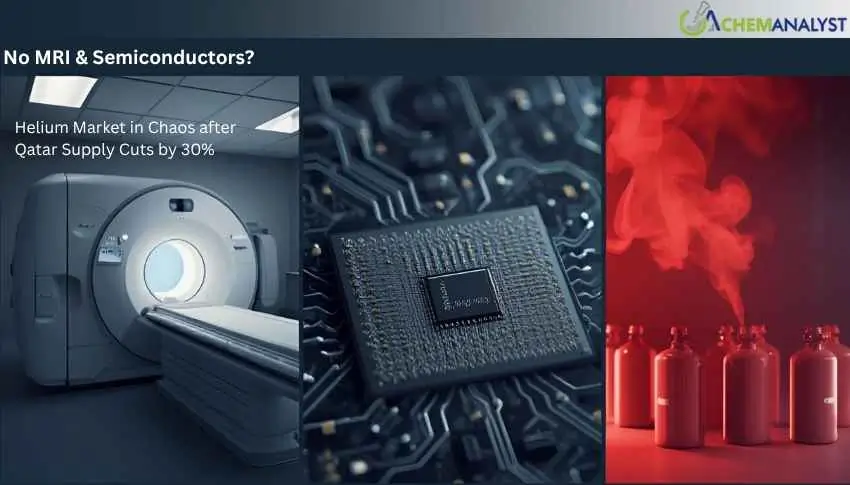
The global helium market has entered a phase of severe disruption following Iranian drone and missile strikes on Qatar’s Ras Laffan Industrial City. The attack has forced shutdowns at one of the world’s most critical energy and helium production hubs, triggering widespread supply shocks across global markets that is leading the high prices.
Ras Laffan, which processes about a fifth of global liquefied natural gas, is central to helium production as the gas is extracted as a byproduct of LNG processing. Following the attacks on March 2 and subsequent strikes on March 18, QatarEnergy halted LNG production, taking associated helium output offline and disrupting global supply chains.
The immediate impact has been significant. The shutdown has resulted in an estimated 30% reduction in global helium supply, while Qatar’s overall helium output is expected to fall by 14%. This comes alongside a broader loss of 17% of Qatar’s LNG export capacity, equivalent to 12.8 million tonnes per annum, further tightening supply conditions.
Qatar plays a crucial role in the global helium market, accounting for nearly one-third of total supply and ranking as the second-largest producer after the United States.
The crisis has been further intensified by disruptions in logistics. The closure of the Strait of Hormuz has delayed shipments and restricted export movements. As a result, supplies expected to reach major Asian markets such as China, Japan, and South Korea are likely to be sharply reduced in April.
Asia remains the most vulnerable region due to its heavy reliance on Qatari helium. In recent periods, some Asian buyers sourced more than 60% of their helium requirements from Qatar, underscoring the magnitude of potential disruption. The ongoing conflict risks interrupting the supply of critical raw materials essential for semiconductor manufacturing, including helium (primarily supplied by Qatar). This has raised concerns over a potential chip shortage, which could push prices higher, particularly given that TSMC produces nearly 90% of the world’s most advanced logic chips.
The semiconductor industry is facing immediate risks due to helium shortages. Major chipmakers are now at risk of production slowdowns, which could lead to delays in supply chains and higher semiconductor prices globally.
Demand for helium remains strong in recent months. Global semiconductor sales reached 82.5 billion, marking a 3.7% increase month-on-month in January 2026 and a sharp 46.1% rise year-on-year. Regional year to year sales expanded significantly across Asia Pacific by 82.4%, China by 47.0%, the Americas by 34.9%, and Europe by 26.1%, sustaining strong helium consumption across high-tech industries.
The impact is also being felt on the healthcare sector. Helium shortages are disrupting the MRI supply chain, particularly in import-dependent regions such as India, where tighter availability is increasing costs and raising the risk of delayed diagnostic procedures.
Alternative suppliers are struggling to fill the gap. While the United States and Russia are key producers, US output cannot be scaled quickly enough, and Russian exports remain constrained due to geopolitical factors. This has limited the ability of the global market to respond effectively to the sudden supply shortfall.
Freight and logistics costs have also surged due to the crisis. Rising bunker fuel prices, higher war-risk insurance premiums, and operational disruptions are increasing overall shipping costs. These factors are adding further pressure on helium prices and tightening supply chains globally.
As per the ChemAnalyst data, the helium market is expected to remain tight into April as supply disruptions persist and shipments remain delayed. If the Strait of Hormuz continues to face restrictions, global trade flows may remain constrained, further limiting availability. In the longer term, delayed repairs at Qatar’s facilities, which may take years, could lead to prolonged supply tightness and increased price volatility across global markets.






Leave a Comment
Comments (0)