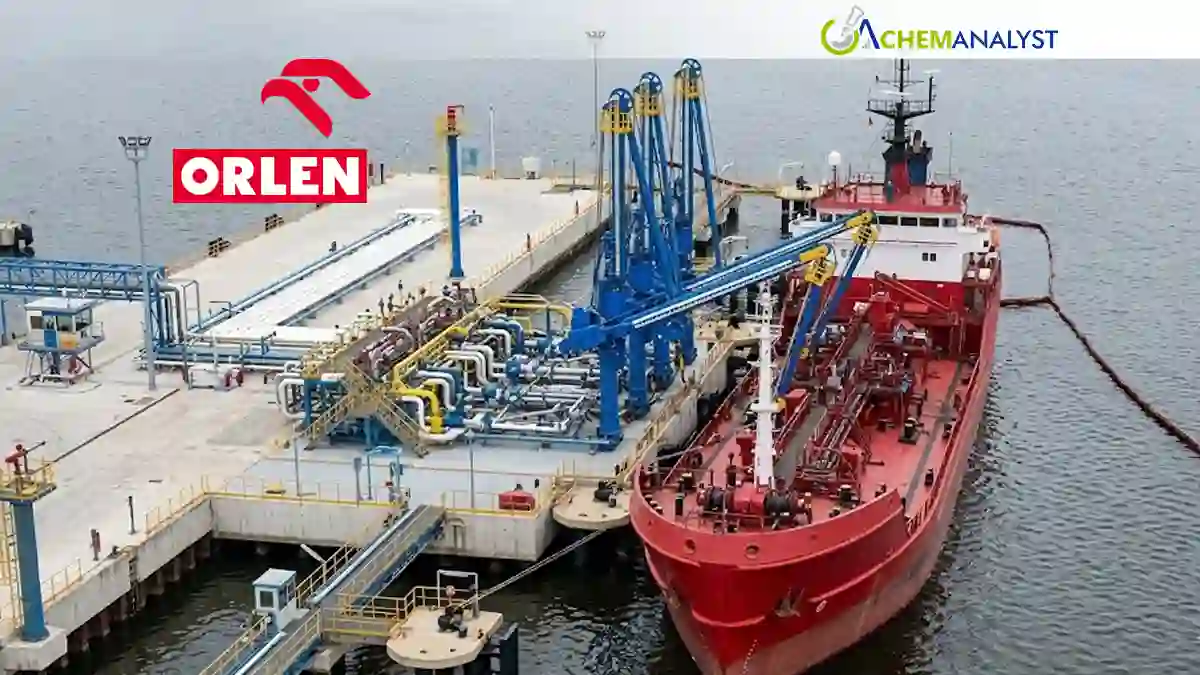
ORLEN has officially commissioned its new Marine Transshipment Terminal at the Gdansk refinery, completing one of the company's most significant logistics investments aimed at improving operational efficiency and strengthening Poland's fuel supply network. Located on the Martwa Wisla River, the terminal allows refinery feedstocks and finished products to move directly between the refinery and marine vessels, eliminating intermediate transportation and streamlining cargo handling.
The facility has already begun operations, receiving its first ships that loaded marine gas oil (MGO) for export while unloading Fatty Acid Methyl Ester (FAME), a key biofuel feedstock. The project represents a major milestone in ORLEN's logistics strategy and was largely executed by Polish engineering and construction companies, highlighting the country's growing capability to deliver complex industrial infrastructure.
According to ORLEN President Ireneusz Fafara, the new terminal strengthens Poland's energy security by shortening supply chains, improving the flexibility of refinery operations, and reducing dependence on external logistics infrastructure. He also emphasized the successful participation of domestic companies, describing the project as proof of Poland's ability to complete technologically advanced energy investments.
The marine terminal features a 380-meter quay equipped with two identical berths that can accommodate two vessels simultaneously. Each berth can receive ships of up to 10,000 deadweight tonnes, measuring up to 130 meters in length with a beam of 17.6 meters and a maximum draft of 5.8 meters. Four automated bidirectional marine loading arms installed at each berth operate at pressures of up to 10 bar and can transfer cargo at rates reaching 500 cubic meters per hour, enabling efficient loading and unloading operations.
The terminal will support exports of Group I and Group II base oils, widely used in manufacturing engine oils and hydraulic lubricants. It will also export low-sulfur marine gas oil for the shipping sector and xylene, an important solvent used across the chemical industry. On the import side, the facility will receive FAME and Used Cooking Oil Methyl Ester (UCOME) for renewable fuel production, ethanol for gasoline blending, and fuel additives such as MTBE and ETBE that improve gasoline octane ratings.
During its first year of operation, the terminal is expected to serve around 100 vessels and process approximately 500,000 tonnes of cargo. Over time, annual throughput capacity is projected to reach between 1.8 and 2 million tonnes. Built at a cost of nearly PLN 500 million, the project is expected to lower logistics costs, reduce dependence on road and rail transport, improve supply reliability, and enhance ORLEN's long-term competitiveness in fuel and petrochemical logistics.
Impact on Products
The new marine terminal will improve the movement of refinery products and petrochemical feedstocks, supporting more reliable exports of base oils, marine gas oil, and xylene while ensuring smoother imports of ethanol, FAME, UCOME, MTBE, and ETBE. Reduced logistics bottlenecks and lower transportation costs will enhance supply chain efficiency, strengthen Poland's biofuel production capabilities, and improve the availability of refined petroleum products and chemical intermediates across regional and export markets.







Leave a Comment
Comments (0)