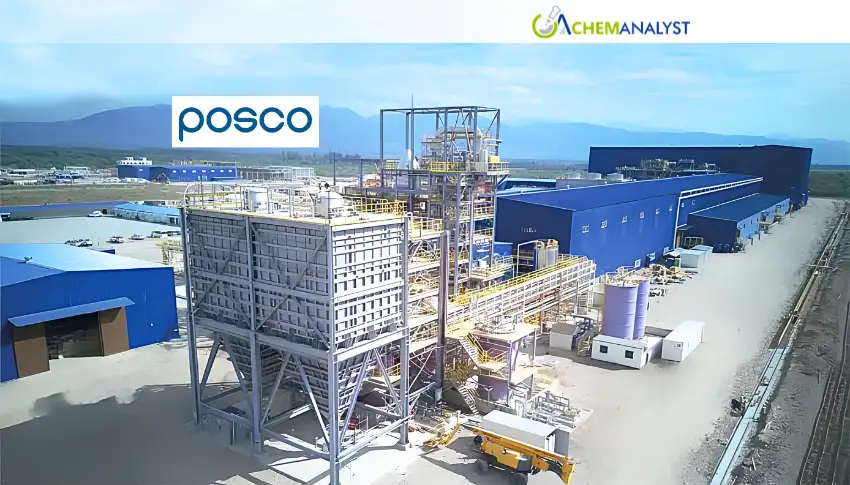
POSCO, a South Korean steel and battery materials company, is preparing to initiate full-scale operations at Phase 2 of its Sal de Oro lithium project in Argentina. This expansion marks a significant step in diversifying its lithium production and strengthening Argentina's role in the global electric vehicle (EV) battery supply chain. The new facility, located at the Salar del Hombre Muerto, is expected to be completed in early August and will focus on producing lithium carbonate.
POSCO's Sal de Oro project operates across two main installations in Argentina. The upstream plant, situated at approximately 4,000 meters above sea level in the Salar del Hombre Muerto, extracts brine and produces lithium compounds. These compounds are then transported to a downstream processing facility in the General Güemes Industrial Park in Salta province.
Phase 1 of the project, a lithium hydroxide plant, began operations in October 2024 and currently has an annual capacity of 25,000 tons. The upcoming Phase 2 will add a lithium carbonate plant with a capacity of 23,000 tons per year of lithium carbonate equivalent (LCE). Once both phases are fully operational, the Sal de Oro project will achieve a combined annual output of 50,000 tons across both lithium hydroxide and lithium carbonate products. POSCO also aims to establish an annual production system of 100,000 metric tons in the future.
The Sal de Oro expansion represents a substantial investment in Argentina's growing lithium industry. The second phase alone involves an investment of US$547 million, with the total capital expenditure for the expansion amounting to approximately US$633 million. The Argentine government has supported this initiative by approving POSCO's inclusion in the Incentive Regime for Large Investments (RIGI), which provides a 30-year framework of fiscal, tax, customs, and foreign exchange stability.
This project is projected to generate over US$300 million in exports annually once Phase 2 is fully operational. It has already created nearly 5,000 jobs during its construction and operational phases and maintains supply agreements with more than 60 local providers. The diversification of lithium production enhances Argentina's position within the "Lithium Triangle," a region encompassing parts of Argentina, Bolivia, and Chile, known for its significant lithium reserves. This strategic development solidifies POSCO's long-term growth strategy and reinforces Argentina's role as a key supplier in the global critical minerals market for electric vehicle batteries.
Impact Analysis
POSCO's Phase 2 launch will lift its Sal de Oro output to 50,000 tons annually (lithium hydroxide plus carbonate), strengthening its position in the EV battery supply chain and Argentina's "Lithium Triangle" standing, while generating over $300 million in exports and nearly 5,000 jobs. For ChemAnalyst-tracked chemical commodities, this signals incremental global lithium carbonate and hydroxide supply growth, potentially exerting mild downward pressure on lithium prices amid already soft demand-supply balances. However, near-term price impact remains limited since new capacity ramps gradually, and broader EV battery demand trends, rather than single-project additions, will continue driving lithium carbonate and hydroxide price trajectories.








 About ChemAnalyst
Leave a Comment
Comments (0)