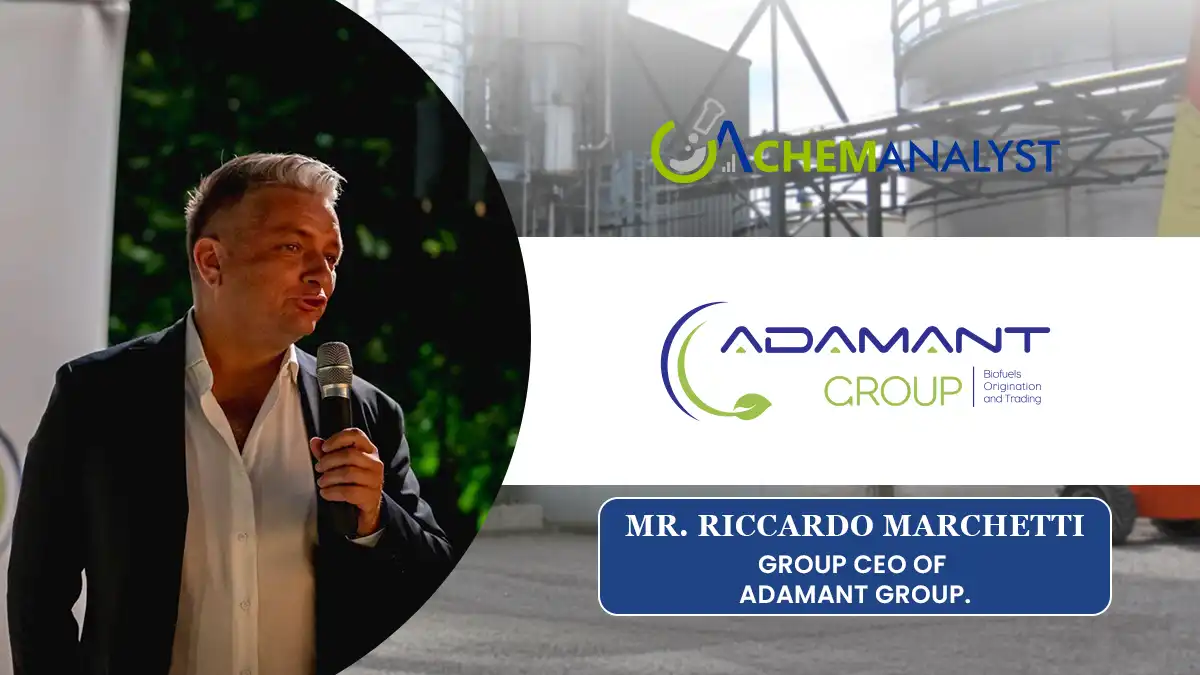
ChemAnalyst Talks with Mr. Riccardo Marchetti, Group CEO of Adamant Group
Adamant Group, founded in 2013 and headquartered in Switzerland, is a leading player in the advanced biofuels and renewable feedstock sector, with operations spanning over 25 countries across Europe, Asia, Africa, the Middle East, and Latin America. The company focuses on developing circular solutions to support the decarbonization of transport, particularly in aviation, maritime, and industrial sectors. Through its integrated value chain encompassing sourcing, processing, and distribution, Adamant delivers sustainable, high-performance liquid biofuels. In 2024, the Group handled approximately 693,000 tonnes of product and reported a consolidated turnover of €743 million. ChemAnalyst spoke with Riccardo Marchetti, Group CEO of Adamant Group, about the company’s evolving strategy in scaling advanced biofuels and building an integrated industrial platform. Drawing on his experience in global commodity markets and renewable energy, Marchetti highlighted the importance of combining industrial capacity with logistics and sourcing to ensure operational efficiency, traceability, and sustainability. He also emphasized the strategic significance of the Xanthos biorefinery in Italy, which strengthens Adamant’s ability to serve key markets such as HVO, advanced biodiesel, and marine biofuels. Looking ahead, the Group aims to expand its industrial footprint, enhance process flexibility, and deepen its role in enabling decarbonization across hard-to-abate sectors.
Complete Interview with Mr. Riccardo Marchetti
Q: Please provide an overview of your professional journey and leadership experience in the advanced biofuels and renewable energy sector, and how these experiences have shaped your strategic vision for Adamant Group’s role in building scalable, circular solutions for the global decarbonization of transport and industrial energy systems.
Mr. Riccardo Marchetti: I founded Adamant Group in 2013, initially focusing on sustainability certification and advisory services within the biofuels sector. Over time, the company evolved into an integrated platform active in sourcing, trading, and distribution of advanced biofuels and circular feedstocks.
My professional background is rooted in international economics and agricultural commodity markets, with senior roles in global trading companies such as Wilmar and Louis Dreyfus Commodities. This experience shaped my understanding of supply chain complexity, traceability, and the importance of scalable logistics.
At Adamant, our strategic vision has consistently focused on two pillars: industrial scalability and credible sustainability. We work predominantly with waste- and residue-based feedstocks and operate within recognised certification schemes. Our objective has always been to build circular solutions that are technically robust, commercially viable, and aligned with global decarbonization goals in transport and industrial energy systems.
Q: Adamant Group has steadily built an integrated presence across sourcing, trading, and distribution of advanced biofuels. What was the moment you realized that owning and operating a biorefinery—rather than relying solely on third-party assets—was essential to your next phase of growth?
Mr. Riccardo Marchetti: Adamant has built a strong presence in sourcing, trading, and distribution. As markets for advanced biofuels mature, greater control over processing, quality management, and operational execution becomes increasingly important.
The acquisition of a majority stake in the biorefinery in the province of Milan reflects the next step in that evolution. Owning and operating industrial capacity allows us to integrate technical expertise, feedstock sourcing, and logistics into a more cohesive platform. It strengthens our ability to manage product specifications, ensure traceability, and respond to market requirements with greater operational certainty.
Q: Why was the Milan area selected for this majority acquisition, and what makes this location strategically important within Adamant Group’s broader European and global industrial footprint?
Mr. Riccardo Marchetti: The Milan province offers strong industrial infrastructure and logistical connectivity within Northern Italy, a region with established refining and energy ecosystems. Proximity to logistics networks and industrial clusters supports operational efficiency and integration with downstream markets.
This location also complements our broader European footprint and enables closer coordination with partners involved in storage, port logistics, and trading.
Q: The newly formed operating company, Xanthos S.r.l., has a refining capacity of around 8,000 tonnes per month. What does this scale mean in practical terms for Adamant’s ability to serve fast-growing markets such as HVO, advanced biodiesel, and bio-bunker fuels?
Mr. Riccardo Marchetti: A refining capacity of approximately 8,000 tonnes per month provides meaningful industrial scale while maintaining operational flexibility.
In practical terms, this capacity supports Adamant’s ability to serve growing markets such as:
• Co-processing in conventional refineries
• Bio-bunker fuels for Mediterranean and Northern European markets
• Feedstock supply for HVO and advanced biodiesel production
The scale allows us to combine consistent output with adaptability to market demand patterns.
Q: The biorefinery is configured for multiple processes, including glycerolysis, acid washing, filtration, and physical distillation. How does this technological flexibility position Xanthos to adapt to changing feedstock quality and evolving fuel specifications?
Mr. Riccardo Marchetti: The facility is configured to perform multiple industrial processes, including glycerolysis, acid washing, filtration, and physical distillation.
This multi-process configuration enhances flexibility in handling feedstocks derived primarily from residues and by-products, which can present variability in quality. The ability to perform different treatments enables us to adjust processing pathways to meet evolving product specifications and quality requirements across different end markets
Q: Many players talk about circular feedstocks, but scaling them consistently remains a challenge. What have been the biggest barriers to industrial-scale processing of residues and by-products, and how does Xanthos address these constraints?
Mr. Riccardo Marchetti: Scaling residue- and by-product-based feedstocks presents several structural challenges:
• Variability in quality
• Ensuring consistent supply
• Meeting increasingly stringent certification and sustainability standards
• Maintaining traceability across complex supply chains
Through Xanthos, Adamant integrates industrial processing with sourcing and logistics. The feedstocks processed are certified sustainable and derived primarily from residues and by-products. This integrated approach supports operational control, quality management, and circularity across the value chain.
Q: The feedstocks processed at Xanthos are certified sustainable and deliver CO2 savings of more than 80% versus fossil alternatives. How important is independently verifiable carbon performance in securing long-term offtake agreements?
Mr. Riccardo Marchetti: Independently verifiable carbon performance is critical for long-term market credibility.
The feedstocks processed at Xanthos are certified sustainable and deliver CO2 savings of more than 80% compared to fossil alternatives. In a market increasingly shaped by regulatory mandates and investor scrutiny, robust certification and traceability are essential to securing long-term offtake agreements and maintaining confidence among stakeholders.
Q: Refined oils from Xanthos will serve diverse end-markets, from co-processing in traditional refineries to marine biofuels. How do you decide where to prioritize volumes as demand patterns evolve?
Mr. Riccardo Marchetti: Volume allocation depends on market demand, regulatory frameworks, product specifications, and logistical considerations.
Xanthos’ refined oils can serve multiple sectors, including co-processing in traditional refineries, bio-bunker markets in the Mediterranean and Northern Europe, and production of HVO and advanced biodiesel. The ability to serve diverse end-markets allows us to adapt as demand patterns evolve while maintaining operational efficiency.
Q: Bio-bunker fuels are gaining momentum in both the Mediterranean and Northern European markets. What signals are you seeing from shipowners and fuel buyers that suggest maritime decarbonization is reaching an inflection point?
Mr. Riccardo Marchetti: We are observing growing interest from shipowners and fuel buyers in renewable and lower-carbon alternatives, particularly in regions such as the Mediterranean and Northern Europe.
The increasing regulatory focus on maritime decarbonization, combined with customer demand for credible and traceable solutions, suggests that the sector is entering a more structured phase of transition. The emphasis is no longer solely on availability, but on verified sustainability and operational reliability.
Q: The partnership brings together Adamant Group, SAAR Depositi Portuali, and Medara Trading. How does combining industrial processing, port logistics, storage, and trading expertise improve execution and reduce project risk?
Mr. Riccardo Marchetti: The project brings together complementary expertise:
• Adamant Group – industrial development and feedstock strategy
• SAAR Depositi Portuali – port infrastructure and over 350,000 cubic meters of storage capacity in Genoa and Vado Ligure
• Medara Trading – active presence in advanced feedstocks and renewable energy markets
Combining industrial processing, port logistics, storage, and trading capabilities enhances execution efficiency and mitigates operational risk across the value chain.
Q: With global biofuel supply chains facing geopolitical uncertainty, how does integrating logistics and sourcing through partners like SAAR and Medara enhance resilience and supply security?
Mr. Riccardo Marchetti: Global biofuel supply chains are exposed to geopolitical shifts and trade flow disruptions.
By integrating sourcing, refining, storage, and trading expertise, and by leveraging partners with established port infrastructure and market access, the platform strengthens supply security and operational resilience. Diversified logistics and coordinated execution reduce exposure to single-point vulnerabilities.
Q: In the months leading up to the March 2026 start-up, what operational improvements—such as automation, efficiency gains, or process optimization—will be most critical to unlocking the asset’s full potential?
Mr. Riccardo Marchetti: In the months leading up to the March 2026 start-up, the focus will be on:
• Operational optimization
• Process efficiency improvements
• Automation where appropriate
• Commercial development and market alignment
These steps aim to ensure that the asset reaches stable and efficient operation while meeting quality and sustainability standards.
Q: Advanced biofuel investments are increasingly shaped by regulatory frameworks. How do European sustainability mandates and certification schemes influence the economics and scalability of projects like Xanthos?
Mr. Riccardo Marchetti: European sustainability mandates and certification schemes significantly shape the economics of advanced biofuel investments.
Compliance with recognised certification systems and alignment with EU sustainability requirements are fundamental to market access. Projects like Xanthos must operate within these frameworks to ensure scalability, credibility, and long-term viability.
Q: Beyond regulation, how are geopolitical developments and shifting trade flows affecting feedstock availability and pricing for advanced biorefineries in Europe?
Mr. Riccardo Marchetti: Geopolitical developments and shifting trade flows affect feedstock availability, pricing dynamics, and logistics routes.
Access to diversified sourcing regions, combined with integrated logistics and industrial processing, helps mitigate volatility and maintain supply continuity in an increasingly complex global environment.
Q: Adamant Group operates across aviation, maritime, and industrial decarbonization. How does the Xanthos biorefinery strengthen your ability to serve these hard-to-abate sectors over the next five years?
Mr. Riccardo Marchetti: Adamant operates across aviation, maritime, and industrial decarbonization markets.
The Xanthos biorefinery strengthens our ability to supply refined oils suitable for co-processing, bio-bunker fuels, and advanced biodiesel production. This industrial capability enhances our contribution to sectors where electrification alone is not sufficient and where liquid renewable fuels remain critical.
Q: Looking beyond this acquisition, what upcoming biorefinery projects, capacity expansions, or technology investments should the market expect as Adamant continues to build a scalable industrial platform for advanced biofuels?
Mr. Riccardo Marchetti: The acquisition of Xanthos represents a step in building a scalable industrial platform.
Adamant will continue focusing on integrating sourcing, logistics, and industrial capabilities, with attention to advanced biofuels and circular feedstocks. Any additional projects, capacity expansions, or technology investments will follow this strategic direction and be communicated in due course.








 About ChemAnalyst
Leave a Comment
Comments (0)