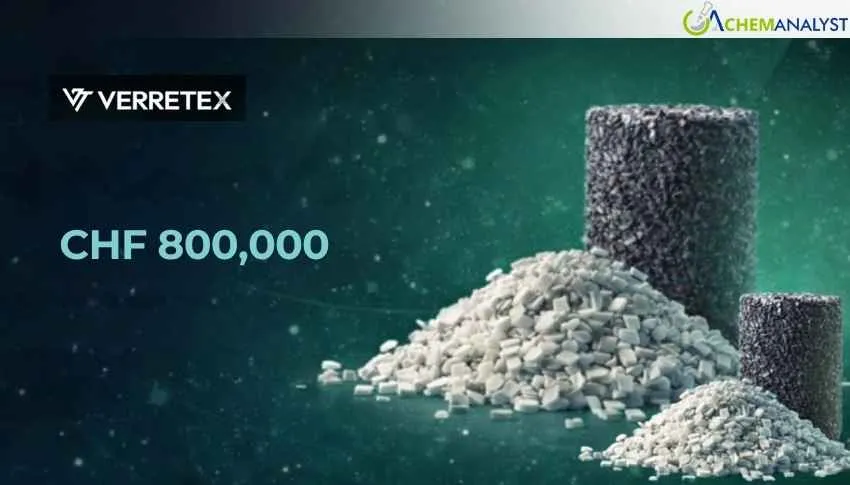
Swiss cleantech startup Verretex has secured substantial funding to accelerate its innovative project focused on upcycling short recycled glass fibres into high-performance thermoplastic composites. The company received CHF 800,000 (approximately US$1 million) in project funding from Innosuisse, the Swiss agency for scientific innovation, for its collaborative efforts with EPFL and OST (Eastern Switzerland University of Applied Sciences). This investment is part of a larger CHF 1.2 million funding round, combining dilutive and non-dilutive capital, aimed at scaling Verretex's industrial production and expanding its market reach.
The project addresses a critical challenge in the composites industry: the treatment of short glass fibres, typically around 10mm, which are often discarded as waste despite the growing momentum for composite recycling in Europe. A significant driving force behind this initiative is the European Union's ban on landfilling decommissioned wind turbine blades, which came into effect at the start of 2026. Furthermore, industries such as wind energy, automotive, aerospace, and marine face increasing pressure from rising costs and tightening sustainability regulations, creating an urgent demand for recycled glass fibre textiles to replace energy-intensive virgin materials. Traditional recycling methods often degrade fibre quality, rendering the output unsuitable for high-performance structural applications, which has historically led to most composite waste being incinerated or landfilled.
Verretex's proprietary upcycling process provides a solution by regenerating end-of-life composite waste into high-performance nonwoven materials. The technology meticulously cleans glass fibres at a microscopic level, restoring their mechanical properties and enabling them to serve as reinforcing fillers in thermoplastics like polypropylene (PP), polybutylene terephthalate (PBT), and polyethylene terephthalate (PET). This process involves surface refunctionalisation, process optimisation, and twin-screw extrusion validation. Crucially, Verretex's solution acts as a "drop-in" replacement for virgin materials, requiring no retooling of existing manufacturing workflows, as demonstrated in a pilot study with wind turbine manufacturer Ryse Energy.
The economic and industry-specific impacts of this project are substantial. Environmentally, it promotes a circular economy, significantly minimizes environmental impact, and reduces the carbon footprint, as avoiding the production of new glass fibre can save 89% of the CO2 emissions associated with fabric production. Economically, the initiative taps into a global recycled glass fibre textiles market projected to reach USD 1.5 billion by 2030, offering a cost-effective and sustainable alternative to virgin materials. Verretex aims to scale its annual production of recycled glass fibres from 500 to 5,000 tonnes through industrial deployment. The project is anticipated to achieve Technology Readiness Level (TRL) 6 by 2028, indicating a demonstration using a prototype in a relevant operational environment. This development marks a significant step towards sustainable material innovation and circularity within the composites industry.







Leave a Comment
Comments (0)