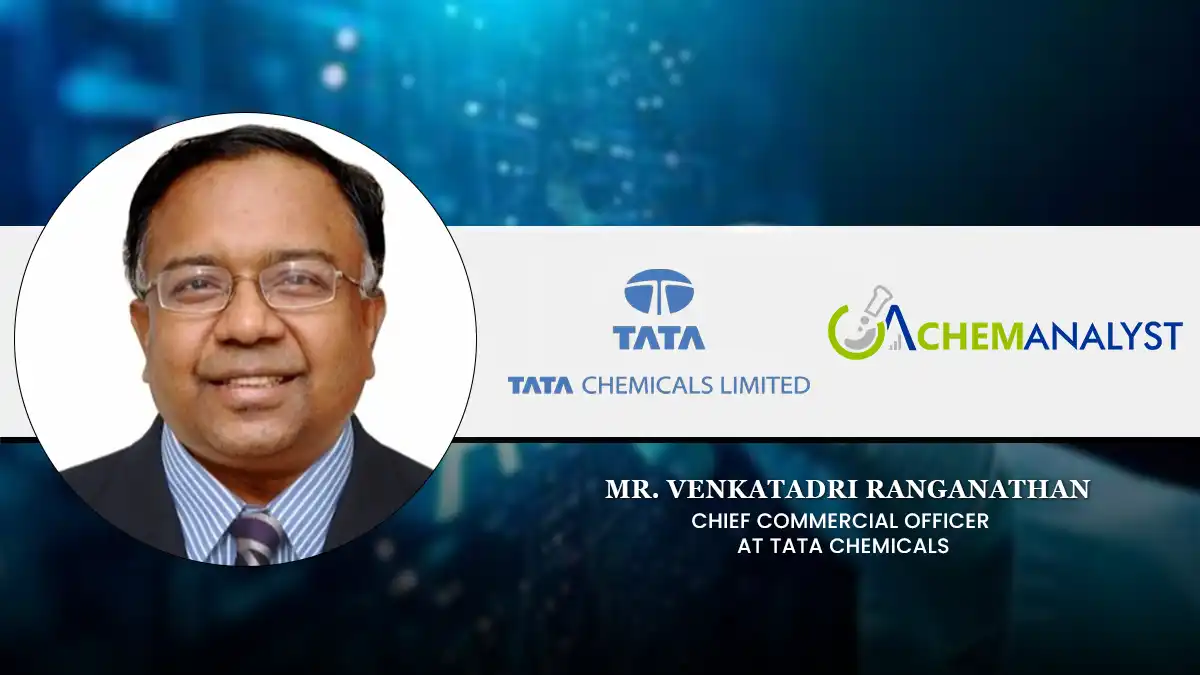
ChemAnalyst Talks with Mr. Venkatadri Ranganathan, Chief Commercial Officer at Tata Chemicals
Tata Chemicals, a leading sustainable chemistry solutions provider and part of the Tata Group, operates across four continents with a strong focus on science-driven innovation and customer-centric solutions. Its diverse portfolio spans basic chemicals and specialty products, supporting industries such as agriculture, food, and advanced materials. ChemAnalyst spoke with Venkatadri Ranganathan, Chief Commercial Officer at Tata Chemicals, about the company’s digital transformation journey in procurement and beyond. Drawing on his leadership experience, Ranganathan highlighted the successful deployment of AI-powered ignio™ Cognitive Procurement (SAKSHAM) in collaboration with Digitate, enabling real-time spend intelligence, improved compliance, and operational efficiency. He emphasized the importance of data readiness, user adoption, and governance in scaling AI solutions globally. Looking ahead, Tata Chemicals aims to expand AI applications across manufacturing, supply chain, and sustainability, leveraging digital twins and advanced analytics to enhance efficiency, reduce emissions, and drive long-term value creation.
Complete Interview with Mr. Venkatadri Ranganathan
Q: How did the collaboration between Tata Chemicals and Digitate come about for the AI-powered spend intelligence solution?
Venkatadri Ranganathan: It felt like a natural partnership because governance, operational agility and procurement are focus areas for Tata Chemicals Ltd (TCL). Digitate’s ignio™ Cognitive Procurement aligned well with TCL vision of building a more intelligent and responsive procurement function. Digitate brings a strong understanding of enterprise-grade AI as well as deep experience in deploying cognitive solutions in complex environments.
The collaboration evolved through shared discussions around how AI could move procurement beyond reporting and automation towards more proactive, insight-driven decision-making. Ignio™ Cognitive Procurement is the result of that journey. It’s a solution shaped jointly around Tata Chemicals’ realities, with Digitate bringing the AI engine and us bringing the functional knowledge, governance and scale.
We successfully deployed ignio™ Cognitive Procurement across all our plants in India as the first phase and have then extended its implementation to our global operations in Kenya, the United Kingdom, and the United States.
Q: What were the key business challenges or inefficiencies that prompted TCL to adopt an AI-driven procurement solution?
Venkatadri Ranganathan: Like in many global manufacturing organisations, the biggest focus areas to address involved fragmented spend data, manual effort in repeat purchases, and limited real-time visibility into compliance and contract adherence. While our teams had access to data, the biggest opportunity we identified was turning that data into actionable insights in a way that was less time-consuming and more proactive.
We also wanted to reduce dependency on manual interventions for routine procurement activities, so teams could focus more on supplier strategy, value creation, and risk management. These opportunities made a strong case for exploring AI-driven solutions that could learn from historical patterns and continuously improve outcomes.
Q: Can you walk us through the early stages of concept development of shaping ignio™ Cognitive Procurement?
Venkatadri Ranganathan: The early work between Tata Chemicals and Digitate was very collaborative. We began with a simple question: “What does good procurement look like at Tata Chemicals in the future?”
From there, we brought together procurement, finance, plant operations and the IT teams for a series of design sessions. Those discussions helped us prioritise the use cases that would help deliver early, tangible value such as repeat purchases, contract leakage, and demand consolidation. Digitate then worked with our data teams to understand our taxonomy, data structures and the realities of our sourcing categories.
Rather than implementing a pre-built product, we co-created a roadmap. Digitate shaped the AI models and reasoning engine, while we ensured the solution reflected our procurement context, policies and business rhythms. This ‘co-design’ approach meant ignio™ Cognitive Procurement was built around the way Tata Chemicals truly works. In TCL, we branded the solution as SAKSHAM – meaning empowerment. This is to signify that the system would empower the procurement teams to do their jobs more effectively and efficiently.
Q: What were some of the major learnings during the pilot and rollout phase of this project?
Venkatadri Ranganathan: AI solutions are only as effective as the quality and consistency of the data they work with, so early attention to data normalisation and integration paid dividends.
To get reliable spend intelligence, we had to invest in cleaning and classifying our spend data and aligning supplier and material taxonomies. That groundwork facilitated SAKSHAM to give us near real-time visibility on patterns such as repeat purchases, contract spend and compliance deviations.
During the rollout phase, we realised that people adopt AI faster when they feel empowered, not monitored. By branding the programme SAKSHAM and embedding insights into everyday procurement workflows, we positioned ignio™ as a support system for buyers and category managers. That subtle shift has been key to scaling the rollout beyond a successful pilot.
We setup champion users in each location and sub-department within procurement, there were regular reviews within TCL and between TCL and Ignio™ to ensure that the progress was continuous and effective.
Q: What kind of effort savings or process improvements have you observed since the implementation? (repeat purchases, contract management, compliance)?
Venkatadri Ranganathan: We’ve seen clear improvements in visibility, compliance, and effort reduction across procurement processes. SAKSHAM now highlights instances where we’re purchasing similar materials through different channels, helping us consolidate demand and strengthen our negotiation position. The system also automatically flags transactions that could have been placed under existing contracts, reducing leakage and improving adherence to negotiated terms.
From a governance standpoint, contract compliance monitoring has become more systematic, reducing leakage and exceptions. This has freed up our teams from chasing exceptions, allowing them to focus more on supplier engagement and developing category insights.
So, while effort savings vary by category, we’ve observed a meaningful reduction in the manual work associated with validation, review, and reporting activities.
Q: What are the next steps in expanding the SAKSHAM initiative to your global operations in Kenya, the UK, and the US?
Venkatadri Ranganathan: When we expanded to our other locations like Kenya, the UK, and the US, the focus was on adapting the solution to local regulatory, supplier, and operating contexts while retaining a common digital backbone. The learnings from the initial implementation helped us to standardise best practices and accelerate deployment in these countries, ensuring consistency without compromising flexibility. With this expansion to all geographies, we are now able to do spend consolidation across categories with common suppliers, thus giving us contracting leverage.
Q: What are some of the biggest challenges organizations face when adopting AI — particularly in traditional, process-heavy industries like chemicals?
Venkatadri Ranganathan: One of the biggest challenges is change management. In process-heavy industries, workflows are often deeply embedded, and there can be hesitation around introducing AI into critical operations.
Another challenge is aligning AI initiatives with clear business objectives. Without a strong use-case-driven approach, AI risks becoming an experiment rather than a value driver. Addressing data quality, user trust, and governance early on is essential for success.
The real hurdle is therefore creating AI solutions that are explainable, governable and embedded into existing risk frameworks, while steadily building skills at the intersection of chemicals, operations and digital.
Q: How is Tata Chemicals leveraging AI beyond procurement — for example, in manufacturing optimization, supply chain, or sustainability tracking?
Venkatadri Ranganathan: Tata Chemicals is moving beyond simple procurement automation to apply AI across manufacturing operations, embedding digital twins and advanced analytics to improve efficiency, reliability, and quality.
In manufacturing, we are working with group partners to deploy AI-driven digital twins at sites such as Mithapur, using real-time data to optimise operating conditions, improve Kiln operations and process efficiency, and provide early warnings that help us avoid unplanned downtime. AI is now getting to a stage where edge cases also being handled significantly better than before.
On the sustainability side, we are increasingly relying on data and AI to get more of a real-time view of our energy use, emissions and resource efficiency in line with the Tata’s Aalingana framework. Our Mithapur unit’s recent AI-related quality awards reflect how embedded this has become in day-to-day operations.
Q: How do you see AI and automation transforming enterprise procurement in the chemical sector over the next few years?
Venkatadri Ranganathan: In the chemical sector, enterprise procurement will move from being largely transactional to becoming a strategic, insight-driven business capability. Routine tasks such as matching invoices and checking contracts will be increasingly automated, as AI will enable real-time spend intelligence, early risk detection, and more informed supplier decisions.
AI and automation will also provide workers in the sector with the tools to focus more on complex scenarios, stakeholder relationships, and judgment-based decision-making where human expertise continues to be critical.
Q: What advice would you give other organizations looking to implement AI in procurement or supply chain management?
Venkatadri Ranganathan: Start with clearly defined business outcomes and prioritise use cases that can deliver quick, measurable value. It’s equally important to invest in data readiness and involve end users early to build trust and adoption. From the AI success stories we’ve seen, AI works best when it complements human expertise and existing processes rather than trying to overhaul an existing process overnight.
Q: You’ve worked extensively across functions — procurement, sales, supply chain, and innovation and also led businesses. Which of these experiences most influenced your leadership philosophy today?
Venkatadri Ranganathan: Every function brings within itself a set of challenges and opportunities to excel in. In the role of a business leader, one has been able to integrate all functional requirements and ensure that business is able to achieve its objective and with the help of a motivated team wanting to excel.
I have always tried to leverage technology – both digital and technical – to ensure that the business or function is able to move to the next orbit.
Q: Having been recognized among India’s top rural marketing professionals and now driving global procurement modernization, how do you see the evolution of leadership in traditional industries like chemicals?
Venkatadri Ranganathan: Today India as a country is on a galloping stage and is poised to become the third largest economy soon. One of the biggest sectors which would help India in this journey is the Chemicals sector. As more manufacturing shifts to India there would be great opportunities. With the Government of India focusing on new age industries like Semi-Conductors, Batteries, chips etc., the chemical sector will play a larger role. The focus of organisation and leaders should be to Think Big, Think Global and Think World Class
Q: Finally, on a personal note — what does “empowerment” mean to you?
Venkatadri Ranganathan: Every human being has aspirations and would like to have a say in his/her area of work. Every member of the team should have the psychological safety to attempt to do things which they are capable and confident of doing. They should not have any hesitation to try things they can do, of course, within the boundary of the organisations system and processes.








 About ChemAnalyst
Leave a Comment
Comments (0)