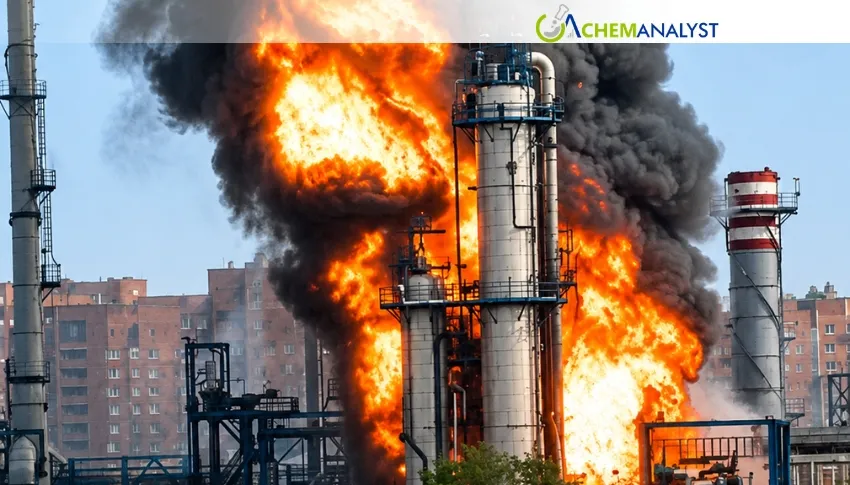
A major Russian helium production facility has reportedly come under attack following a long-range drone strike carried out by Ukrainian forces, marking another significant escalation in the ongoing conflict between the two countries. The strike is said to have targeted the integrated gas processing and helium production complex located in Orenburg, one of Russia’s oldest and most important industrial sites for natural gas processing and helium extraction.
According to statements released by Ukraine’s Special Operations Forces, the overnight operation focused on both the Orenburg Gas Processing Plant and the neighboring Orenburg Helium Plant. Videos shared widely across social media appeared to show flames and smoke rising from the industrial complex, although the full extent of the damage has not yet been officially confirmed. Russian authorities have not provided detailed information regarding the impact of the attack or whether production has been disrupted.
The Orenburg Gas Processing Plant is among Russia’s largest gas processing facilities, with the capability to process as much as 45 billion cubic metres of natural gas annually. This represents approximately 6% of the country’s total gas production capacity, making the complex a strategically significant component of Russia’s energy infrastructure. Alongside the gas processing operations, the adjoining helium plant produces between 100 million and 150 million cubic feet of helium each year, making it one of Russia’s longest-established domestic helium production facilities.
Although the Orenburg complex is considerably smaller than the massive Amur Gas Processing Plant located in eastern Russia, it continues to play an important role in the country’s helium industry. Operated as part of Gazprom’s extensive gas processing network, the facility has remained a dependable contributor to Russia’s helium supply for many years. Industry analysts believe that while any temporary disruption at Orenburg could affect certain supply chains, Russia’s larger helium production assets are expected to compensate for potential production losses over time.
Nevertheless, the incident may create additional uncertainty for helium customers, particularly those relying on consistent deliveries from Russian suppliers. Russia remains one of the world’s leading helium producers, generating approximately 17 million cubic metres of helium annually. This accounts for nearly 10% of global helium production, positioning the country behind only the United States and Qatar in terms of output.
Russia’s helium industry has already experienced considerable volatility in recent years. Even before the outbreak of the Russia-Ukraine conflict, exports were constrained due to prolonged operational issues at key production facilities. One of the most significant setbacks occurred in 2021, when a major fire at the Amur Gas Processing Plant forced an extended shutdown lasting nearly 20 months. The incident substantially reduced Russia’s helium exports during that period.
Following Russia’s invasion of Ukraine in 2022, production gradually recovered as two of the three helium production lines at the Amur facility resumed full operations. By 2025, the country’s annual helium production had climbed to around 20 million cubic metres. Domestic demand remained relatively modest, estimated at approximately four million cubic metres each year, leaving Russia with a considerable export surplus.
A large portion of this excess helium has been directed toward markets that are not subject to sanctions, with China emerging as one of the primary destinations. Chinese buyers have imported significant quantities of Russian helium, in some cases purchasing more than domestic demand requires before re-exporting surplus volumes into international markets. This trading pattern has helped maintain global helium availability despite geopolitical tensions and restrictions affecting Russian exports.
Earlier this year, renewed instability in the Middle East prompted the Russian government to introduce additional controls on helium exports. The temporary measures, which are scheduled to remain in effect until the end of 2027, require exporters to obtain special approval from senior government officials before shipping helium outside the Eurasian Economic Union. These restrictions were introduced to safeguard strategic supplies and strengthen oversight of exports during a period of heightened geopolitical uncertainty.
The reported drone strike on the Orenburg complex adds another layer of uncertainty to the global helium market. While Russia possesses sufficient production capacity elsewhere to offset any localized disruption, continued attacks on critical energy infrastructure could increase logistical challenges and create short-term concerns for international buyers that depend on reliable helium supplies.
Here's a focused ~150-word analysis on helium:
________________________________________
Impact on Helium Prices After the Orenburg Strike
The drone strike on the Orenburg Helium Plant — which produces 8.8 million cubic metres of helium per year — is a significant supply-side shock to global helium markets.
Before this strike, Russia had been flooding non-sanctioned markets like China with surplus helium, with China re-exporting volumes into international markets. Any confirmed damage breaks this supply chain immediately, removing a meaningful volume from an already tight global market.
Russia had also recently imposed export controls on helium effective until end-2027, requiring special government permission for exports outside the Eurasian Economic Union. Combined with this physical disruption, both policy and supply factors are now simultaneously bearish for availability.
Helium consultant Richard Brook noted the facility is "still of some consequence" to Russia's energy markets if damage is confirmed.
For ChemAnalyst-tracked helium prices, expect a near-term bullish spike, particularly in Asian spot markets, with semiconductor, medical imaging (MRI), and aerospace end-users facing tighter supply and higher procurement costs.







Leave a Comment
Comments (0)