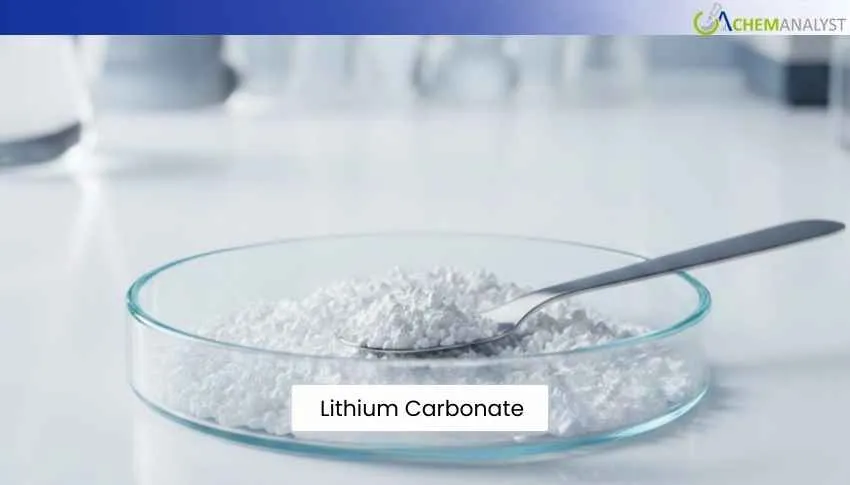
US lithium carbonate prices eased in early February, slipping 1.53% after an exceptionally strong January, which saw month-on-month gains of roughly 46.47%, according to ChemAnalyst data. The pullback represents a short-lived recalibration following a sustained buying wave through January, when procurement teams and spot buyers aggressively chased battery-grade material. Market tone remains fundamentally bullish, underpinned by compliance-related front-loading and constrained available offers, but the early-February move reflects modest profit-taking and the first sign of price consolidation after rapid advances.
Demand for lithium carbonate across the automotive and battery-manufacturing segments continued to underpin market strength. The automotive sector remained strong as automakers front-load purchases to meet the Inflation Reduction Act’s 40% North American-origin mineral threshold, supporting offtake for NMC and LFP cathodes as well as EV battery packs. In contrast, there were few meaningful demand weak spots to absorb the surge; battery manufacturing and utility-scale energy-storage procurement also held firm.
Capacity additions have intensified demand pull for lithium carbonate, particularly from Tesla’s Austin facility. Operating rates at LG Energy Solution’s Holland, Michigan, line have also increased, adding further pressure to near-term requirements. These expansions are anticipated to elevate short-term procurement for battery-grade lithium carbonate. Stronger production schedules are prompting buyers to secure volumes earlier than usual. As a result, spot demand is expected to remain firm in the immediate term.
Supply dynamics have amplified the bullish tilt. Sellers of lithium carbonate reported reduced offer volumes as landed costs for certain import cargoes rose, prompting tighter spot availability. Persistently low regional supply of lithium carbonate in Asia and still-limited domestic production were cited as shaping expectations of continued tightness, while elevated import costs from policy changes abroad squeezed workable volumes.
Weekly patterns showed a torrid January of back-to-back strong weeks before the market paused in early February. As per the weekly assessment, prices of lithium carbonate recorded several double-digit weekly gains through January as buyers front-loaded requirements, then edged lower in the first week of February as some participants booked profits and re-assessed near-term needs for lithium carbonate supplies. The early-February decline in lithium carbonate prices was modest relative to January’s rapid advance and is best viewed as a consolidation rather than a reversal of the underlying trend.
Looking ahead, the near-term outlook for lithium carbonate prices is expected to remain firm and supported based on current market trends. Compliance-driven buying under the Inflation Reduction Act, sustained EV and energy-storage procurement, and recent capacity expansions are expected to keep material pull elevated, while higher landed costs for certain import origins could continue to restrict sellers’ willingness to offer large volumes.







Leave a Comment
Comments (0)