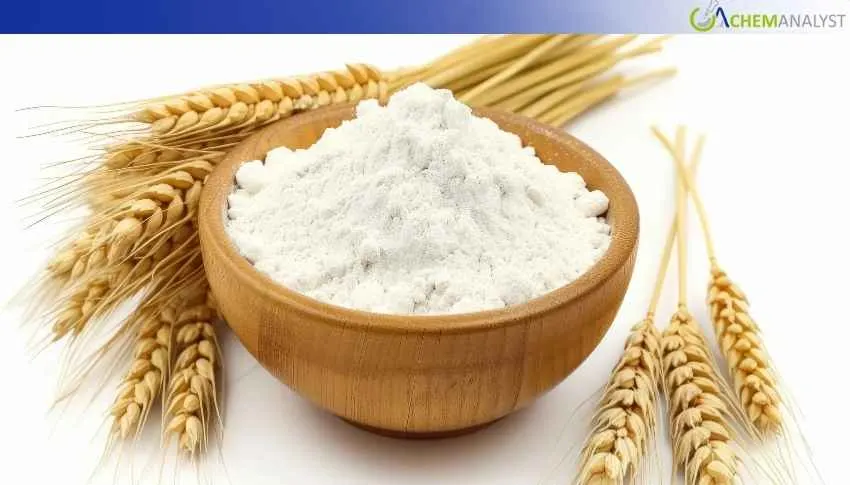
Moving forward across November 2025, the Import prices for wheat starch within the U.S. market continued a multi-month trend of weakness with prices dropped at a steady rate and by 0.74% owing to the weaker regional purchasing for wheat starch, easing logistic pressures and abundant supplies from major exporting regions weighed on prices.
Downstream suppliers and the trades mentioned that ahead of earlier increased supplies overseas, stable freight rates, and improved wheat starch demand-supply efficiency in the U.S. contributed to a more flexible buying sentiments which continue to weigh on prices across import market prices. Market analysts also pointed forward contracts placed earlier in the year by several large food and industrial manufacturers, reducing urgency in the wheat starch spot market and further moderating import price levels.
Combined, these factors produced an environment in which sellers remained willing to concede on wheat starch price to maintain volume flows during an otherwise slow seasonal period. Against the continued falls seen throughout November, market participants nonetheless stressed the downtrend is not likely to carry on unabated into December. Early signs of wheat starch firmer pricing are at least partly underpinned by expectations of fresh buying interest over the coming weeks, as major processors look to restock ahead of first-quarter production cycles.
Analysts highlighted that December is likely to bring a reassessment of feedstock buying, with food, adhesives, paper, and fermentation collectively accounting for the majority of U.S. wheat starch demand.
As companies prepare to increase operational throughput at the start of the new year, demand for imported wheat starch is expected to increase modestly, opening an opportunity for suppliers to progressively raise prices from the November lows. This anticipated rebound is further supported by forecasts of tighter export availabilities for wheat starch from key markets, where producers adjust supply in response to earlier oversaturation.
Another factor that could contribute to December's upward movement is the changing currency landscape. The stabilization of the euro and strong Asian regional currencies relative to the U.S. dollar place upward cost pressure on wheat starch import transactions and make lower November price levels less tenable. Furthermore, several maritime carriers have indicated that freight rates may be adjusted in response to heightened year-end demand for shipping lanes, especially containerized agricultural and industrial inputs.
While none of these logistical cost changes is expected to be dramatic, they may contribute incrementally to firmer landed prices in December.
Market participants also refer to ongoing geopolitical considerations, including regulatory revisions in certain export nations that could impact wheat by-product, particularly wheat starch allocation. Early indications are that more restrictive supply management policies may indeed be put in place in some areas to protect the wheat starch domestic downstream industries, reducing the volume available for export.
Anticipating these conditions, U.S. importers are setting the stage for a moderate tightening in supply that, combined with seasonal inventory rebuilding, is expected to push contract values higher entering December.
While the November market was unmistakably buyer-friendly, analysts now warn that the oncoming uptrend in wheat starch prices should be seen as stabilization, not a spike. Prices can be expected to gradually increase through December, based on balanced fundamentals rather than sudden external shocks. For now, the stakeholders in the industry continue to watch global production updates for wheat and its byproduct- wheat starch, freight market behavior, and end-user demand patterns to see how quick and sustainable the forecast upward movement is. If these unfold as expected, the U.S. wheat starch market would enter early 2026 with a more normalized price environment following the extended softness recorded in November.







Leave a Comment
Comments (0)