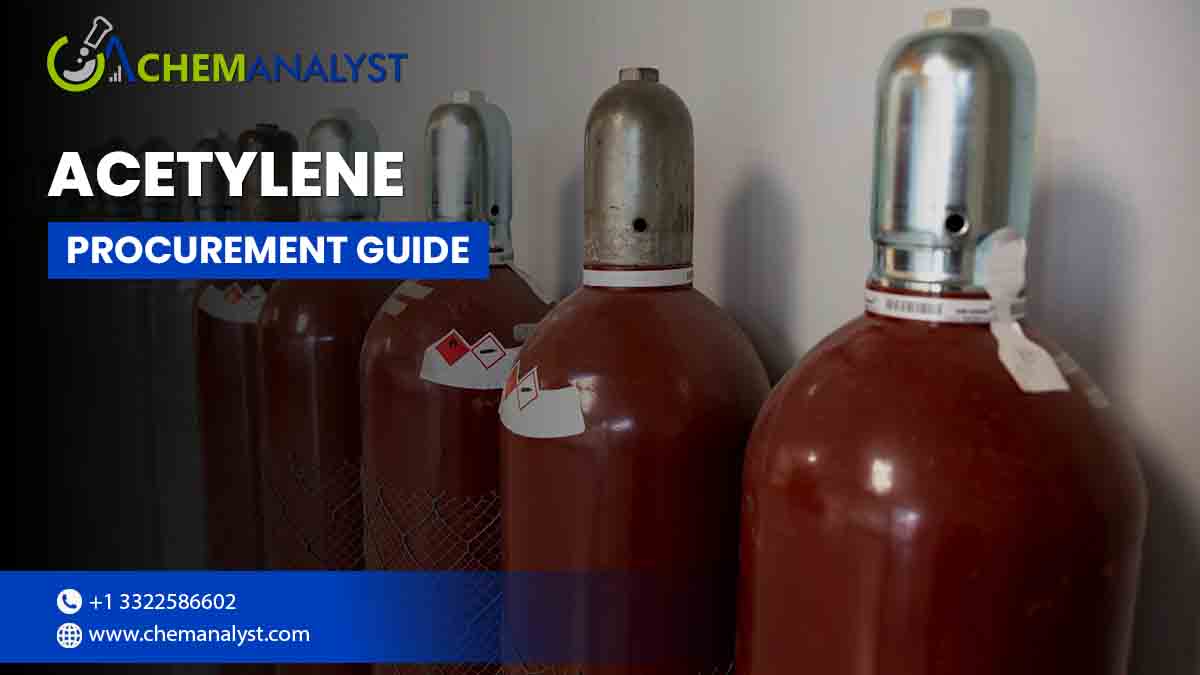
Acetylene Procurement Guide for Professionals

Acetylene Procurement Guide for Professionals

Francis Stokes 22-Dec-2025

Welcome to the comprehensive Acetylene Procurement Guide. This document is specifically tailored for procurement managers in the industrial gas, chemical manufacturing, and metal fabrication sectors who oversee the sourcing of Acetylene (C2H2). As the simplest alkyne and a high-energy fuel gas, acetylene presents unique challenges due to its extreme flammability, instability at high pressures, and critical role in both heavy industry (welding) and fine chemical synthesis.

1. Understanding Acetylene

Acetylene (Ethyne) is a colorless, highly flammable gas known for its triple bond structure, which makes it chemically reactive and energy-dense. It produces the hottest flame of any common hydrocarbon gas (approx. 3,150°C), making it indispensable for oxy-fuel cutting and welding. In the chemical industry, it serves as a vital C2 building block for producing versatile polymers and solvents.

  • Chemical Formula: C2H2 (HC≡CH)
  • Key Properties:
  • Instability: Acetylene is thermodynamically unstable and can decompose explosively into carbon and hydrogen if compressed above 15 psig (approx. 1 bar gauge) without a stabilizing solvent.
  • Storage Method: To transport it safely, acetylene is dissolved in a solvent (usually acetone or DMF) within a cylinder packed with a porous mass (like calcium silicate). This "Dissolved Acetylene" (DA) prevents the propagation of decomposition.
  • Odor: Pure acetylene is odorless, but commercial grades have a distinctive garlic-like smell due to impurities like phosphine.
  • Production Methods:

Calcium Carbide Process (Traditional): The reaction of water with calcium carbide (CaC2 + 2H2O → C2H2 + Ca(OH)2). This remains the dominant method for generating acetylene for welding and local industrial use.

Thermal Cracking / Partial Oxidation: For large-scale chemical synthesis, acetylene is produced by the partial oxidation of natural gas (methane) or as a by-product of ethylene cracking. This yields higher purity gas suitable for chemical feedstocks.

2. Key Procurement Considerations

2.1 Grade Selection

Procuring the correct grade is not just a matter of purity but of safety and application suitability:

  • Industrial / Welding Grade (98.0%+): The standard grade for metal cutting, welding, and heat treating. The primary impurities are air, phosphine, and hydrogen sulfide, which do not affect flame temperature significantly but must be kept within safe limits.
  • Chemical Synthesis Grade (99.0% - 99.5%): Required for "Reppe Chemistry" and other organic syntheses (e.g., producing 1,4-butanediol or vinyl esters). Impurities like sulfur and phosphorus must be minimized to prevent catalyst poisoning.
  • Atomic Absorption (AA) Grade (99.6%+): A high-purity grade specifically for flame atomic absorption spectroscopy. Low background noise and minimal metallic impurities are critical for accurate trace-metal analysis.
  • Electronic Grade (99.99%+): Ultra-high purity used in semiconductor manufacturing (carbon source for deposition).

2.2 Packaging & Safety Specifications

Acetylene procurement is synonymous with cylinder management:

  • Cylinders: Must contain a porous mass (monolithic filler) and a solvent (acetone). The integrity of this internal structure is vital for preventing explosions.
  • Safety Regulations: Procurement must ensure vendors comply with CGA G-1, ISO standards, and local transport laws (DOT Class 2.1).
  • Handling: Cylinders must always be stored and used in an upright position to prevent the liquid solvent from being drawn out with the gas.

3. Regional Sourcing Strategy

  • Americas (Linde, Praxair, Airgas, Matheson): The market is consolidated among major industrial gas giants. Sourcing is typically local/regional due to the high cost and risk of transporting heavy cylinders over long distances.
  • Europe (Linde, Air Liquide, Messer, Nippon Gases): A mature market with a strong focus on high-purity grades for the chemical and analytical sectors.
  • Asia-Pacific (BOC China, Taiyo Nippon Sanso, Air Water Inc.): China dominates the chemical acetylene market (carbide-based) for PVC and BDO production. Japan leads in high-purity electronic grades.

4. Application-Specific Selection Guide

The table below outlines recommended grades and suppliers based on specific industrial applications.

Application

Recommended Grade

Key Standards

Supplier by Region

Basic Properties

Oxy-Acetylene Welding

Industrial Grade (98%)

CGA G-1 / AWS

US: Airgas
EU: Air Liquide

Max flame temp (3100°C)
High heat release

1,4-Butanediol (BDO)

Chemical Grade (99%+)

Manufacturer Spec

China: Sinopec
EU: BASF (Captive)

Feedstock
Low sulfur/phosphine

Atomic Absorption (AA)

AA Grade (99.6%)

Inst. Grade

Global: Linde
Global: Messer

Low background noise
Consistent burn

Glass Manufacturing

Industrial Grade

ISO 14175

Global: Air Products
Asia: Taiyo Nippon

Carbon coating (mold release)
Lubricity

Pharmaceutical Intermediates

Chemical Synthesis Grade

GMP Compliance

EU: Solvay
US: Praxair

Ethynylation reagent
High purity

Acrylic Acid Synthesis

Chemical Grade

Reppe Chem Spec

Global: Major Gas Cos
China: Local Carbide

Carbonylation feedstock
Catalyst safe

Metal Heat Treating

Industrial Grade

AMS 2759

US: Matheson
EU: Nippon Gases

Carburizing atmosphere
Surface hardening

Research & Lab

Research Grade (99.9%+)

High Purity

Global: Merck/Sigma
Global: Air Liquide

Defined impurity profile
Trace analysis

Vinyl Chloride (VCM)

Chemical Grade

ASTM D2035

China: Xinjiang Tianye
Asia: Integrated

Carbide route feedstock
Mercury catalyst use

Carbon Black

Industrial Grade

Standard

Global: Local Supply

Thermal decomposition source
Acetylene black

Plastic Welding

Industrial Grade

-

Global: Welding Supply

High temp source
Controlled flame

Electronic Deposition

Electronic Grade 5.0

SEMI Spec

Global: Linde Electronics
Asia: Showa Denko

Carbon source
Ultra-low metals


5. Cost Optimization Strategies


  • Cylinder Economics: The cost of acetylene is often outweighed by cylinder rental fees and delivery surcharges. For high-volume users, negotiating "bulk pack" (manifolded cylinder pallets) rates or investing in owned cylinders can reduce long-term opex.
  • Calcium Carbide pricing: For chemical synthesis users (especially in China), the price of acetylene is directly pegged to coal and electricity costs (via the carbide route). Monitoring energy indices is crucial.
  • On-Site Generation: For massive consumption (e.g., a large welding shop or chemical plant), installing an on-site acetylene generator (carbide-to-water) can be far cheaper than buying bottled gas, eliminating logistics costs.

6. Quality Assurance Checklist

Safety and purity are non-negotiable:

  • Purity Verification: Check the Certificate of Analysis (CoA) for phosphine (PH3) and hydrogen sulfide (H2S) levels. These impurities can lower weld quality and poison chemical catalysts.
  • Cylinder Inspection: Verify hydrostatic test dates. Ensure valves are clean and free of oil/grease (which can ignite spontaneously with high-pressure oxygen).
  • Solvent Carryover: Ensure the gas is not carrying over acetone spray, which can damage regulators and contaminate the flame or reaction. This often happens if cylinders are used horizontally or drawn down too fast.

7. Common Procurement Pitfalls to Avoid

CRITICAL SAFETY WARNING:

  • Incompatible Materials: Never use copper piping or fittings (with >65% copper content) for acetylene. It reacts to form copper acetylide, a highly explosive compound that can detonate from shock or friction.
  • Pressure Limits: Ensure all regulators and downstream equipment are rated for acetylene. Never exceed 15 psig (1 bar) outlet pressure.
  • Storage Errors: Storing cylinders in unventilated areas or near oxidizers (oxygen cylinders) without separation walls is a major fire code violation.
  • Ignoring Withdrawal Rates: Drawing gas too fast (>1/7th of cylinder capacity per hour) causes acetone to withdraw with the gas. Procurement must size the cylinder bank correctly for the peak flow rate, not just total volume.

8. Next Steps for Procurement

  • Audit Consumption Profiles: Determine your peak flow rates to ensure you are renting the correct cylinder sizes and manifold configurations to prevent acetone carryover.
  • Review Safety Compliance: Work with EHS to ensure your facility's storage cages, piping materials (no copper!), and flashback arrestors meet local fire codes before signing a supply contract.
  • Regional Vendor Consolidation: Since gas transport is expensive, consolidate spend with a primary regional gas supplier to leverage better delivery frequencies and rental terms.

9. Conclusion

Acetylene is a unique commodity where "procurement" is inextricably linked to "safety engineering." It is not just about buying a gas; it is about buying a safe delivery system. The risks associated with its instability mean that supplier reliability, cylinder quality, and technical support are far more valuable than marginal price savings.

To navigate the volatile energy and carbide markets that drive acetylene pricing, leverage ChemAnalyst benchmarking data. Their insights into regional feedstock costs and supply chain disruptions will empower you to make informed, safe, and cost-effective sourcing decisions.

Disclaimer: This guide is for informational purposes only. Acetylene is an extremely hazardous material. Always strictly follow CGA, ISO, and local safety regulations. Consult with certified safety professionals for handling and storage system design.


Tags:

Acetylene

We use cookies to deliver the best possible experience on our website. To learn more, visit our Privacy Policy. By continuing to use this site or by closing this box, you consent to our use of cookies. More info.