Global Phosphoric Acid Market Size and Growth Forecast
Global Phosphoric Acid Market is projected to grow from USD 56595 million in 2025 to USD 96697 million by 2036, registering a CAGR of 5.54% during the forecast period. Chemically defined as orthophosphoric acid (H3PO4), this tribasic mineral acid is predominantly manufactured via the wet process, mirroring the heavy industrial acidulation techniques of the broader fertilizer sector but replacing the energy-intensive combustion of elemental phosphorus found in thermal processing with the chemical digestion of tricalcium phosphate rock using concentrated sulfuric acid to precipitate calcium sulfate. Functionally, the material offers distinct competitive advantages over aggressive mineral acids like hydrochloric or nitric acid, specifically through its non-oxidizing nature that provides superior metal passivation by forming insoluble phosphate barriers on steel surfaces, coupled with exceptional sequestering properties and pH buffering capabilities critical for food preservation and technical electrolytes. The market’s expansion is fundamentally anchored by the non-discretionary global demand for food security, which necessitates vast volumes of ammonium phosphate fertilizers in the agrarian economies of Asia-Pacific and South America, while the simultaneous tightening of environmental regulations promotes the use of purified phosphoric acid in water treatment and the burgeoning semiconductor industry, driving sustained economic momentum across these key regional hubs.
Phosphoric Acid Applications in Packaging and Construction Industries
Phosphoric acid serves as the fundamental backbone of the global agricultural sector, primarily utilized in the production of phosphate fertilizers such as Diammonium Phosphate (DAP) and Monoammonium Phosphate (MAP) due to its ability to chemically convert insoluble phosphate rock into bioavailable nutrients critical for maximizing plant root development, photosynthesis, and crop yields. Beyond this dominant agricultural baseload, demand is increasingly driven by high-purity thermal grade applications in the food and beverage industry, where the material is prized as a premier acidulant and preservative for its distinct tartness and chemical capacity to sequester metal ions, thereby preventing oxidation and extending shelf life in carbonated soft drinks and processed consumables. The market is simultaneously undergoing a technical transformation fueled by the rapid electrification of the automotive sector, as high-purity phosphoric acid becomes an essential precursor in the synthesis of Lithium Iron Phosphate (LFP) battery cathodes, a technology chosen for its superior thermal stability, safety profile, and cost-efficiency compared to nickel or cobalt-based alternatives. Industrial consumption remains bolstered by the acid’s specific utility in metal treatment, where it is leveraged to convert iron oxide into stable ferric phosphate layers, providing exceptional corrosion resistance and surface adhesion for subsequent coating processes. Consequently, the global landscape is witnessing a robust trajectory of expansion, sustained by the parallel necessities of intensifying agricultural productivity to support population growth and the surging industrial requirement for advanced materials in energy storage and surface finishing.
Global Phosphoric Acid Market Segmentation by Resin Type and End-Use Application
The global phosphoric acid market is intricately segmented based on production process, grade, and end-use application, primarily categorized into fertilizers, animal feed, food and beverages, water treatment, and specialized industrial sectors such as electronics and metal treatment. Among these divisions, the fertilizer segment currently retains a commanding lead in the market, a position fundamentally secured by the critical necessity of phosphorus as a macronutrient in modern agriculture and the extensive global consumption of products like Diammonium Phosphate (DAP) and Monoammonium Phosphate (MAP). This dominance is reinforced by the cost-effectiveness and scalability of the wet-process production method, which satisfies the immense volumetric requirements of the agrarian sector to support global food security without necessitating the ultra-high purity levels required in non-agricultural applications. Conversely, the high-purity industrial and electronic grade segment is identified as the fastest-growing category, propelled significantly by the burgeoning electric vehicle ecosystem's demand for Lithium Iron Phosphate (LFP) batteries and the semiconductor industry's requirement for precision etching agents. This expansion is technically driven by the chemical's superior thermal stability and specific electrochemical properties essential for synthesizing cathode materials, alongside its sustained adoption as an acidity regulator and preservative in carbonated beverages and processed food formulations.
Asia-Pacific's Dominant Role in the Global Phosphoric Acid Market
Asia-Pacific currently holds the undisputed leading position in the global phosphoric acid market, leveraging its status as both the world’s primary production hub and its most significant consumption base. This regional dominance is fundamentally anchored in the intense agricultural requirements of its agrarian economies, where government-backed initiatives, such as the comprehensive nutrient-based subsidy frameworks in high-population nations, relentlessly drive the procurement of phosphate derivatives to ensure national food security. Concurrently, strategic resource policies in major manufacturing jurisdictions have prioritized domestic availability over exports, stabilizing local supply chains while incentivizing the modernization of extraction and processing infrastructure to meet rigorous environmental standards. Beyond its traditional reliance on fertilizers, the region is aggressively spearheading the diversification of the chemical's utility, pivoting toward high-tech applications; specifically, the surging industrial emphasis on clean energy has catalyzed a unique regional demand for high-purity phosphoric acid as a critical precursor for Lithium Iron Phosphate (LFP) batteries, effectively cementing the area's role as the epicenter for the electric vehicle material supply chain.
Key Players in the Global Phosphoric Acid Market
Major players in the Global Phosphoric Acid market are Mosaic Company, Nutrien, OCP Group, Potash Corporation of Saskatchewan, Others(Mianyang Venus Phosphorus Chemical Co., Ltd., Sichuan Blue Ocean Chemical (Group), Yunnan Nanlin Group)
Recent Developments and Strategic Initiatives (2025)
The global phosphoric acid market has seen a wave of verified capacity expansions and strategic integration projects from late 2024 through early 2026. In March 2025, OCP Group commissioned a new phosphoric acid treatment unit with a daily capacity of 1,500 tonnes of P2O5, significantly enhancing its downstream processing capabilities. Parallel to this, Coromandel International advanced its backward integration strategy in India, progressing with the construction of a 650 tonnes-per-day phosphoric acid plant at its Kakinada complex, which is targeted for commissioning by early 2026. Regional consolidation also accelerated in the Middle East, where Jordan Phosphate Mines Company (JPMC) and Arab Potash Company signed an agreement in August 2025 to develop a USD 600 million industrial complex dedicated to purified phosphoric acid; JPMC further committed capital in February 2026 for a sulfuric acid facility designed to support an increase in its phosphoric acid production capacity to 550,000 tons annually.
Years considered for this report:
Historical Period: 2015-2024
Base Year: 2025
Estimated Year: 2026
Forecast Period: 2026-2036
This report will be delivered through an online digital platform with a one-year subscription, along with quarterly updates.
Objective of the Study:
• To assess the demand-supply scenario of the Phosphoric Acid, covering production, demand, and supply at the global level.
• To analyze and forecast the market size of Phosphoric Acid
• To classify and forecast the Global Phosphoric Acid market based on end-use industries and regional distribution.
• To examine competitive developments in the global Phosphoric Acid market, such as expansions, mergers & acquisitions, and other strategic initiatives.
Research Methodology: How Was the Phosphoric Acid Market Data Collected?
To extract data for the Global Phosphoric Acid market, primary research surveys were conducted with Phosphoric Acid manufacturers, suppliers, distributors, wholesalers, and traders. During the interviews, respondents were also asked about their competitors.Through this approach, ChemAnalyst was able to identify and include manufacturers that could not be captured through secondary research due to its limitations.Moreover, ChemAnalyst analyzed various market segments and projected a positive outlook for the Global Phosphoric Acid market over the coming years.
ChemAnalyst calculated the global demand for Phosphoric Acid by analyzing the volume consumed by end-user industries. The forecast was developed based on the growth rates of these end-use industries. These values were obtained from industry experts and company representatives and were externally validated by analyzing the historical sales data of respective manufacturers to determine the overall market size. Additionally, various secondary sources, such as company websites, association reports, and annual reports, were reviewed by ChemAnalyst.
Key Target Audience for This Report
• Phosphoric Acid manufacturers and other industry stakeholders
• Organizations, forums, and alliances related to Phosphoric Acid distribution
• Government bodies, including regulatory authorities and policymakers
• Market research organizations and consulting firms
The study provides insights into several critical ques tions relevant to industry stakeholders, including Phosphoric Acid manufacturers, customers, and policymakers. It also helps identify high-growth segments over the coming years, thereby supporting stakeholders in making informed investment decisions and facilitating strategic expansion.
Report Scope and Market Segmentation Framework
In this report, the Global Phosphoric Acid market has been segmented into the following categories. In addition, key industry trends have been detailed below:
Attribute
Details
Market size Value in 2025
USD 56595 Million
Market size Value in 2036
USD 96697 Million
Growth Rate
CAGR of 5.54% from 2026 to 2036
Base year
2025
Estimated year
2026
Historical Data
2015 - 2024
Forecast period
2027 - 2036
Quantitative units
Demand in thousand tonnes and CAGR from 2026 to 2036
Report coverage
Capacity By Company, Capacity by Location, Production by Company, Demand by End- Use, Demand by Region, Demand by Sales Channel, Demand-Supply Gap, Company Share, Foreign Trade
Segments covered
By End-Use: (Fertilizers, Feed and Food Additives, and Others) By Sales Channel: (Direct Sale and Indirect Sale)
Regional scope
North America, Europe, Asia Pacific, Middle East and Africa, and South America.
Market Data & Insights
Table of Content
1. Capacity By Company
On our online platform, you can stay up to date with essential manufacturers and their current and future operation capacity on a practically real-time basis for Phosphoric Acid.
2. Capacity By Location
To better understand the regional supply of Phosphoric Acid by analyzing its manufacturers' location-based capacity.
3. Production By Company
Study the historical annual production of Phosphoric Acid by the leading players and forecast how it will grow in the coming years.
4. Demand by End- Use
Discover which end-user industry (Fertilizers, Feed and Food Additives, and Others) are creating a market and the forecast for the growth of the Phosphoric Acid market.
5. Demand by Region
Analyzing the change in demand of Phosphoric Acid in different regions, i.e., North America, Europe, Asia Pacific, Middle East and Africa, and South America, that can direct you in mapping the regional demand.
6. Demand by Sales Channel (Direct and Indirect)
Multiple channels are used to sell Phosphoric Acid. Our sales channel will help in analyzing whether distributors and dealers or direct sales make up most of the industry's sales.
7. Demand-Supply Gap
Determine the supply-demand gap to gain information about the trade surplus or deficiency of Phosphoric Acid.
8. Company Share
Figure out what proportion of the market share of Phosphoric Acid is currently held by leading players across the globe.
9. Country-wise Export
Get details about the quantity of Phosphoric Acid exported by major countries.
10. Country-wise Import
Get details about quantity of Phosphoric Acid imported by major countries.
I am satisfied with overall performance of ChemAnalyst. Weekly updates before the final report were especially helpful and reassuring. Additional requests on the interim and/or final reports were handled in a swift and professional manner
Mr.Shin Dosho
Member - Board of Directors
Osaka Gas Co. Ltd
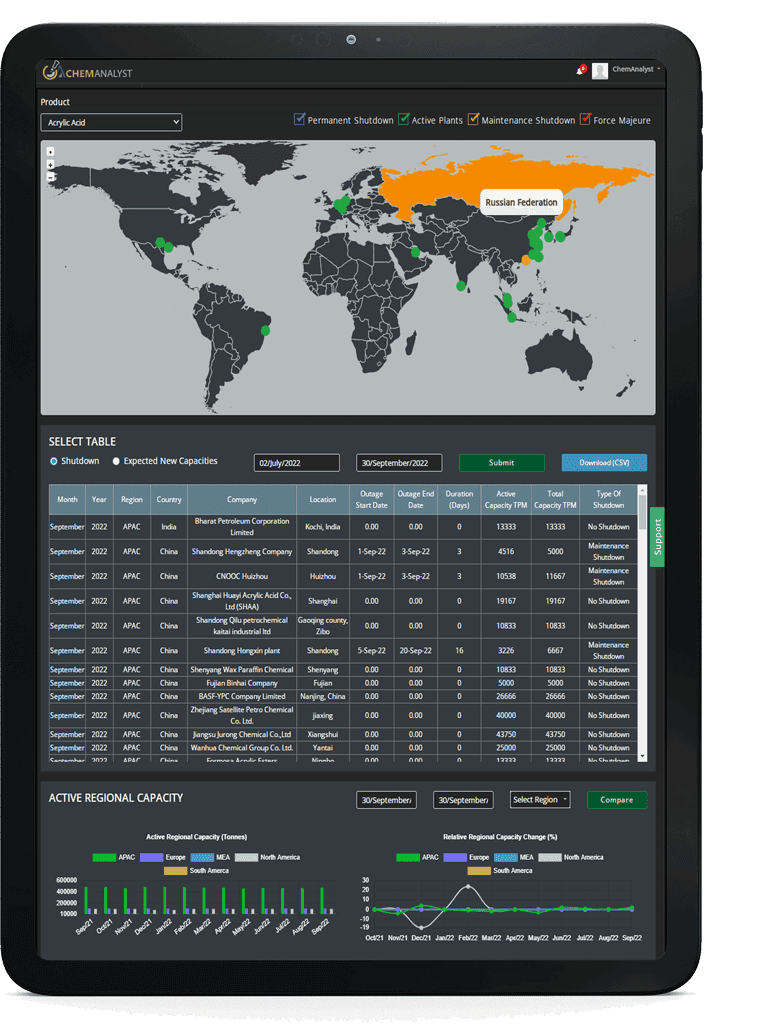
Disruption Tracker
Disruption Tracker reflect the major shutdown on monthly basis which will help you in
tracking the inventory management and smooth functioning of business. Unforeseen shutdowns and disruptions
resulting in a loss of production capacity to impact the bottom line. The capacity tracker provides industries
with a global view of production and consumption capacity loss that reflects the corresponding conversion factors.
It also highlights the immediate impact on supply due to planned and unplanned outages as well as upcoming start-up
of new capacities. Additionally, it emphasizes how each shutdown—whether due to a maintenance turnaround or a case
of force majeure, affects the plant's operating rate for the given duration. Disruption tracker gives a clear insight
into the worldwide outages affecting the commodity of interest. With every shutdown, it also reflects the impact on
supply of the product in the market at a Global level.
The Global Phosphoric Acid Market was valued at USD 56595 million in 2025 and is projected to reach USD 96697 million by 2036, growing at a CAGR of 5.54% during the forecast period.
Major players include Mosaic Company, Nutrien, OCP Group, Potash Corporation of Saskatchewan, Others(Mianyang Venus Phosphorus Chemical Co., Ltd., Sichuan Blue Ocean Chemical (Group), Yunnan Nanlin Group).
The report covers market sizing and forecasting (2015–2036), segmentation, regional analysis, competitive landscape, and recent strategic developments. It also offers solutions including Custom Research for tailored business strategies.
Our Solutions
Custom Research
We at ChemAnalyst provide tailor-made solutions to our clients based on their requirements which help them in building and expanding their business by developing customized strategy such as sales strategy, GTM Strategy, product portfolio and new product development. Our dedicated team helps clients in getting the best solution for their requirements. We at ChemAnalyst look forward to serving our clients for long term association.
Techno Economic Feasibility Report (TEFR)
ChemAnalyst provide TEFR reports which include market sizing, plant cost (ISBL and OSBL units), financial modelling, covering all the major financial calculations and ratios including production cost, IRR, major technology, licensing fee (if required), and others fixed and variable costs. TEFR reports will help the client to build greenfield project as well as brownfield expansion for a specific geography. Our Team of experts have delivered multiple TEFR reports which help clients in moving ahead of their business competition by grabbing the opportunity and expanding their business portfolio.
Price Benchmarking
Pricing benchmark report provides real-time data perpetuating current market scenarios, in a world that is changing at a rapid pace, having real-time prices is an imperative to make impactful insights and thereby informed decisions. The Price Benchmarking report provides pricing data for an individual market, or group of markets, which can be converted into localized insights and comparable listings. Benchmarking Reports help clients to make informed decisions by construing the data on several filters: region, country, category, grade and subsequently increasing their brand presence. Clients majorly require pricing benchmarks when they opt for a competitive pricing strategy.
We use cookies to deliver the best possible experience on our website. To learn more, visit our
Privacy Policy.
By continuing to use this site or by closing this box, you consent to our use of cookies.
More info.