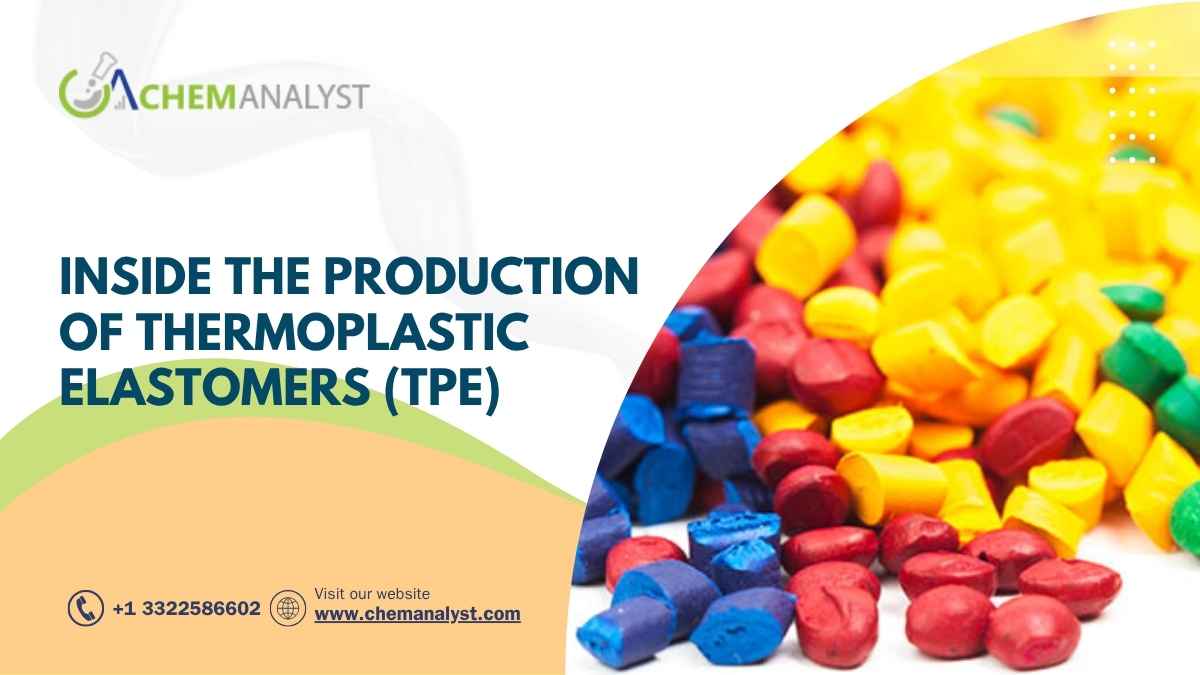
Summary Thermoplastic Elastomers (TPEs) offer rubber-like flexibility with plastic processability, making them essential in automotive, electronics, and medical sectors. Understanding their production helps manufacturers optimize costs, lower emissions, and ensure product quality, sustainability, and scalability in evolving global markets.
I. Introduction
Thermoplastic Elastomers (TPEs) are now an absolute necessity in all modern industries because of their special capability to achieve rubber-like elasticity along with the processing benefits of plastics. TPEs are used extensively in automotive components, consumer electronics, medical devices, and footwear. Knowing the manufacturing process of TPEs is vital—not only for achieving maximum cost-effectiveness, but also for controlling carbon emissions and achieving process scalability. From raw material selection to the ultimate compounding stage, each step is pivotal in defining product performance, sustainability indices, and conformance to international quality benchmarks. This blog delves into the complex manufacturing process of TPE and identifies pivotal technologies, materials, and innovations that are defining its destiny.
II. Overview of the Production Process
The manufacture of TPEs is done through batch or continuous processing, depending on the product grade, amount desired, and technological capacity of the plant. Batch processing adds raw material in defined ratios and treats it in controlled batches suitable for specialty grades. Continuous processing, however, is best suited for production on a large scale because of efficiency and uniformity. The process of transformation may involve polymerization, blending, and extrusion or pelletizing. Polymer backbones are formed or altered in the process, commonly through grafting, crosslinking, or dynamic vulcanization processes. The yield of the process is typically high and has few solid by-products, but some volatiles or off-spec residues might need post-treatment.
The diagram Fig a.) Overview of production & Fig b.) Process Flow Diagram (PFD)


The production of TPE is based on a selection of well-specified raw materials. The essential inputs are polyolefins (e.g., polypropylene or polyethylene), styrenic block copolymers (SBCs), elastomeric rubbers (e.g., EPDM or butadiene rubber), and thermoplastic resins. Purity and availability of these materials—particularly olefins and elastomers—play an important role in determining product properties as well as production efficiency. Stabilizers, plasticizers, UV protectants, and catalysts are other additives that may be added during formulation to improve durability or processability. Feedstock purity is critical, particularly for medical- or automotive-grade TPEs, where impurities can degrade performance or regulatory acceptability.
?? Critical Raw Materials
• Polymeric Base Resins
Polypropylene (PP), polyethylene (PE), or styrenic block copolymers (SEBS, SBS) form the thermoplastic phase, offering processability and mechanical structure.
• Elastomeric Phase Components
EPDM (for TPVs), SEBS (for TPE-S), and TPU prepolymers (polyols + isocyanates) impart rubber-like elasticity and flexibility.Processing
• Additives & Masterbatches
Include antioxidants, UV stabilizers, flame retardants, color masterbatches, and maleic anhydride grafts to enhance durability, adhesion, and resistance properties.
• Processing Aids (optional)
Used to improve melt flow, reduce die build-up, and optimize surface quality during extrusion or molding. (styrenic block copolymers) provide elasticity in TPE-S types.
?? Top Polypropylene-Producing Countries (Feedstock Origin)

TPEs are synthesized by a range of different routes, including mechanical compounding, reactive extrusion, and in-situ polymerization. For styrenic TPEs, anionic polymerization of butadiene and styrene is typical, followed by hydrogenation for enhanced thermal stability. In olefin-based TPEs such as TPV (thermoplastic vulcanizates), dynamic vulcanization is a desired pathway—where rubber is finely dispersed and crosslinked in a thermoplastic matrix under extrusion. Region-specific differences are seen: Japan tends to prefer highly refined, functionalized blends, whereas North America has a tendency towards mass-scale TPV and SBC production. Increased environmental pressures also gave rise to bio-based and recyclable substitutes like PLA-based TPEs and solvent-free compounding technologies that are complementary to circular economy principles.
V. Equipment and Technology Used
Equipment used for TPE manufacturing is usually twin-screw extruders, reactive mixers, polymerization reactors, and pelletizing and cooling units. The equipment used would be based on the formulation and volume of production. Sophisticated control systems track temperature, shear rates, and residence time to provide batch-to-batch or continuous run consistency. Technologies such as reactive extrusion, where chemical reactions take place within the extruder, have increased efficiency and minimized energy input. Energy optimization modules and real-time monitoring systems are used more and more to minimize downtime and maximize yield in high-throughput settings.

??? Key Equipment (in Sequence)
• Material Feeders: Automatically dose polymers, elastomers, and additives using gravimetric or volumetric controls for precise blending.
• Dryers / Dehumidifiers: Remove residual moisture from hygroscopic raw materials (e.g., SEBS, TPU polyols) before melt processing.
• Pre-Mixers / Blenders: Homogenize raw ingredients prior to extrusion to ensure uniform material distribution.
• Twin-Screw Extruder / Internal Mixer: Melt-blends thermoplastics and elastomers with high shear, enabling thorough mixing or reactive extrusion.
• Dynamic Vulcanization Zone (TPVs only): Crosslinks the rubber phase inline during melt mixing using curing agents like peroxides.
• Reactive Grafting Section (Optional): Introduces functional groups (e.g., maleic anhydride) to enhance polarity and adhesion in certain TPE grades.
• Cooling Conveyor / Water Bath: Cools down the hot extrudate to prepare it for pelletizing without deformation.
• Pelletizer (Strand or Underwater): Cuts the cooled extrudate into uniform, free-flowing pellets (typically 2–5 mm in size).
• Vibratory Sieve / Classifier: Separates fines and oversized pellets to ensure product consistency and flowability.
• QA/QC Lab Instruments: Test melt flow index, hardness, tensile strength, and thermal properties to ensure each batch meets spec.
• Bagging & Packaging Unit: Fills, seals, and labels 25 kg bags or bulk containers for storage and dispatch.
VI. Environmental and Safety Impacts
TPE processing, though cleaner than thermoset rubber processing, still emits polymerization volatile and thermal degradation emissions. Emission control via VOC capture systems, closed-loop cooling, and solvent recovery units is implemented. In-house recycling of waste polymer scrap is common, and off-spec materials can be reworked or sold to secondary manufacturers. Regulatory agencies such as the EPA (USA) and EU Emission Trading System impose rigorous compliance, particularly for emissions, effluents, and worker exposure. Handling chemicals, especially peroxides or solvents, demands sophisticated safety features such as inert gas blanketing, LEL monitoring, and automated shutdown systems to avoid fires or worker exposure.
VII. Conclusion and Future Innovations
Manufacturing of TPEs is transforming at a fast pace with constant R&D in greener catalysts, bio-based raw materials, and energy-saving process technology. Catalyst technology improvements, including metallocene-based catalyst systems, provide greater precision in controlling polymer microstructure. Additionally, bio-based polyesters and rubber analogs are on the rise as companies transition to sustainable materials. With increasingly stringent pressure to curb emissions and phase out toxic chemicals, the way ahead for TPE manufacture is closed-loop systems, AI-optimized compounding, and hybrid technologies that marry performance with eco-friendly conformity. The path forward is obvious: smart manufacturing and sustainability will drive the next generation of TPE innovation.