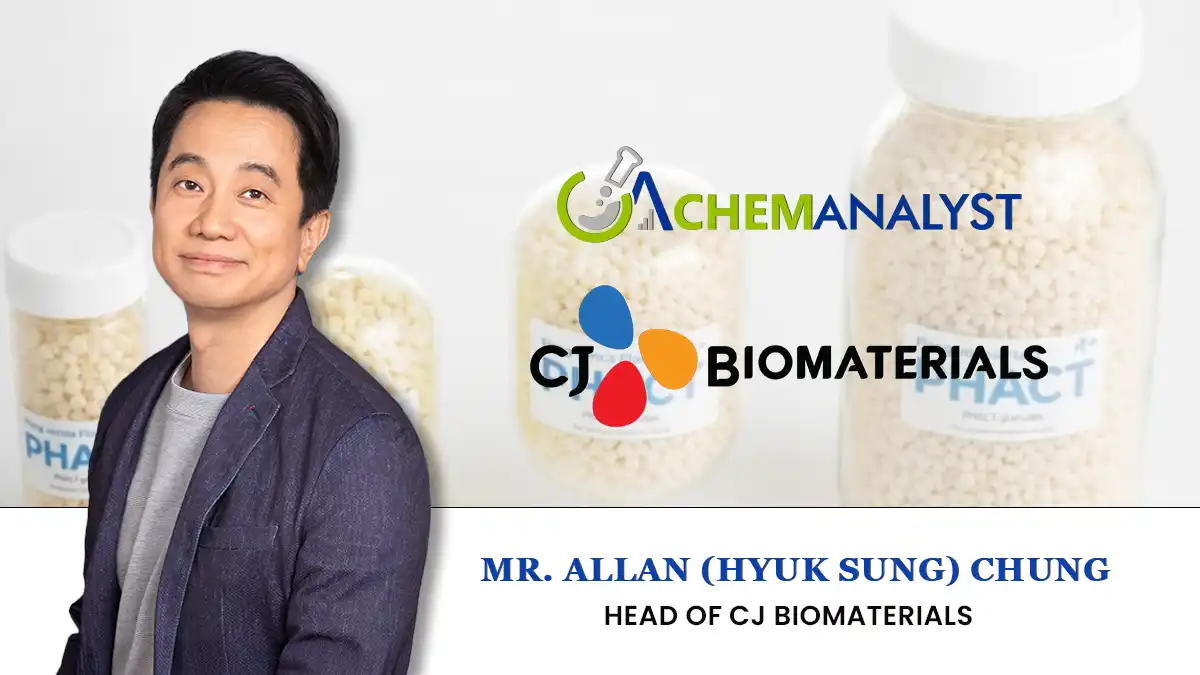
ChemAnalyst Talks with Mr. Allan (Hyuk Sung) Chung, Head of CJ Biomaterials
CJ Biomaterials, a business unit of CJ CheilJedang, is advancing the global transition away from fossil-based plastics through its proprietary PHACT™ PHA biopolymers, designed to address persistent microplastics and carbon-intensive materials. Leveraging highly efficient fermentation technology that converts plant-based sugars into certified biobased, compostable, and inherently biodegradable PHAs, the company is positioning PHA as a functional, scalable alternative across applications ranging from packaging and consumer goods to artificial turf infill. ChemAnalyst spoke with Allan Chung, Head of CJ Biomaterials, about how his cross-sector leadership experience in petrochemicals, advanced materials, and battery sustainability is shaping the company’s global PHA strategy, the role of regulatory-driven markets such as Europe in accelerating adoption, and how strategic collaborations with partners like BIQ Materials are helping commercialize PHA solutions that balance performance, cost competitiveness, and sustainability while supporting the transition toward a circular bioeconomy.
Complete Interview with Mr. Allan (Hyuk Sung) Chung
Q: Mr. Allan Chung, as Head of CJ Biomaterials, could you share an overview of your professional journey and leadership experience across biomaterials, biopolymers, and sustainability? How have these experiences shaped your strategic vision for advancing PHA-based solutions globally?
Mr. Allan (Hyuk Sung) Chung: I currently serve as the Head of the Biomaterials Business Division. While my background wasn't directly in the bio-field previously, I have accumulated extensive experience in various materials companies, including petrochemicals and materials for semiconductors/displays. Furthermore, I gained significant business experience related to sustainability while working at a lithium-ion battery company for electric vehicles.
My time in materials companies provided me with a strong understanding of the traditional plastics industry, coupled with expertise in providing high-functional materials solutions. In the battery sector, I gained experience in developing recycling solutions that aligned with the sustainability policies of both governments and customers.
I believe these experiences have equipped me with the necessary competencies and expertise for growing the PHA business. Specifically, PHA is essential as it is a substitute for petrochemical-based plastics at a time when we are looking to decouple materials from carbon intense fossil fuel feedstocks and reduce the impact of plastic waste, yet it is a new material that requires us to provide solutions that create functional applications. Therefore, I am confident that all my previous experiences developing materials and products that meet both sustainability and performance objectives will be of great benefit in this role.
Q: The collaboration between CJ Biomaterials and BIQ Materials represents a major step toward scaling biodegradable turf infill. How have your prior leadership insights influenced your approach to accelerating PHACT™ PHA adoption in sectors with strict regulatory and performance requirements, particularly in Europe?
Mr. Allan (Hyuk Sung) Chung: I believe that in markets like this, it is crucial to collaborate with industry leaders from the outset to effectively create and shape the market. If regulations are in place but viable solutions are lacking, regulatory enforcement may be delayed. Therefore, the key is to establish partnerships with local companies in the regulated region to ensure a rapid market response. Once we have grown the market to a certain degree, this regulation-driven adoption of turf infill made with biodegradable materials will have the potential to become the basic industry standard.
Q: With the EU classifying petroleum-based turf infill as intentionally added microplastics and banning their use by 2031, how do you assess the market trajectory for biodegradable alternatives? What demand trends from regulators, sports infrastructure developers, and sustainability-driven brands are shaping this opportunity?
Mr. Allan (Hyuk Sung) Chung: The inherent property of biodegradability in a material can be impactful in two ways. First, within the context of a well-managed compost waste system, certified compostable materials will breakdown safely and completely through both disintegration and biodegradation processes. Second, inherent biodegradability is a backstop or reassurance that if materials are leaked out of a well-managed waste system, common microorganisms will break them down so that they will not persist in the environment indefinitely.
The regulation for turf-infill supports the adoption of materials like PHA with this inherent biodegradability so that they will breakdown when leaked into the environment. Other regulations like the Single-Use Plastics Directive (SUPD) or Packaging and Packaging Waste Regulation (PPWR) are focused on the role of compostable materials in well-managed waste systems. Both pathways are creating accelerated market opportunities for PHA, which can be used for applications within more circular waste systems like composting, but also guard against the impact of litter and materials outside those systems.
Q: As CJ Biomaterials supplies PHACT™ PHA A1000P for BIQ Materials’ turf infill solutions, how do you expect this partnership to influence the commercialization of PHA in Europe and help position PHA as a mainstream alternative to petroleum-based plastics?
Mr. Allan (Hyuk Sung) Chung: I anticipate this will develop into a crucial commercialization case in Europe, utilizing PHA as a solution to reduce the creation of persistent microplastics and comply with regulation. This success will demonstrate that our PHACT™ PHA can effectively substitute for traditional plastics, matching needed performance functionality without sacrificing sustainability. By delivering on both attributes, it will encourage wider use of our PHAs in other applications seeking sustainable alternatives. In the long term, I am confident that this will solidify PHA's position as a mainstream alternative to petroleum-based plastics.
Q: Given accelerating global momentum to ban persistent microplastics, what is the demand outlook for PHA-based applications—from turf infill to packaging and consumer goods? How prepared is CJ Biomaterials’ global PHA production capacity to meet this rising need for sustainable materials?
Mr. Allan (Hyuk Sung) Chung: The demand outlook for PHA-based applications is steady and growing. Governments, brands, NGOs, and consumers are all concerned about the presence of persistent microplastics in the environment and in our bodies. Materials with inherent biodegradability like our PHAs are needed for their tunable persistency and inherent safety in case they are leaked or littered in the environment. However, it will be critical that new biomaterials like PHA deliver functional performance as well. As we are able to expand the types of PHAs available, like we did when introducing our unique amorphous PHA, we meet the performance needs of a wider range of applications from flexible films to paper coatings to artificial turf.
We have a 15kta commercial-scale PHA manufacturing facility operating now, but that is just the beginning. As the market grows, we are thinking about not just building the next PHA plant, but how do we reduce the capital intensity of expanding manufacturing while optimizing our production process. We need to be ready to grow quickly in response to market demand and with CJ’s prior experience developing global fermentation capacity for other markets, we are in a unique position to efficiently scale the global production of PHA.
Q: Regulatory developments such as EU REACH restrictions, along with rising corporate sustainability commitments, are reshaping the materials landscape. How will these forces influence demand, pricing dynamics, and market competitiveness for PHACT™ PHA in the coming years?
Mr. Allan (Hyuk Sung) Chung: Regulatory developments like EU REACH, the Single-Use Plastics Directive, and Packaging and Packaging Waste Regulation have been shaping the market for compostable biobased materials for several years now. While these regulations are encouraging companies to focus on the sustainability of materials they use for products and packaging, sometimes they struggle to support the new innovative materials coming to market like PHA. It’s critical as we continue to shape these types of legislation, so that we encourage innovation and don’t focus our systems only on incumbent plastic materials.
We are starting to see how these types of regulations are supporting the growth of biomaterials. More companies are interested in beginning partnerships and in-depth development projects focused on incorporating biomaterials like PHA to take advantage of how their sustainability attributes align them with regulation. However, while regulation will help accelerate the adoption of biomaterials, it isn’t the only driver impacting the economics. Compared to incumbent plastics like PP or PET, which came to market in the 1950s and 60s, PHAs for commercial use are relatively new. Our unique amorphous PHA has only been commercially produced since 2022. Therefore, we see that there are tremendous opportunities for optimizing both PHA manufacturing and conversion technologies that will support improved system economics for products and packaging well outside of regulation.
Q: CJ Biomaterials has announced strategic collaborations with partners including BIQ Materials, Cosmax, and Itochu Plastics. How will these partnerships strengthen supply chain resilience, expand application diversity, and enhance the long-term commercial viability of PHA worldwide?
Mr. Allan (Hyuk Sung) Chung: In any nascent market, forming strategic partnerships with core players is an excellent strategy to focus on in order to accelerate application development. Since PHA is still becoming a mainstream material, engaging with numerous customers simultaneously is challenging. By focusing our development efforts with partners who possess specialized expertise in their respective fields, we gain the opportunity to commercialize our product much faster, thereby enhancing the long-term commercial viability of PHA.
Q: With PHACT™ PHA A1000P receiving the 2025 Innovation in Bioplastics Award, what technological breakthroughs or ecosystem collaborations do you foresee accelerating global PHA scaling? How is CJ Biomaterials preparing to ensure performance, cost competitiveness, and customer adoption as demand grows?
Mr. Allan (Hyuk Sung) Chung: Our amorphous PHA was a “new to the world” polymer when we began manufacturing it at scale in 2022. With the range of co-polymers available in PHAs and our expertise in PHA manufacturing, we are equipped for a future where we will have the ability to produce a broad portfolio of PHA biopolymers that are tuned for different properties in downstream applications. Having more options for functional, safe, sustainable biopolymers will expand the number of applications PHA can be used in and accelerate global market demand. This same expertise in manufacturing via fermentation will underpin our ability to improve the economics of producing PHAs to achieve a cost competitive position with incumbent materials.
Q: PHACT™ PHA A1000P is produced from plant-based sugars through microbial fermentation. How does this feedstock and production process influence the polymer’s sustainability profile, carbon footprint, and scalability compared to bioplastics like PLA or traditional petrochemical plastics? Additionally, how do you see its applications evolving across packaging, textiles, cosmetics, and consumer products as brands increasingly adopt compostable and biodegradable materials?
Mr. Allan (Hyuk Sung) Chung: By using annually renewable feedstocks like sugarcane, we are able to take advantage of how plants naturally capture and sequester carbon dioxide by fixing it into sugars via photosynthesis. We account for the uptake of this atmospheric carbon dioxide in our manufacturing process, which results in a very low carbon footprint for PHA compared to fossil-based incumbent plastics. Our current feedstock, sugarcane, is an abundant and sustainability grown agricultural crop that makes it suitable from both a cost and sustainability perspective for producing PHA. However, we don’t need to rely only on sugarcane to produce our PHAs. We have current R&D projects that are focused on diversifying our feedstocks to include oils or waste streams, so that no matter where we locate future manufacturing sites, we can take advantage of local, abundant, sustainable feedstocks for our production. This flexibility in feedstocks will be a key factor in how we can globally scale PHA manufacturing both quickly and cost effectively.
Packaging and serviceware items that carry food scraps are a natural fit for compostable products, which help divert more of these food scraps away from landfill and incineration to a compost environment where they contribute to the production of a valuable soil amendment in compost. These applications from paper coatings to cutlery to flexible films will certainly continue to accelerate in the near future. Additionally, we are just starting to see the first applications, like with artificial turf infill, that are coming to market where preventing the release of persistent microplastics is the key part of the value proposition. Long term, I think there are more opportunities for introducing biopolymers like PHA into applications where it can provide a unique mechanical property that provides an attribute that fossil-based plastics cannot deliver. For example, our amorphous PHA is fully miscible in PVC and acts as an effective compatibilizer for incorporating recycled PVC content improving properties like mechanical strength in both rigid and flexible durable traditional PVC applications.







Leave a Comment
Comments (0)