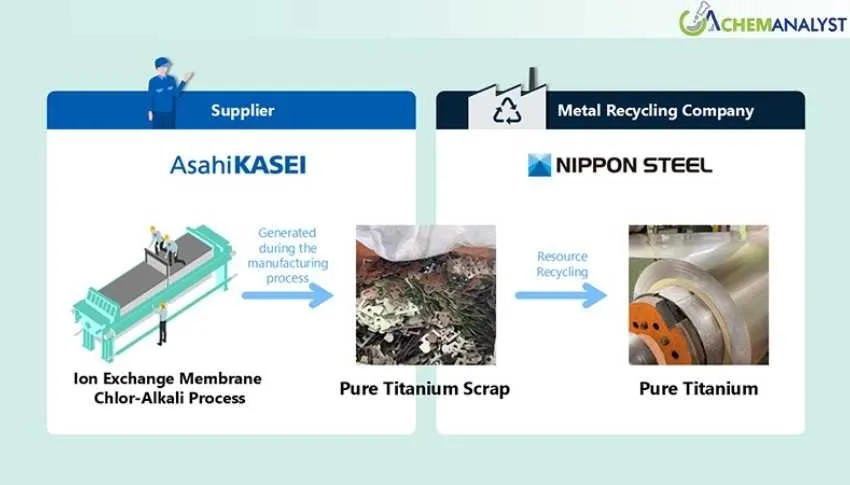
Asahi Kasei, Nippon Steel, and Nippon Steel Trading have jointly introduced an innovative recycling program aimed at converting production scrap from chlor-alkali electrolysis cells into high-grade pure titanium. This collaborative effort is designed to minimize environmental impact while enhancing the efficient reuse of valuable materials within the manufacturing cycle.
For over five decades, Asahi Kasei has maintained a prominent role in the chlor-alkali electrolysis sector, a critical industrial process responsible for producing caustic soda, chlorine, and hydrogen. These chemicals are widely used across numerous industries, including plastics, water treatment, and pharmaceuticals. The company provides a comprehensive portfolio of solutions for electrolysis plants, including electrolyzer systems, ion-exchange membranes, electrodes, and operational expertise. Central to this process is the use of pure titanium, particularly on the anode side of electrolysis cells, where it serves as a protective material against the highly corrosive effects of chlorine.
Pure titanium used in such applications must meet extremely high standards of purity to ensure durability, corrosion resistance, and workability. However, recycling titanium scrap generated during manufacturing presents significant challenges. Even minimal contamination can compromise its quality, making stringent pre-treatment processes and advanced quality control measures essential before the material can be reused.
Recognizing the value of this resource and the importance of closing the material loop, Asahi Kasei partnered with Nippon Steel, its supplier of pure titanium, along with Nippon Steel Trading. Through this initiative, titanium scrap generated at Asahi Kasei’s production facility in Nobeoka, Japan, is collected, processed, and remelted to produce new high-quality titanium suitable for reuse in electrolysis cell manufacturing.
To ensure the integrity of the recycled material, Asahi Kasei employs strict process controls and utilizes digital tracking systems to maintain full traceability throughout production. The collected scrap is handled by Nippon Steel Trading, which prepares it for remelting by converting it into a suitable raw material form. A portion of this processed material is then supplied back to Nippon Steel, where it is reintroduced into the production cycle using advanced remelting technologies.
This initiative is underpinned by Nippon Steel’s expertise in industrial-scale pure titanium remelting, particularly through the use of electron beam melting furnaces, which enable high-precision processing while minimizing impurities. By combining this technological capability with Asahi Kasei’s established scrap management systems, the partners have created an efficient and sustainable recycling loop.
Executives from all three companies emphasized that this collaboration reflects a shared commitment to sustainability and resource efficiency. The initiative not only supports the reduction of industrial waste but also contributes to broader efforts aimed at achieving a circular economy and reducing carbon emissions. It also aligns with ongoing initiatives, including Asahi Kasei’s previously announced closed-loop recycling of precious metals used in electrolysis systems.
Looking ahead, the companies plan to deepen their collaboration and further improve the recycling rate of pure titanium. By expanding such initiatives and integrating them with other material recovery programs, they aim to strengthen sustainability practices across the chlor-alkali industry. This effort represents a significant step toward more responsible resource utilization while maintaining the high performance standards required in industrial electrolysis applications.






Leave a Comment
Comments (0)