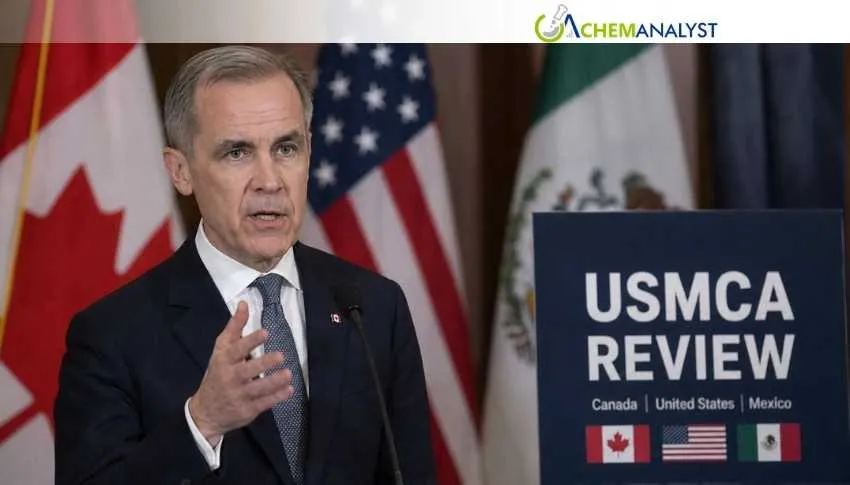
Canadian Prime Minister Mark Carney on Thursday emphasized the importance of establishing a renewed and stronger partnership with the United States, only weeks before U.S. President Donald Trump is expected to determine the future of the existing free trade framework between the neighboring countries. Speaking at the Economic Club of New York, Carney highlighted the need for what he described as a “true partnership” between Canada and the United States, one that would reshape and modernize cooperation across sectors increasingly challenged by global economic competition.
His remarks come ahead of the scheduled July review of the United States-Mexico-Canada Agreement (USMCA), the trade pact that replaced NAFTA and has governed North American trade relations in recent years. Carney stressed that while Canada remains deeply connected to the United States economically, the country is also actively broadening its international trade relationships. According to him, Canada has already been pursuing agreements with numerous countries worldwide in an effort to reduce excessive dependence on a single market.
Carney explained that Canada’s broader strategic goal is to strengthen its autonomy in a rapidly changing global landscape. He argued that economic integration, once viewed as a guarantee of prosperity and cooperation, has increasingly become a geopolitical tool. In his view, nations that are unable to independently secure food supplies, energy resources, and defense capabilities cannot claim complete sovereignty. This evolving global reality, he said, has prompted Canada to diversify trade and reinforce domestic resilience.
Relations between Canada and the United States have become strained under Trump’s administration, particularly after the president launched aggressive tariff measures and repeatedly suggested that Canada should become America’s 51st state. These comments and policies generated strong backlash among Canadians and significantly influenced the political climate that ultimately helped Carney secure the office of prime minister. Throughout his campaign and early tenure, Carney positioned himself as a leader willing to firmly confront Trump’s policies while protecting Canadian economic interests.
The Canadian leader has increasingly emerged as an advocate for greater international cooperation among countries seeking to reduce vulnerability to U.S. economic pressure. Carney announced an ambitious target for Canada to double its exports to markets outside the United States over the next decade. He argued that uncertainty created by American tariffs has discouraged investment and forced Canada to rethink its long-term trade strategy.
Despite these tensions, Carney maintained that cooperation between the two nations remains highly beneficial. He stated that a strong Canada contributes positively to American prosperity, emphasizing that both countries are better positioned when they collaborate to compete globally. According to Carney, Canada has already submitted several practical proposals to the U.S. administration aimed at strengthening bilateral cooperation while preserving mutual competitiveness.
Although the USMCA has shielded Canada from the full impact of Trump’s broader tariff campaign, several major industries, particularly aluminum and steel, have still suffered significant consequences. Carney specifically pointed to aluminum exports, noting that Canadian aluminum supplied to the United States represents an energy contribution equivalent to the output of ten Hoover Dams. He questioned whether it would be economically or environmentally practical for the United States to replace Canada as a supplier, especially considering America’s increasing energy demands.
The prime minister also underscored the importance of the North American automotive industry. He highlighted that Canada remains the largest customer for American automobiles and argued that maintaining an integrated continental production system is the most effective way to compete against growing global rivals in the sector.
In addition, Carney stressed Canada’s importance as a supplier of critical minerals, including potash, nickel, copper, and uranium. These resources, he said, are essential for supporting affordable food production, strengthening national defense, and meeting rapidly growing energy requirements associated with artificial intelligence technologies. He further noted that Canada supplies the vast majority of U.S. natural gas imports, a substantial share of electricity imports, and most imported crude oil, making it a vital contributor to American economic growth and energy security.
Carney also reminded his audience that Canada is the United States’ largest customer overall, purchasing more American goods than China, Japan, and Germany combined. Reflecting on the long history between the two nations, he stated that despite periodic disagreements, Canada and the United States have consistently managed to resolve disputes because of their deeply interconnected economies and shared values.
During his visit to New York, Carney met with representatives from major financial institutions including BlackRock, JP Morgan Chase, Blackstone, Morgan Stanley, and Apollo. Meanwhile, Canada’s Minister for U.S. Trade, Dominic LeBlanc, is scheduled to travel to Washington next week for further discussions. LeBlanc has previously cautioned that the USMCA could potentially face annual reviews, warning that ongoing uncertainty itself may be part of the Trump administration’s broader negotiating strategy.








 About ChemAnalyst
Leave a Comment
Comments (0)