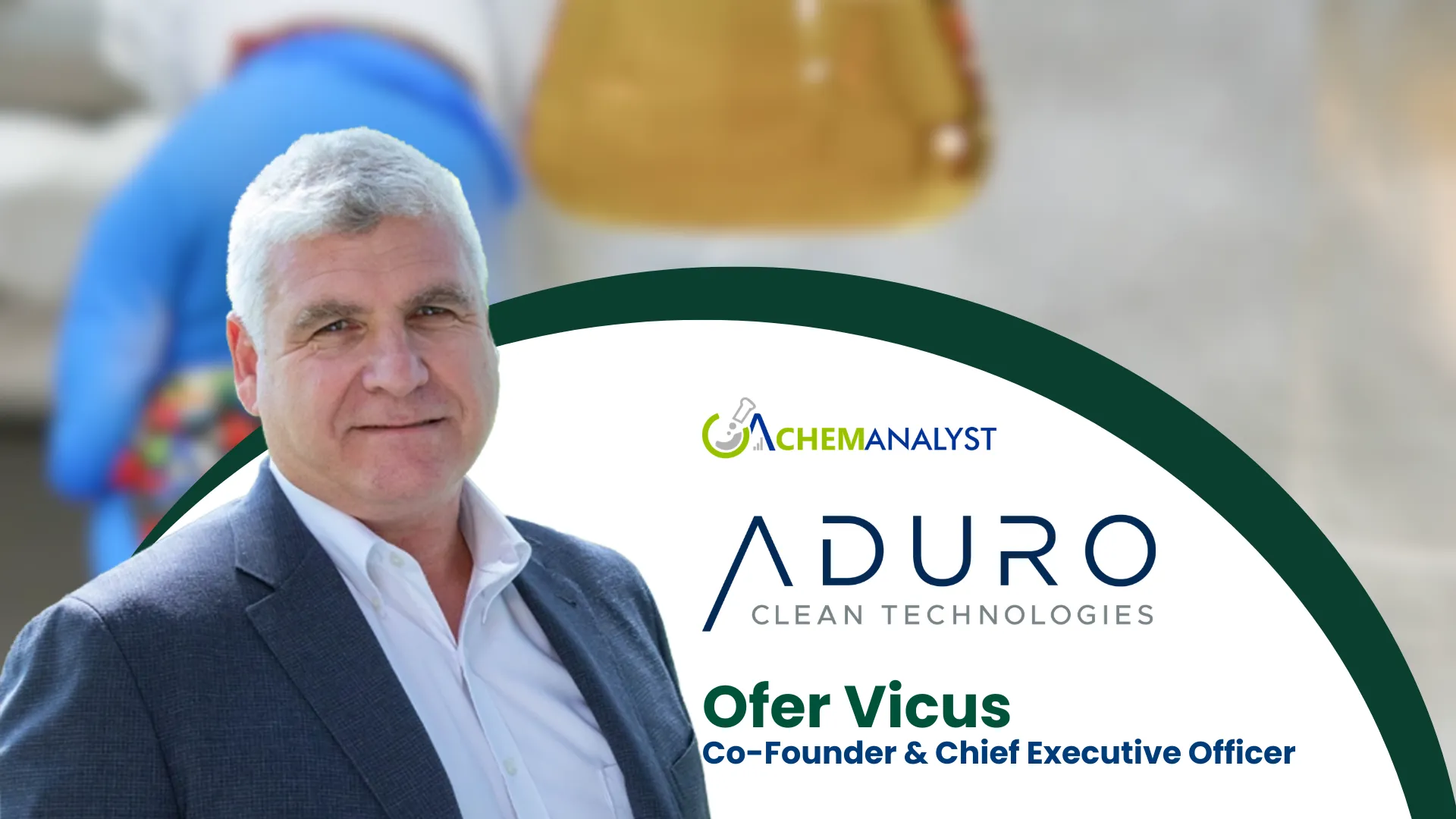
ChemAnalyst Talks with Ofer Vicus, Co-founder and CEO of Aduro
Aduro Clean Technologies is an advanced recycling and clean technology company developing patented Hydrochemolytic™ Technology (HCT), a water-based chemistry platform designed to transform low-value feedstocks into high-value resources. The company's innovative technology enables the chemical recycling of waste plastics, the upgrading of heavy crude and bitumen into lighter and more valuable oils, and the conversion of renewable oils into higher-value fuels and chemicals. By utilizing water as a critical reaction agent and operating at relatively low temperatures with improved efficiency, HCT offers a scalable and cost-effective alternative to conventional thermal processes, supporting the transition toward a more circular and resource-efficient energy and chemical industry.
ChemAnalyst spoke with Mr. Ofer Vicus, Co-founder and Chief Executive Officer of Aduro Clean Technologies, about the company’s journey from a scientific concept to an emerging player in advanced recycling and hydrocarbon upgrading. He shared insights into the development and advantages of Hydrochemolytic™ Technology, its ability to process challenging feedstocks and produce refinery-compatible outputs, and its role in enhancing circularity and energy security. The discussion also covered Aduro’s commercialization strategy, industrial deployment plans, the impact of evolving geopolitical and regulatory landscapes, and the company’s long-term vision for delivering sustainable and economically viable solutions for the future of energy and materials.
Complete Interview with Ofer Vicus
Question 1: Can you share a bit about your professional background and what specifically drew you to the field of chemical recycling?
Ofer Vicus: My professional journey spans over two decades across multiple industries. I am an industrial engineer by background with additional business education. The early part of my career was in the communications sector, after which I gradually transitioned into the energy industry, primarily focusing on business development and strategic opportunities.
My interest in what eventually became Aduro’s core technology began much earlier. As a teenager, I came across scientific concepts related to this unique phenomenon, which remained in the back of my mind for years. In 2009, I encountered an individual in Toronto who was exploring similar scientific ideas, and that became the starting point of a much deeper investigation.
Initially, my curiosity was purely intellectual. However, as I began to understand the enormous scale of the hydrocarbon industry—where millions of barrels of material move through global infrastructure every day—I realized the commercial significance of such a breakthrough. What fascinated me even more was that despite the presence of massive energy companies with decades of research and resources, this particular phenomenon had remained largely unexplored.
That realization ultimately led to the creation of Aduro. After conducting extensive research between 2009 and 2011, we officially founded the company in 2011 with the goal of understanding and commercializing this unique chemistry.
Question 2: What was the 'defining gap' in the market that motivated you to co-found Aduro Clean Technologies?
Ofer Vicus: The defining gap was the realization that there was a potentially transformative approach to upgrading hydrocarbons that had not been fully recognized by the industry.
In the early years, our focus was primarily on heavy oil. At that time, Canada was producing millions of barrels of heavy oil per day, and we recognized that even a small improvement in upgrading this resource into a lighter and more valuable product could create tremendous economic impact.
The opportunity was significant not only from a business perspective but also from a scientific standpoint. The idea that a new chemistry could improve the efficiency of such a large global market was incredibly compelling. This combination of scientific curiosity and the potential for meaningful industrial impact kept us committed during the company’s earliest stages.
Question 3: Reflecting on your time since founding and leading Aduro, what has been the most significant milestone in scaling the company from a concept to a global contender?
Ofer Vicus: One of the most significant milestones has been successfully moving from a purely research-driven organization into a company with validated technology, industrial partnerships, and a clear commercialization pathway.
For many years, Aduro operated quietly, focusing almost entirely on research and development. We had no website, no public presence, and very limited visibility because our priority was understanding the science behind the technology.
What sustained us during those years was a strong belief that we had discovered something genuinely unique. Once we validated the scientific principles and recognized the enormous addressable market, we remained focused on advancing the technology step by step.
Today, the company has evolved from a concept into a recognized player in advanced recycling and hydrocarbon upgrading, with pilot-scale validation, customer engagement initiatives, and plans for industrial deployment. Reaching this stage after years of scientific development represents one of Aduro’s greatest achievements.
Question 4: How would you describe the core mission of Aduro to someone outside the energy and chemical sectors?
Ofer Vicus: At its core, Aduro’s mission is to develop innovative chemistry that helps transform difficult-to-process hydrocarbons and waste materials into more valuable and sustainable resources.
Whether it involves converting plastic waste into circular feedstocks or improving the value and usability of unconventional crude resources, our goal is to make existing materials more useful while reducing inefficiencies and waste.
We believe that the future of energy and materials will require solutions that combine strong economics with environmental responsibility. Our mission is to provide technologies that can bridge those two objectives by enabling a more circular and efficient use of carbon-based resources.
Question 5: How would you describe Hydrochemolytic™ Technology (HCT) to a broader audience in simple terms?
Ofer Vicus: Hydrochemolytic™ Technology, or HCT, is a process that uses a carefully controlled combination of water, catalysts, temperature, and pressure to break down complex hydrocarbon molecules into smaller, more valuable components.
Unlike conventional thermal approaches such as pyrolysis, which rely primarily on extremely high temperatures to force molecules to break apart, HCT creates a specific chemical environment where molecular bonds can be selectively broken in a more controlled way.
The technology relies on the interaction between catalysts, water, pressure, and temperature to guide the reaction and prevent undesirable side reactions, such as excessive polymerization. As a result, the process can produce high-value hydrocarbon products efficiently while using relatively simple and cost-effective materials.
Question 6: What role does water play in your process, and why is it more advantageous than conventional methods like pyrolysis?
Ofer Vicus: Water plays a critical role in Hydrochemolytic™ Technology (HCT), but it is important to understand that HCT is not simply a water-based thermal cracking process. The technology is based on a carefully engineered interaction between water, catalysts, pressure, and temperature that creates a highly controlled chemical environment.
In conventional technologies such as pyrolysis, high temperatures are used to break molecular bonds, which can often lead to unwanted reactions, including excessive cracking, gas formation, and re-polymerization. These processes generally require significant energy input and additional upgrading steps.
In contrast, HCT uses catalysts to selectively break carbon-carbon bonds while water helps create an environment where reactive intermediates are stabilized and undesirable side reactions are minimized. The process also involves in-situ reactions, such as aqueous-phase reforming and quenching mechanisms, which help control the chemistry more effectively.
Another advantage is that HCT does not require large amounts of water or expensive reaction materials. The catalysts and additives used in the process are relatively inexpensive, making the overall system more energy-efficient, cost-effective, and capable of producing valuable hydrocarbon products within a desirable carbon range suitable for further petrochemical applications.
Question 7: How scalable is your technology across diverse and contaminated feedstocks, such as mixed plastic waste?
Ofer Vicus: There is no such thing as a technology that can process completely uncontrolled waste without any preparation. If the input material is highly contaminated with food waste, organic matter, or unrelated materials, some level of sorting and cleaning will always be required.
However, one of the advantages of HCT is its higher tolerance toward contamination compared with many conventional recycling technologies. The process is designed primarily to handle polyolefin-based plastics such as polyethylene (PE), polypropylene (PP), and polystyrene (PS), which represent a major portion of plastic waste streams.
Materials such as polyethylene terephthalate (PET) and polyvinyl chloride (PVC) are generally considered contaminants in the process and must be controlled at acceptable levels. While PET can participate in certain reactions and components such as ethylene glycol can provide some value within the chemistry, excessive PET content is better separated and processed through dedicated recycling routes.
The key advantage of HCT is its ability to generate a higher yield of liquid hydrocarbon products with reduced formation of low-value fuel fractions. The resulting product is also highly saturated, reducing or potentially eliminating the need for an additional hydrogenation step before entering downstream petrochemical processes.
This combination of contamination tolerance, high liquid yield, and improved product quality makes HCT a promising solution for processing realistic mixed plastic waste streams at industrial scale.
Question 8: What makes your recycled output suitable for direct use in existing petrochemical infrastructure without extensive upgrading?
Ofer Vicus: The major differentiating factor of our output is its high level of saturation. Many conventional plastic recycling processes, especially pyrolysis-based systems, produce pyrolysis oil that often requires a separate hydrogenation stage before it can be introduced into sensitive petrochemical assets such as steam crackers or naphtha crackers.
HCT is designed to produce a more stable hydrocarbon stream that requires little or no additional hydrogenation. This significantly reduces both capital investment and operating costs for customers.
Existing petrochemical infrastructure has been optimized over many decades, and operators are understandably cautious about introducing new feedstocks. By delivering a product that aligns more closely with existing refinery and cracker specifications, HCT lowers the barriers to adoption and allows companies to integrate circular feedstocks without requiring major modifications to their facilities.
Question 9: What are currently the biggest technical or economic barriers to scaling chemical recycling globally?
Ofer Vicus: The biggest challenge is not only developing an effective technology but also proving reliability and building trust within a highly established industry. Refining and petrochemical operations have existed for decades, and operators are naturally skeptical of new technologies that claim to integrate seamlessly into their facilities.
The industry’s first response is often, “We have heard similar claims before—come back when you have demonstrated it at a meaningful scale.” Recognizing this challenge early, Aduro adopted a strategy focused on both technology validation and customer engagement.
From the earliest stages of development, we involved potential industrial partners to allow them to understand the technology’s progress over time. At the same time, Aduro developed a business model that combines build-own-operate projects with technology licensing. Building its own industrial facilities allows the company to demonstrate performance, generate future revenue opportunities, and reduce the risks associated with commercialization.
Ultimately, the transition from laboratory innovation to industrial deployment requires patience, consistent execution, and a transparent approach to proving technological performance.
Question 10: How does your technology enhance the value of heavy crude and bitumen, and where does this fit into your long-term business strategy?
Ofer Vicus: Aduro’s long-term strategy extends beyond plastic recycling and includes upgrading unconventional hydrocarbon resources such as heavy oil, bitumen, and paraffinic crude.
The company views these applications as a natural extension of the expertise developed through HCT. For example, paraffinic crude shares many similarities with long-chain hydrocarbons found in plastics, making it a suitable application for the technology.
By selectively breaking long hydrocarbon chains, HCT can reduce the wax content and improve the flow properties of paraffinic crude, making it easier to transport through conventional pipelines. This can unlock previously challenging resources and improve their commercial value.
In regions such as the United States, where energy security and domestic resource utilization are strategic priorities, such technology could enable greater use of unconventional crude resources by reducing transportation challenges and improving economic viability.
For Aduro, this represents an additional growth pathway alongside chemical recycling, renewable feedstocks, and future applications such as rubber recycling. The company’s broader vision is to apply Hydrochemolytic™ Technology wherever it can create economic value while improving resource efficiency.
Question 11: Could you share the most critical insights gained from your pilot plant operations so far?
Ofer Vicus: One of the most important insights from our pilot-scale development has been the value of demonstrating the technology under real-world operating conditions. In the chemical and refining industries, innovative concepts are not accepted based solely on laboratory results. Industrial partners need to see consistent performance, operational reliability, and a clear pathway toward commercialization.
From the early stages of development, we recognized the importance of involving potential customers in our journey. Even when our experiments were being conducted in small laboratory reactors, we invited petrochemical companies to observe our progress and understand the science behind HCT. This long-term customer engagement has helped build confidence and allowed industry players to evaluate the technology as it matured.
The pilot phase has also validated our strategy of progressing from research to demonstration and eventually to industrial deployment. It has confirmed that successful commercialization requires not only strong technology but also transparency, patience, and continuous engagement with industry stakeholders.
Question 12: What are the main risks you are managing as you move from the pilot stage to your first-of-a-kind industrial plant?
Ofer Vicus: The greatest challenge in scaling any new chemical technology is reducing the perceived risk for customers and investors. Established petrochemical companies operate highly valuable assets and are naturally cautious about integrating new processes that have not yet been proven at commercial scale.
To address this, Aduro has developed a dual commercialization strategy that combines build-own-operate facilities with technology licensing. Our objective is to initially construct and operate our own industrial units, demonstrating performance while also creating future revenue streams. Once the technology has been fully validated at industrial scale, licensing will become a more straightforward pathway for wider market adoption.
This strategy allows us to place our own investment behind the technology and demonstrate confidence in its commercial potential. It also gives customers time to understand the technology and assess its long-term value before making their own investment decisions.
Question 13: Why was Europe selected as the primary location for your first industrial facility, and what is the timeline for full deployment?
Ofer Vicus: Europe has become one of the most attractive regions for advanced recycling technologies because of its strong regulatory framework and increasing commitment to circular economy goals. European policymakers have recognized that plastic waste should no longer be exported, landfilled, or treated as a disposable material. Instead, regulations are creating a market where circular feedstocks have increasing value.
The region is also moving toward stricter recycled-content requirements, with significant regulatory targets expected to take effect around 2030. This creates a strong opportunity for technologies capable of producing high-quality circular feedstocks that meet petrochemical industry requirements.
Aduro believes HCT is well-positioned to support this transition because of its ability to generate high-value hydrocarbon products with minimal upgrading requirements. The company aims to have its industrial technology ready around 2028, allowing time to scale production capacity between 2028 and 2030 to meet the growing demand driven by European circularity mandates.
Question 14: How do geopolitical tensions in major oil-producing regions influence Aduro’s long-term strategic planning?
Ofer Vicus: The current geopolitical environment has increased the importance of localized resource solutions and energy independence. Countries and regions are increasingly looking for technologies that can reduce their dependence on imported resources while strengthening domestic supply chains.
For Aduro, this trend creates a favorable environment. Chemical recycling allows countries to convert locally generated plastic waste into valuable feedstocks, reducing reliance on virgin fossil-based materials. Similarly, technologies that improve the usability of domestic unconventional crude resources can contribute to greater regional energy resilience.
Therefore, geopolitical uncertainty has reinforced the importance of circular technologies, not only from a sustainability perspective but also from a strategic and economic standpoint.
Question 15: Does the current volatility in global energy prices make your sustainable solutions more commercially attractive to investors?
Ofer Vicus: While energy market volatility can increase interest in alternative technologies, Aduro’s approach has always been focused on long-term value creation rather than short-term market fluctuations.
As a public company, we have built investor confidence by consistently delivering measurable milestones each year. Our strategy is not based on making ambitious promises of immediate large-scale commercial success, but rather on gradually reducing technological risk, creating new opportunities, and advancing the company toward commercialization.
This disciplined approach has helped us attract long-term shareholders who understand the scale of the opportunity. The addressable market for our technologies is extremely large, and our focus remains on steady execution, scientific validation, and achieving the milestones required to unlock that potential.
Question 16: Do you see your technology contributing to greater energy security for countries that lack significant natural resources?
Ofer Vicus: Absolutely. One of the major shifts we are witnessing globally is that countries and regions are increasingly prioritizing resource independence and localized supply chains. In this context, circular technologies can play a meaningful role by transforming domestic waste streams into valuable resources.
For example, chemical recycling enables countries to convert plastic waste—materials that were traditionally viewed as a disposal challenge—into valuable hydrocarbon feedstocks that can re-enter existing industrial systems. This reduces dependence on imported virgin materials and creates a more resilient local supply chain.
Similarly, our work in unconventional crude upgrading demonstrates how previously challenging resources can become more commercially viable. The broader objective is not only sustainability but also improving resource efficiency and supporting long-term energy resilience.
Question 17: How might shifting global trade patterns and sanctions impact your expansion plans into North America and Asia?
Ofer Vicus: Changes in global trade dynamics are encouraging countries and industries to rethink their supply chains and prioritize local solutions. We believe this trend aligns well with the value proposition of Aduro’s technology.
Rather than relying solely on international supply chains, regions are increasingly looking to process their own resources—whether that means recovering value from plastic waste or improving the usability of domestic hydrocarbon reserves. This creates new opportunities for technologies that support regional self-sufficiency.
Our expansion strategy is therefore designed to remain flexible and adaptable to changing global conditions. While each market has its own regulatory and commercial landscape, the fundamental need for efficient resource utilization and circular solutions remains consistent across North America, Europe, and Asia.
Question 18: In your view, does the current geopolitical environment accelerate the global transition toward circular technologies?
Ofer Vicus: Yes, I believe recent geopolitical developments have accelerated the conversation around circularity. Initially, many regions—particularly Europe—approached recycling mainly from a sustainability perspective, with the objective of reducing waste and environmental impact.
Today, there is an additional strategic dimension: resource security. Governments increasingly recognize that developing local circular supply chains can reduce dependence on imported raw materials and strengthen domestic industries.
Europe, in particular, has taken a proactive approach by introducing regulations that encourage the use of recycled content and discourage the disposal or export of plastic waste. These measures are helping to create a stronger market for advanced recycling technologies.
From our perspective, this regulatory direction, combined with the growing importance of energy and material independence, creates favorable conditions for technologies like HCT that can convert waste into valuable industrial feedstocks.
Question 19: How resilient is the Aduro business model to global disruptions, such as supply chain shocks or regional conflicts?
Ofer Vicus: Resilience has always been an important part of our long-term strategy. We understand that developing a breakthrough technology requires patience, disciplined execution, and the ability to adapt to changing market conditions.
Our business model combines direct project development with technology licensing, providing multiple pathways for growth. Additionally, HCT has been designed with scalability in mind, using largely commercially available equipment rather than highly specialized components.
The modular nature of our technology allows capacity to be expanded by adding additional processing units rather than redesigning the entire system. This flexibility helps reduce deployment risks and allows us to respond more efficiently to changing market demands.
Most importantly, our focus has always been on achieving realistic milestones, continuously reducing technological risk, and maintaining transparency with our partners and investors. That disciplined approach is what strengthens the company’s resilience during periods of global uncertainty.
Question 20: Looking forward five years, what does success look like for Aduro in terms of market share and environmental impact?
Ofer Vicus: Over the next five years, success for Aduro will be measured by our ability to transition from a technology developer into a fully commercial industrial player with meaningful market presence.
Our vision has always been to build a company capable of operating at a very large scale, potentially creating billions of dollars in value. However, achieving that vision requires a strong foundation built on scientific integrity, operational excellence, and consistent execution.
We believe that successful deep-tech commercialization requires patience. There are no shortcuts in chemistry—real innovation must be supported by rigorous science, transparent communication, and a long-term commitment to solving meaningful industrial challenges.
Ultimately, our goal is to establish Hydrochemolytic™ Technology as a widely adopted solution for converting difficult hydrocarbons and waste materials into valuable resources, contributing to a more circular, efficient, and sustainable global materials economy.






Leave a Comment
Comments (0)