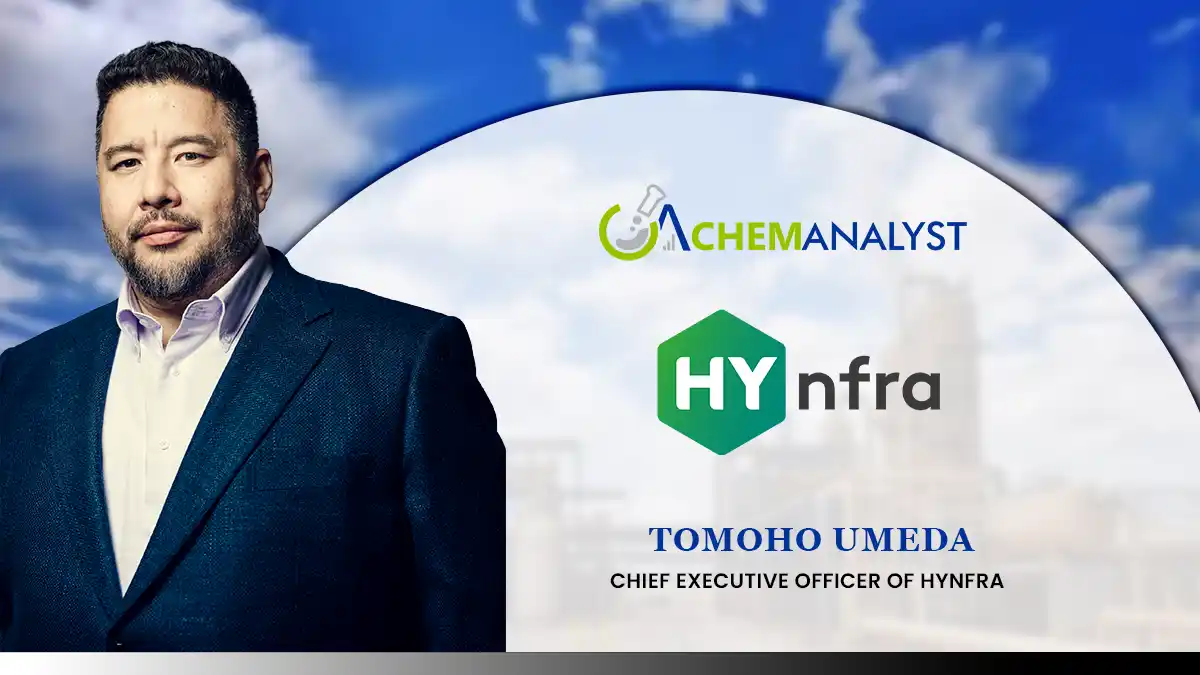
ChemAnalyst Talks with Tomoho Umeda, Chief Executive Officer of Hynfra
Hynfra is a Poland-based system designer, technology integrator, and project developer specializing in large-scale green hydrogen and green ammonia projects. Leveraging decades of expertise from Poland's conventional ammonia and fertilizer industry, including experience rooted in Grupa Azoty, the company develops integrated renewable energy solutions across Europe, the Middle East, Asia, and Africa. ChemAnalyst spoke with Mr. Tomoho Umeda, Chief Executive Officer of Hynfra, about the company's global strategy for advancing green hydrogen and green ammonia production. Drawing on his extensive experience in international business development and cross-border partnerships, Umeda highlighted Hynfra's modular project approach, the importance of renewable energy economics, and the growing role of green ammonia in decarbonizing hard-to-abate industries. He also discussed the strategic advantages of project locations in Mauritania, Jordan, and Oman, evolving global demand, pricing dynamics, policy frameworks, and the long-term outlook for international hydrogen trade. Looking ahead, Hynfra aims to accelerate the deployment of commercially viable green hydrogen and green ammonia projects, strengthen technology partnerships, and support the global transition toward a low-carbon, secure, and sustainable energy future.
Complete Interview with Tomoho Umeda
Q1: Please provide an overview of your professional journey in the energy and infrastructure sectors, and how your experiences have shaped Hynfra's vision for large-scale green hydrogen and green ammonia development.
Tomoho Umeda: I didn't start out in industry sector. My path began in communications and cross-cultural advisory work, which turned out to matter more than I expected. I studied ethnology and cultural anthropology at the University of Warsaw, then spent the late 1990s and early 2000s working in public communications, including a role at Poland's Ministry of Foreign Affairs and editorial work, before founding my own advisory firms - first Tomo Strategy & PR in 2004, then Tomo Group in 2006. That period taught me how to build trust between institutions and across cultures, a skill I didn't yet know I'd need in the business I run today.
The real turning point came through my family. My father, Yoshiho Umeda, spent decades building bridges between Poland and Japan. First as a Solidarity-era activist, later as a businessman bringing Japanese capital and partnerships into Poland through his company, Yoho. When he passed away in 2012, I took over that firm, and with it, a network and a way of working I'd absorbed without quite realizing it. People sometimes say sons grow into their fathers without meaning to. I didn't plan to follow him into this sector - but I did.
By the late 2010s, it was clear to me that green hydrogen and its derivatives, particularly ammonia, were going to be the next major axis of industrial transformation. It's a structural necessity for any economy that takes decarbonization seriously. I founded Hynfra in 2020 together with Pawel Jarczewski, former CEO of Grupa Azoty and Zaklady Azotowe Pulawy - two of Poland's flagship chemical companies - on a simple conviction: Poland has a genuine, underused advantage here. We built one of the world's first nitrogen and ammonia industries over a century ago, under Ignacy Moscicki and Eugeniusz Kwiatkowski, and that engineering competence never disappeared. Pairing that domestic expertise with the international relationships I'd inherited, particularly across Asia and the Middle East, gave Hynfra a starting position few competitors could match.
Green hydrogen, for us, is a means to decarbonize systems that currently run on coal, gas and oil. We also believe this transition will happen in a distributed way - project by project, region by region, because renewable energy installations are inherently constrained by space, so large, centralized energy systems simply won't scale in this new world. That's why we have projects spanning MENA as well as India, the Philippines, and Alaska. My background isn't typical for this industry, but I'd argue that building trust across very different worlds - Polish and Japanese, technical and financial, local and global - is exactly the skill this transition requires.
Q2: Hynfra has selected Mauritania, Jordan, and Oman as key project locations. What economic and strategic factors make these countries particularly attractive for green hydrogen investment compared with other emerging markets?
Tomoho Umeda: The most important factor is the efficiency of renewable energy production in these locations. Jordan has extremely competitive solar conditions, while Mauritania and Oman exceed in both, solar and wind. This is crucial, because green hydrogen requires the use of electrolysis which remains energy intensive process. The more efficient renewable energy, the lower CAPEX allows you to produce the same volume of hydrogen and thus ammonia. Every of these countries represents different level of economic development. At the same time all of them are developing countries, eager to tackle energy transition with all their potential. All 3 governments already recognize the advantages their territories and geographic locations bring to the table, including seawater access for desalination but also logistics, as ammonia produced there will most likely be entirely exported.
Q3: Global green hydrogen production costs vary significantly by region. How do you expect production costs in the Middle East and Africa to compare with Europe, North America, and Asia over the next decade?
Tomoho Umeda: As already mentioned, greater efficiency of renewables in the equator belt transfers into lower CAPEX. This is obviously true for projects complying with Article 5 of famous DA 2023/1184 but we believe it is also more economically sustainable as well. Look: if you plan to install electrolysis in Europe and are trying to persuade European Commission that so called additionality is the true evil you have to look at simple economics. If the project assumes procuring energy from the grid, there is absolutely no-way that at anyone can guarantee you the cost of this energy in let's say 10-year horizon. Actually, no one can guarantee that for even 2 years. Yes, we can sign a PPA for much longer, but it only secures you with energy production cost, not the distribution, Guarantee of Origin and other components that constitute your actual marginal energy consumption cost. When, as we are doing, you decide to comply with Article 5 and build your own energy assets, the actual cost of energy is in essence depreciation of this investment, resulting in very low actual energy costs, energy systems independence and long-term economic sustainability. Yes, it is much harder to build enough renewables in Europe and yes, you have to build much more of the installed power than in let's say global south, but this is the result of RES load factor, not the politics. The 2.5x higher efficiency of solar energy in Jordan than in any CEE country will prevail, no matter how regulations will evolve.
Q4: Green hydrogen prices remain substantially above those of grey hydrogen in most markets. What specific technological, operational, or policy developments are required to achieve cost parity?
Tomoho Umeda: This comparison is more nuanced than the headline suggests, and the gap is closing, though I would be careful about calling it closed. First of all, you have to compare apples to apples. Our projects, and most green ammonia capacity coming online globally, are scheduled to start operating from 2030/2031, by then conventional hydrogen and ammonia producers will be facing a materially different economic reality, with far fewer free EUA allocations. That mechanism was designed specifically to level the playing field between the fossil and renewable molecule, and it is one of the clearest paths toward parity, though the exact price point depends on where EUA prices settle and how fast free allocations phase out.
We are also seeing geopolitical events that exceed any planning matrix, imported ammonia into Northwest Europe on a CFR basis can spike toward $1,000 per metric tonne under supply stress. This is not the first time; we saw a comparable surge during the 2022/2023 gas crisis in Europe. Under that kind of stress, the grey-green gap compresses sharply, sometimes disappears — but that is a crisis price, not a structural one, and I would not build a parity case on it. The regulatory environment favours green hydrogen structurally, which you can see in which technologies dominate the project pipeline worldwide, but translating that into durable price parity still depends on carbon pricing trajectories, financing costs, and how offtake contracts get structured over the next several years.
Q5: Many analysts forecast a significant decline in electrolyzer costs by 2030. How important will equipment cost reductions be in driving lower hydrogen prices, and what pricing trajectory do you anticipate for green hydrogen over the next five years?
Tomoho Umeda: Decline in electrolysers system costs is very well-known fact, but remember that this does not happen to all system components. When we read that stacks are 4x cheaper than they were in 2022 it is great, but the entire BoP including water treatment, rectifiers are not subjected to the same cost decline. But this is the fact, that equipment gets cheaper, and we see this in PV modules, energy storage systems and electrolysers. At the same time, it is worth noting that electrolysers costs are not determining the green molecule price, it is the cost of energy used for electrolysis. Cost decline in equipment make large scale investments closer to break even, but the actual challenge is in the capital cost not the equipment. I believe that the initial wave of market enthusiasm has already subsided and we are witnessing now a professionalization and rationalization of projects.
Q6: Renewable electricity prices are often considered the most important factor in hydrogen economics. How sensitive are project returns to power costs, and what electricity pricing environment is necessary for green hydrogen to become globally competitive?
Tomoho Umeda: We know for sure, that electric energy costs are the cornerstone of every electrolytic hydrogen project and that as long as the market will be shaped by wishful thinking of policymakers or OEM marketing to just sell the next bunch of units we are not going to go anywhere. Unfortunately, this was the case up until now, where it was in fashion to shame Article 5 but we believe it is a necessary evil. We need to build dedicated assets to power hydrogen production, only then we can make it sustainable in terms of long-term economics but also for the entire energy system. Hydrogen as an energy carrier will always face the same difficulty, that results from its physical properties, it will be always energy intensive to move and store. One of the ways to escape from this rabbit hole is to already make a destined product that already has a market today and faces serious decarbonization challenge. Namely the ammonia (NH3).
Q7. Europe's RFNBO regulations are expected to create substantial demand for green hydrogen and green ammonia imports. How confident are you that demand growth will keep pace with the large number of projects currently being announced worldwide?
Tomoho Umeda: The number of project announcements has already slowed down, which has a lot to do with what is in the spotlight of large institutional investors i.e. AI. But because AI is now taking the lead, it does not mean that energy transition is not happening. Green ammonia imports is the consequence of the structural difficulty in placing enough renewable power supply at competitive costs in Europe, it creates a gap, that can be filled only with imports. On top of that comes the production economics, that again, is relentless. It is true that in EU regulations drive the market and we do not expect it to change, this is because the climate policy is the backbone of the entire EU DNA for more than 10 years and despite some hardship in meeting ambitious pace created by already adopted regulation it works. Projects that were too big, were simply not adjusted to the current market stage. Developers who announced GW scale electrolysers were also not aware what is the current state of the art in this domain. Apart from little sarcasm, we also need to remember that while we developers are learning by doing, it is also uncharted waters for the demand side, they have to corelate if we want to have a business case eventually.
Q8: Some market observers warn that the industry could face an oversupply of green ammonia if all planned projects move forward. Do you share these concerns, or do you believe future demand will absorb the expected capacity additions?
Tomoho Umeda: It is very hard to believe or even imagine. Let me refer to some numbers. Today, as a humankind we produce roughly 184 million metric tonnes of ammonia annually, mainly to feed ourselves with help of nitrogen fertilizers. Decarbonizing just this pot is an immense challenge. We as Hynfra are currently developing a project portfolio of 1.5 MT, out of which just 0.6 is mature. So, we know how hard it is to replace even 0.3% of current ammonia volume. In the meanwhile, there is IRENA (International Renewable Energy Agency) and a World Bank forecast that if ammonia becomes a shipping sector fuel of choice together with some use of ammonia as hydrogen carrier it will extrapolate the annual demand to 600 million metric tonnes in just 2050. Even if these assumptions will be met only partially, we will witness CAGR of the sector that will make any competition purely theoretical.
Q9: How do you see global green ammonia prices evolving as more large-scale production projects come online in the Middle East, Africa, Australia, and Latin America?
Tomoho Umeda: It will be extremely interesting to observe it in coming years. In Middle East many of them will be delayed due to current situation around Hormuz Strait. The more projects will come online, the more references sector will get. It is fascinating to be involved into all of this. Because heavy chemicals were always a spot market, we see trust issue in product indexes price definition. However the more projects start to operate, the more transactions are made public, the closer we are to transparency.
Q10: Shipping is increasingly being viewed as a major future consumer of green ammonia. What level of demand growth do you expect from the maritime sector, and how important could this market become for project economics?
Tomoho Umeda: Yes, there is a number of reasons for shipping being in the spotlight. First, there is obvious thing – volumes. Second, the carbon footprint. The use of ammonia only makes sense in shipping if it is not ordinary grey, because the whole point is in replacing fossil fuels. Using ammonia as a bunker fuel for vessels will ultimately attract the tier one investors. It is also the case that marine shipping is resilient and healthy sector, powering the global trade and therefore having a lot of financial health and balance sheets to step up to the task of being at the forefront. It is hard to predict but if you will compare energy density of today used bunker fuel and ammonia it simply means that even insignificant from the entire sector consumption perspective amounts, transfers into millions of metric tons.
Q11: Beyond Europe, which countries or regions do you expect to emerge as the largest future importers of green hydrogen and green ammonia, and what factors are driving demand in those markets?
Tomoho Umeda: It is not hard to point at Far East Asia, where ammonia is gaining traction as an energy carrier. The region, much like Europe, is accustomed to importing commodities, and ammonia is no exception. This is no longer pilot-scale, nor limited to Japan: co-firing trials and pilots are underway or planned in China, South Korea, India, and Indonesia, alongside further activity in Thailand, Malaysia, the Philippines and Vietnam. Rystad Energy estimates the region will need around 8.8 million tonnes per annum of ammonia to meet 2030 co-firing targets, with China, Indonesia, Japan and South Korea emerging as the key hubs. Energy-intensive economies across Asia are looking to ammonia as one option for cutting coal use. Notably, the first commercial cargo of green ammonia was shipped not from Europe or the Middle East, but from China to South Korea: in early 2026, Envision Energy delivered green ammonia from its Chifeng facility in Inner Mongolia to Lotte Fine Chemical in Ulsan, the world's first end-to-end commercial delivery of the molecule. Green ammonia is no longer a European dream, at least not exclusively.
Q12: Energy security has become a top priority following recent disruptions in global energy markets. How has this shift changed government attitudes toward green hydrogen investment and long-term procurement agreements?
Tomoho Umeda: Again, it is not common, but China was one of the very first to put hydrogen in front of their crisis-response measures. They announced long-term plans to invest in the sector, not only in equipment manufacturing (as they almost always do) but also as the offtaker for green fuels to cut their dependence on crude oil imports. Japan for instance had to release its national crude oil reserves to maintain fuel supplies to oil stations and Taiwan seriously seeks coal and LNG alternatives to power its semiconductor giant.
Q13. Historically, energy-exporting nations have derived geopolitical influence from oil and natural gas resources. Could green hydrogen create a new group of strategic energy exporters, and which countries are best positioned to benefit?
Tomoho Umeda: Yes, it will be a new sort of net exporters and net importers. The difference is the sheer number of locations which at the same time have great RES potential, sea water access and therefore also logistics gateway. To point exact winners is hard, as it very much depends how much demand centres will be willing to mirror EU RFNBO regulation on production criteria. If for instance additionality is not used as a rule of thumb, then i.e. Latin America with its excellent hydropower becomes viable net exporter, the only question remains to whom it might export and how this demand centre defines renewable character of the molecule. Before President Trump re-election, we had an example with IRA, which in essence levelized electrolytic hydrogen with renewable aka green, but in Europe we know that this is not true.
Q14: Mauritania, Jordan, and Oman are seeking to diversify their economies through clean energy investment. What broader economic benefits could these projects generate beyond hydrogen and ammonia production itself?
Tomoho Umeda: First of all, in case of Jordan and Mauritania it allows them to demonstrate that they are mature enough to host a large infrastructure project. If these projects will reach FID and start to operate it will be a vivid sign to financial markets that these countries are viable partners. Second, hydrogen is energy intensive, but it is also water intensive, and we are aiming at locations that experience severe water crisis, any additional water desalination capacity is significant value for them. Then there is the operational and tax income stemming from port logistics handling which will contribute directly to host countries budgets. Every project is also supposed to create hundreds permanent and thousands temporary jobs related to construction phase. On top of that is obviously the image of a country that takes the lead position in global energy transition, similarly as NEOM does for Saudi Arabia.
Q15: Supply chain constraints remain a concern across the hydrogen sector. Which areas—electrolyzers, renewable equipment, critical minerals, logistics, or skilled labor—represent the greatest risks to project execution today?
Tomoho Umeda: This is a tricky question, as the global turmoil is so surprising that you never know what is around the corner. There are solutions to every problem and it happens to be that we mastered the ammonia production at scale. We believe that the modular approach we provide in our project contributes to fewer on-site work hours, less equipment and lower costs incurred and faster development between FID and COD. All of that means that because we are integrating commercial, mature technologies with industry leaders in each segment (renewables, energy storage systems, electrolysers, ammonia loop and chemical infrastructure) we can be sure that each of them, knows who is responsible for what. We do not see any high concern areas. Obviously, the majority of equipment, particularly on energy part comes from a single country even if some other OEM is stated on the nameplate, but this is no different than in any other industry and the world knows and deals with this risk for quite some time.
Q16: Hynfra maintains multiple technology partners for key project components. How does this strategy help mitigate supply disruptions and pricing volatility in a rapidly growing hydrogen market?
Tomoho Umeda: Yes, as mentioned we have this modular approach which builds on lasting relationships with major OEMs. Although our projects are not the biggest, we are going to procure considerable amount of equipment for each type of technologies. Our modular approach allows our projects to benefit on economies of scale, as we develop them in parallel, but it is also our responsibility to select credible suppliers who can deliver on time, on scale and with sufficient quality. In such volatile environment it means that we always need some back up that will save the project even if for any reason one subcontractor fails to meet any of the above criteria. It doesn’t come cheap, nor is an easy job, but we know from decades long experience in manging large-scale investments in chemical industry, that it is necessary.
Q17: Looking at the global hydrogen market, where do you currently see the biggest mismatch between projected supply and expected demand?
Tomoho Umeda: The biggest mismatch lies between policy expectations and today's technological realities. In many markets there is still an assumption that hydrogen can rapidly replace natural gas across a wide range of existing applications using much of today's infrastructure. While hydrogen will undoubtedly become an important part of the future energy system, its physical properties make production, storage and transport fundamentally different from natural gas. Rather than trying to replicate the existing gas economy, we believe the industry should focus first on applications where hydrogen and its derivatives already offer a clear competitive advantage. Green ammonia is a good example. It is an established global commodity with mature logistics, existing demand and a clear decarbonization pathway. Building these commercially viable markets first will ultimately create a stronger foundation for the broader hydrogen economy.
Q18: As more low-cost producers enter the market, do you anticipate increasing competition putting downward pressure on green hydrogen and green ammonia prices over the next decade?
Tomoho Umeda: I am not sure what low-cost producer means. I am a great fan of competition as it always drives better prices for end users and forces innovation. Yet it is important to differentiate the media noise from the technical realty. All large-scale projects that are being deployed all over the world are employing mature proven technologies. This is not F1 or aviation, where after a short trial you can replace or change the set up. The whole project economics is based on uninterrupted operation. This is why for example both, alkaline electrolysers are still on top of installed capacity despite obvious advantages of PEM’s in cooperation with renewables and why lithium-ion are still used despite solid electrolyte being just around the corner, or redox. Industry application is a very different animal and because banks financing all of this are also playing with their rules, we need to act responsibly.
Q19: How do geopolitical tensions, trade policies, and evolving carbon-border regulations influence investment decisions for export-oriented hydrogen projects?
Tomoho Umeda: This is a question that could end with dissertation thesis. Geopolitical tensions only remind us how much vulnerable some logistic chains are for local disruptions. Green molecules are more democratic and can be produced in more locations than today fossil fuels are sourced from. This is a good thing. CBAM and trade policies sparked by US IRA are tool to protect more advanced decarbonization markets from so called carbon leakage. Without protection all energy intensive manufacturing will disappear from Europe. This is easier than planning actual decarbonization based on new technologies as evidenced by multiple global players, with Germany taking the lead (BASF, Siemens but also many others). Obviously the more exposed are the projects and players targeting the mid-term decarbonization market i.e. blue ammonia projects, which still rely on fossil fuels but are aiming to cash on low-carbon appetite. We see how this concept slips out of hands in the US, where many projects were betting on CCS/CCU to export to Europe or Japan but uncertainties on CBAM in EU just ruin their business cases.
Q20: Looking ahead to 2035, what is your outlook for global green hydrogen demand, international trade flows, pricing trends, and the role of hydrogen in reshaping the future energy landscape?
Tomoho Umeda: I believe that some common sense is required to one more time acknowledge that global warming that we are fighting with decarbonization doesn't recognize the borders or politics. This is the force of nature and as long as we are taking care more of who controls what, we are only losing time on saving this Planet from facing increasingly severe climate consequences. Pricing in perspective of decades is a kind of prophecy I try to avoid. I am proud to be a CEO of a company that designs projects to deliver ammonia at prices comparable to fossil alternatives, which is already an incredible thing. If you realize that you start with one of the most energy intensive products apart from steel or cement and you design a process to deliver an exact equivalent apart from carbon footprint, there is quite a good achievement in that already.








 About ChemAnalyst
Leave a Comment
Comments (0)