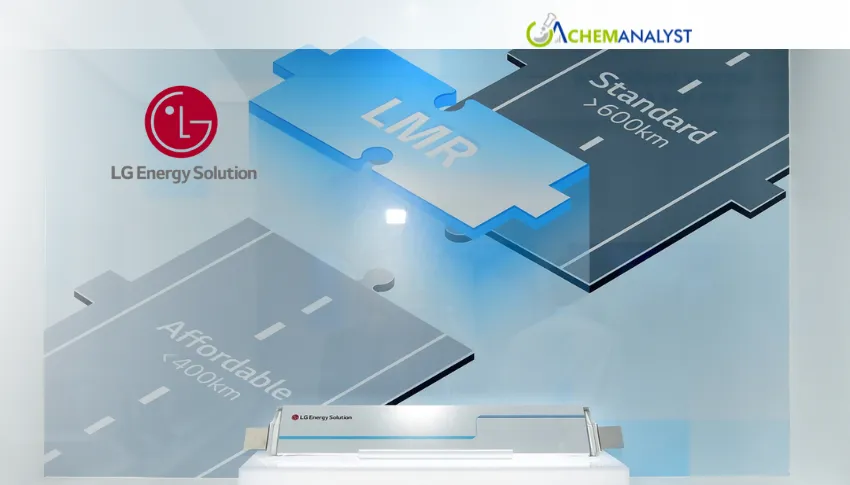
LG Energy Solution and Seoul National University have made a significant advancement toward the commercialization of lithium manganese-rich (LMR) batteries for electric vehicles (EVs). The companies announced research findings on September 7, Seoul time, showing that optimized electrochemical operating conditions can substantially improve the stability and cycle life of large-format LMR battery cells.
The joint research, conducted with Professor Jongwoo Lim and his team from Seoul National University's Department of Chemistry, was published in Nature Communications. The study addresses one of the major barriers preventing LMR cathode materials from being widely adopted in large-format EV batteries: gas generation and associated capacity degradation.
LMR cathodes offer an attractive pathway to reduce battery material costs because they rely heavily on manganese, a comparatively lower-cost material, while eliminating the need for cobalt. The technology can also deliver high energy density because energy storage involves both transition metals, including nickel and manganese, and oxygen within the cathode structure.
However, oxygen reactions during charging and discharging can destabilize LMR materials. When oxygen oxidized during charging fails to fully return to its original state during discharge, structural damage and gas formation can occur. In large-format EV cells, accumulated gas can increase internal pressure because of limited available space, potentially reducing battery performance and durability.
The research team examined oxygen redox behavior under different charging and discharging conditions. The study found that oxygen reversibility depends significantly on both the upper charging voltage and the discharge cutoff voltage. Reducing the charging voltage from 4.6 V to 4.3 V increased oxygen reduction from 86% to 97%. Meanwhile, reducing the discharge cutoff voltage from 3.0 V to 2.0 V enabled oxygen to recover almost completely to its original state.
Using these findings, LG Energy Solution redesigned the voltage operating range and formation conditions for 40Ah-class large-format LMR cells. Researchers also introduced a lower-temperature formation process to further limit gas generation.
The optimized cells retained 92.2% of their initial energy after 883 charge-discharge cycles. The result demonstrates that electrochemical protocol optimization can significantly improve LMR cell durability without relying solely on material modifications.
The findings strengthen the prospects for deploying LMR technology in large-format EV batteries. If further validated at commercial scale, the approach could support lower-cost battery production while reducing dependence on cobalt and improving the competitiveness of LMR-based energy storage systems.
Impact on Chemical Commodity Price Impact
The development is positive for LMR battery commercialization, potentially increasing future demand for manganese-based cathode materials while reducing reliance on cobalt. Successful scale-up could encourage battery manufacturers to adopt LMR technology in EV applications, supporting long-term demand for manganese, nickel, lithium and related battery chemicals. Manganese could see the strongest structural benefit because LMR chemistry uses manganese as a major cathode component. However, the near-term price impact should remain limited because commercial deployment will require further validation and manufacturing scale-up. Over the medium to long term, stronger LMR adoption could support manganese and manganese sulfate prices, while potentially moderating cobalt demand and prices.








 About ChemAnalyst
Leave a Comment
Comments (0)