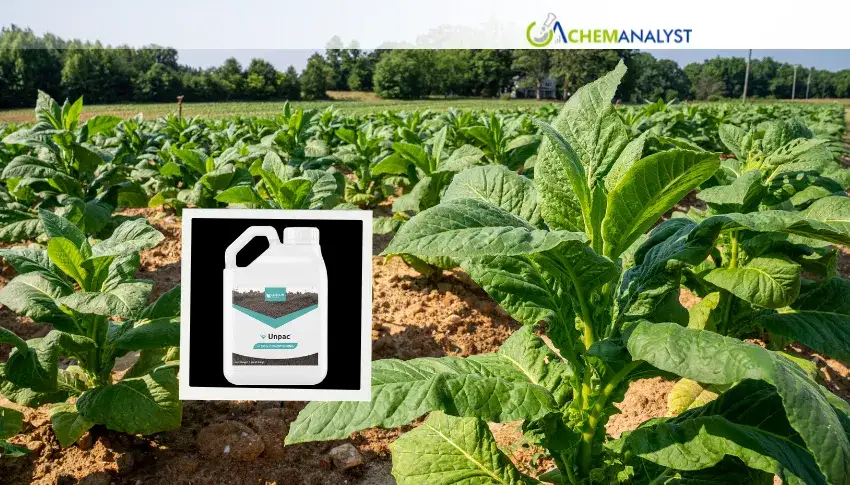
Soil compaction remains a significant challenge for farmers because dense soil can restrict root growth and prevent crops from efficiently accessing water and nutrients. According to an analysis by the USDA Economic Research Service, growers identified soil compaction as a resource concern across 22% of surveyed wheat, soybean, oat and cotton fields. Locus Agriculture is addressing this challenge with Unpac®, a soil solution based on fermentation-derived glycolipid technology.
Unpac is designed to improve soil-water interactions by lowering surface tension. This enables water to spread more effectively through the soil profile and penetrate areas that may otherwise remain difficult for roots to access. By improving water movement and creating more favorable root-zone conditions, the product is intended to support stronger root development and improve crop access to available moisture and nutrients.
Third-party laboratory testing evaluated Unpac across different moisture conditions using agricultural soils collected from California’s Central Coast and Central Valley. The tests indicated reduced soil density and improved water penetration in both soil types compared with untreated water. These findings suggest that the product could provide growers with an additional approach to managing compacted soils without relying solely on mechanical soil disturbance.
Locus Agriculture says Unpac is being integrated into production programs across several crop systems, particularly specialty crops where soil structure can significantly influence plant development and yield. In potato cultivation, the product can be applied in-furrow to help create a looser growing environment for developing roots and tubers. Locus field experience involving programs that combine Unpac with microbial technology has reported yield improvements of approximately 10% to 15%.
The product is also being used by strawberry growers in California, where raised-bed construction can contribute to soil compaction. Applied through drip irrigation beneath plastic-covered beds, Unpac is intended to improve root-zone conditions and facilitate deeper root penetration. Locus agronomists have observed looser soil conditions in treated areas.
At an application rate of approximately four fluid ounces per acre, Unpac takes a different approach to compaction management by modifying water behavior within the soil rather than physically disturbing the soil. Improved water movement into micropores may help roots access moisture and nutrients more efficiently while allowing growers to incorporate the solution into existing crop-management programs.
Unpac expands Locus FS’s use of fermentation-derived glycolipid technology in agriculture. While its microbial products primarily rely on biological activity, glycolipid-based solutions are designed to address physical and chemical challenges affecting crop-production systems.
The company continues to expand its portfolio across biologicals, inoculants, foliar products, soil solutions and adjuvants, targeting root development, nutrient efficiency, soil and water management, and improved spray performance.
Chemical Commodity Price Impact
The launch and broader adoption of Unpac could strengthen demand for fermentation-derived glycolipids used in agricultural formulations, potentially supporting prices for specialty glycolipid intermediates if commercial volumes increase. However, the immediate price impact is likely to remain limited because Unpac is a niche soil-management product and its application rate is only about 4 fluid ounces per acre. Greater penetration across potato, strawberry, cotton, soybean and other crops could gradually increase consumption of glycolipid-based agricultural inputs. For chemical commodities tracked by ChemAnalyst, the move is therefore mildly bullish for relevant specialty surfactants and fermentation-derived ingredients, while having little near-term influence on major commodity chemicals.








 About ChemAnalyst
Leave a Comment
Comments (0)