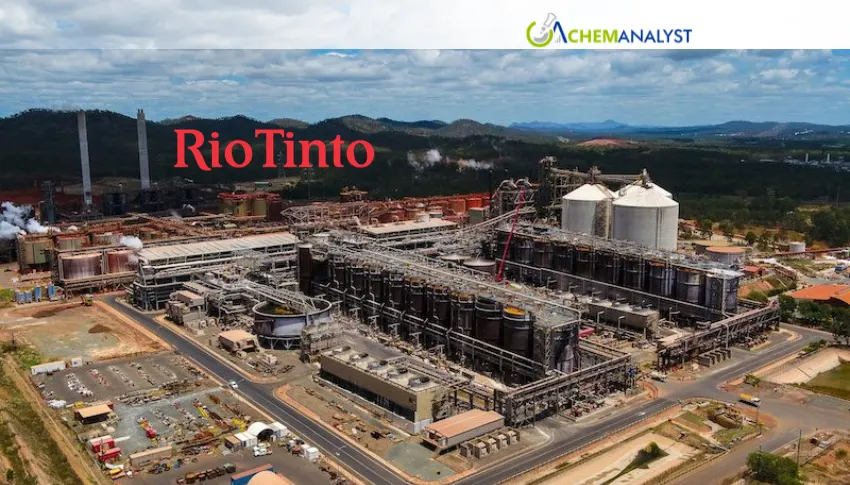
Rio Tinto has entered into a five-year bio pellet supply agreement with Australian bioenergy company SuperChar Limited (SCL), marking another significant step in its strategy to reduce fossil fuel consumption at its Gladstone alumina refineries in Queensland. The agreement outlines the supply of locally manufactured bio pellets, with commercial deliveries expected to begin in 2028. The partnership reflects Rio Tinto’s continued efforts to identify and implement lower-carbon energy alternatives for its alumina refining operations while supporting the development of regional renewable fuel supply chains.
The agreement follows an extensive series of operational trials and a detailed feasibility assessment conducted by Rio Tinto to evaluate the viability of bio pellets as a replacement for coal in refinery boilers. These studies demonstrated encouraging results, showing that bio pellets could substitute up to 30% of the coal currently used for steam generation under the tested operating conditions. Steam production is a critical process in alumina refining, making fuel substitution an important pathway toward lowering operational greenhouse gas emissions.
Building on these successful trials, Rio Tinto plans to conduct additional operational demonstrations using various blends of bio pellets and coal. The company intends to evaluate mixtures containing between 5% and 50% bio pellets to better understand their performance, efficiency, reliability, and compatibility with existing refinery infrastructure. These expanded assessments will help determine whether bio pellets can be integrated on a larger scale into day-to-day refinery operations while maintaining production efficiency and operational stability.
The agreement with SuperChar Limited serves as an initial supply arrangement, allowing both companies to validate the commercial and technical feasibility of the project before potentially increasing production volumes in the future. If the demonstrations prove successful, the partnership could pave the way for larger-scale adoption of biomass fuels across Rio Tinto’s alumina operations.
To support the supply agreement, SuperChar Limited intends to establish a dedicated bio pellet manufacturing facility in the Gladstone region. The plant will use bana grass as its primary feedstock. Bana grass is a fast-growing perennial energy crop that is well suited to the climatic conditions of Central Queensland. It offers high biomass yields, can be cultivated and harvested using conventional sugar cane farming equipment, and remains productive for more than 15 years after planting. These characteristics make it an attractive renewable feedstock for industrial bioenergy production while also providing opportunities for local agricultural diversification.
Initially, the planned production facility will have an annual output capacity of approximately 35,000 tonnes of bio pellets. According to current projections, supplying this volume to Rio Tinto’s Gladstone refineries could reduce the company’s reported Scope 1 greenhouse gas emissions by up to 90,000 tonnes of carbon dioxide equivalent each year under Australia's National Greenhouse and Energy Reporting framework. Such reductions would contribute meaningfully to Rio Tinto’s broader decarbonization objectives and support Australia's industrial emissions reduction efforts.
Rio Tinto Aluminium Pacific Operations Managing Director Armando Torres emphasized that reducing emissions from alumina refining will require a combination of innovative technologies, alternative fuels, and collaborative partnerships. He noted that the operational trials and feasibility studies have provided valuable technical insights, while the new agreement enables the company to further evaluate the practical implementation and scalability of bio pellet technology at its Gladstone operations. Torres also highlighted the project's potential to stimulate new agricultural and industrial supply chains across Central Queensland by creating stronger links between regional farming communities and heavy industry.
SuperChar Limited Executive Chairman Michael Palmer described the agreement as the result of several years of collaboration between the two companies. He stated that the partnership demonstrates the growing potential of locally cultivated, regeneratively produced biomass as a cleaner industrial fuel alternative while generating economic opportunities for regional communities. Palmer added that SuperChar looks forward to working closely with Rio Tinto and local stakeholders as the project progresses toward commercial deployment.
SuperChar plans to begin the phased cultivation of bana grass from late 2026, providing sufficient feedstock ahead of the planned commencement of bio pellet production in 2028. As the project advances, it is expected to strengthen Australia's emerging bioenergy sector while supporting Rio Tinto's long-term strategy to reduce dependence on fossil fuels and transition toward more sustainable industrial operations.
Product Impact and ChemAnalyst Price Impact
The agreement is expected to increase demand for bio pellets and bana grass, supporting the growth of Australia's biomass fuel industry while gradually reducing coal consumption at Rio Tinto's Gladstone alumina refineries. However, as commercial bio pellet supply will begin only in 2028, the immediate impact on fuel markets remains limited. For chemical commodities tracked by ChemAnalyst, the announcement is unlikely to influence near-term prices of caustic soda, bauxite, alumina, aluminium, calcined petroleum coke, or coal. Over the longer term, wider adoption of biomass fuel in alumina refining could marginally reduce thermal coal demand and improve the carbon footprint of alumina production without significantly affecting commodity prices.








 About ChemAnalyst
Leave a Comment
Comments (0)