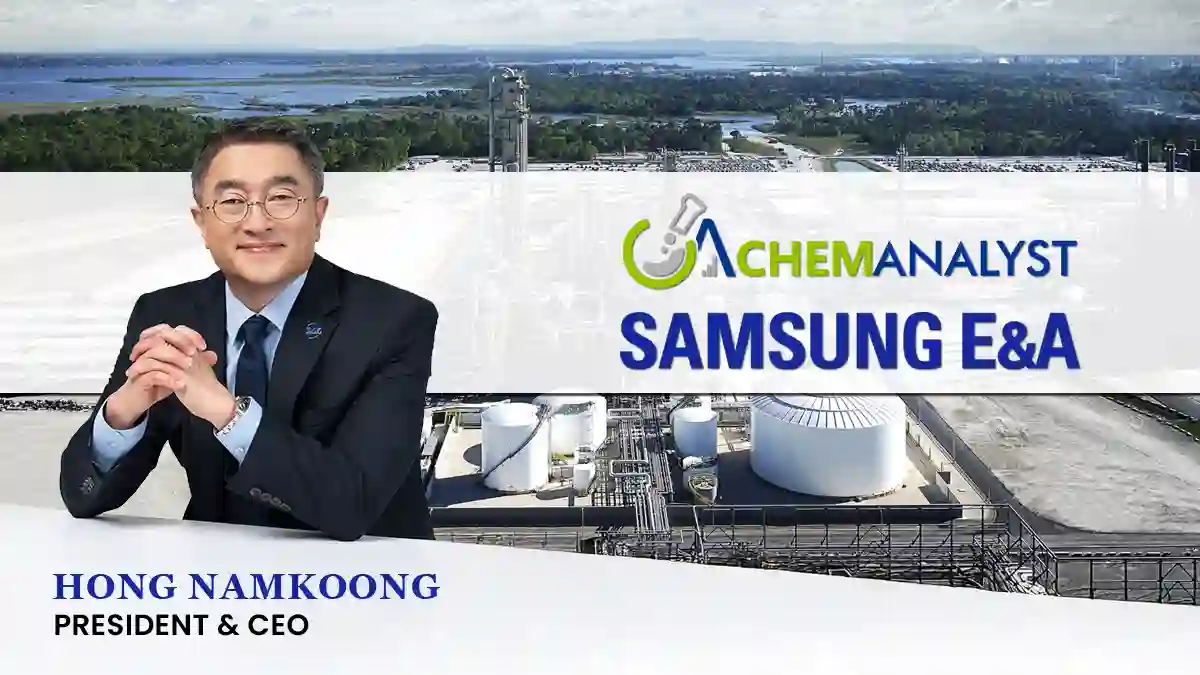
SAMSUNG E&A, a global EPC and engineering leader, is accelerating its shift toward low-carbon, technology-driven growth as it expands across the clean energy and sustainability value chains. With over 50 years of experience and more than 1,600 projects worldwide, the company delivers comprehensive solutions spanning oil and gas, petrochemicals, energy transition, environmental systems, industrial facilities, and bio-based technologies. Backed by strong engineering capabilities—from feasibility studies to full EPC execution and O&M—SAMSUNG E&A is leveraging digital innovation, advanced technology, and strategic global partnerships to shape its next phase in the evolving energy landscape. ChemAnalyst spoke with Hong Namkoong, President & CEO of SAMSUNG E&A, about the company’s evolution into a low-carbon technology leader, its strategic milestone projects such as the Wabash low-carbon ammonia facility in the United States, and its expanding collaboration network with global partners including Honeywell, Johnson Matthey, Carbon Clean, Svante, and GIDARA Energy. Namkoong shared insights into the company’s E&Able strategy—centered on Low, Zero, and Circle pillars—its growing presence in emerging hydrogen and SAF value chains, and its broader ambition to build a collaborative, technology-driven ecosystem that supports industries worldwide in achieving net-zero and circular-economy goals.
Complete Interview with Hong Namkoong
Q: Please share an overview of your leadership journey within the energy and engineering sectors. How have your experiences shaped SAMSUNG E&A’s transition toward low-carbon and technology-driven growth?
Hong Namkoong: Since its founding in 1970, SAMSUNG E&A has delivered over 1,600 projects across 48 countries, laying the foundation for growth in the global energy industry. I have been part of this journey for over three decades, taking on various roles and responsibilities since the 1990s and witnessing first-hand the major shifts in energy markets, the engineering industry, and technological innovation.
These experiences have played a pivotal role in shaping SAMSUNG E&A’s low-carbon and technology-driven growth strategy. After becoming President & CEO in 2023, I set forth a new vision for the company: ‘An engineering company that builds a better future with advanced technology.’ This reflects our commitment not only to leveraging our technology to achieve sustainable growth in the era of energy transition, but also to addressing broader societal challenges through engineering innovation.
Guided by this leadership philosophy, we are driving digital transformation and sustainable technologies as core engines of growth, and we are fully committed to delivering the technology and solutions that our clients and the market need. In practice, SAMSUNG E&A has recently achieved visible results in carbon capture, low-carbon hydrogen and ammonia, and clean fuel technologies. At the same time, we continue to advance technology development and business collaboration with global partners, positioning ourselves at the forefront of the global energy transition.
Q: SAMSUNG E&A recently secured a USD 475 million EPF contract for the Wabash Low-Carbon Ammonia Project in the U.S. What makes this project strategically significant for the company's re-entry into the North American energy market?
Hong Namkoong: The United States is the world’s largest EPC market and a leader in global energy transition trends. However, it has high entry barriers, and successful project execution requires high-level project management expertise, including a deep understanding of local regulations, labor environments, and stakeholder communication. As a result, only a limited number of global contractors have the capabilities to compete effectively in this market. Since entering the U.S. market with a Chlor-Alkali project in 2011 and successfully delivering the MEG project awarded in 2015, SAMSUNG E&A has steadily expanded its footprint and execution track record in the country.
The newly awarded Wabash Project is highly significant, as it not only continues SAMSUNG E&A’s performance in the U.S. market but also represents our first contract in the low-carbon ammonia sector. Located in West Terre Haute, Indiana, this state-of-the-art facility will produce 500,000 tons of ammonia annually while capturing and permanently storing 1.67 million tons of CO2.
Leveraging our advanced technical capabilities and extensive project experience, we plan to execute this project successfully and further strengthen our position in the North American energy market. In particular, through our partnership with Honeywell, we will apply world-class carbon capture technology while actively leveraging our digital twin, AI, and automation solutions to maximize efficiency and minimize risk throughout the project lifecycle.
Q: How does the collaboration with Honeywell on carbon capture technologies enhance SAMSUNG E&A’s ability to deliver advanced, sustainable energy projects globally?
Hong Namkoong: Although carbon capture has a long history in the oil and gas industry, bringing it to full commercialization still requires overcoming several challenges, such as scalability, cost efficiency, and operational stability. To expand carbon capture into non-hydrocarbon industries, such as power generation, cement, steel, and pulp and paper, highly optimized and economically viable solutions are essential. This is not something a single company can solve alone; it requires deep collaboration between technology leaders and EPC experts.
SAMSUNG E&A and Honeywell each bring world-class expertise to the partnership. SAMSUNG E&A contributes its global EPC capabilities, including project-integration expertise and innovative engineering solutions, while Honeywell offers proprietary process technologies together with enabling technologies such as advanced solvents and membrane systems.
Together, the two companies’ collaborative model enables optimized carbon-capture systems in ways that reduce CO2 removal costs while delivering high performance. Another significant advantage is that the solution can be applied to both new greenfield plants and existing industrial facilities, enabling a broader deployment of decarbonization technologies worldwide.
Q: SAMSUNG E&A's "E&Able" strategy focuses on Low, Zero, and Circle pillars. Could you elaborate on how this framework is driving innovation and guiding your investment decisions in clean energy projects?
Hong Namkoong: SAMSUNG E&A's E&Able strategy is our long-term roadmap for delivering sustainable solutions across the clean energy value chain. It is structured around three main pillars—Low, Zero, and Circle— and each pillar reflects a specific pathway for reducing emissions, enabling carbon-free energy, and creating circular value.
E&Able Low targets meaningful emission reduction in exiting industrial systems. This includes deploying carbon-capture technologies across hydrocarbon, industrial, and power plants, and developing low-carbon fuels like blue ammonia. The Wabash low-carbon ammonia project in the United States is a representative project aligned with this pillar.
E&Able Zero focuses on carbon-free fuels derived from renewable energy. This includes green hydrogen, green ammonia, e-SAF, and e-Methanol. These solutions are essential to achieving decarbonization and meeting global net-zero targets.
E&Able Circle supports the circular economy and environmental initiatives. It includes converting waste into new energy sources or materials, using sustainable materials such as biofuels and bioplastics, and applying environmental technologies that reduce impacts during plant operation, including water treatment and air-quality systems.
These three pillars serve as a strategic compass for SAMSUNG E&A, guiding our innovation priorities and shaping and executing our projects. We are collaborating with Carbon Clean, Svante, and Honeywell to advance next-generation carbon capture technologies. In the hydrogen sector, we invested in Nel, a leading electrolysis technology company, and launched CompassH2, a green hydrogen production solution. We also expanded our presence into the broader sustainability sector by winning a biodegradable plastic project in the UAE last May.
Through the E&Able strategy, SAMSUNG E&A is advancing across low-carbon solutions, carbon-free fuels, and circular economy projects. We aim to deliver integrated, end-to-end solutions that help industries transition toward a more sustainable and resilient future.
Q: Strategic partnerships are emerging as critical in sustainable energy transitions. How is SAMSUNG E&A leveraging alliances with Honeywell, Johnson Matthey, and GIDARA Energy to expand its role across the SAF and hydrogen value chains?
Hong Namkoong: SAMSUNG E&A’s strategic partnerships with Honeywell, Johnson Matthey, and GIDARA Energy are highly significant because together we provide a fully integrated, end-to-end “one-stop solution” for producing waste-based Sustainable Aviation Fuel (SAF).
Within this model, GIDARA?Energy supplies waste-to-gasification and syngas production technologies, converting waste streams into high-quality synthesis gas. Johnson Matthey then applies its proven catalyst and process technologies to upgrade this syngas into liquid fuel. Honeywell delivers plant design, digital automation, and control solutions that optimize overall plant operation and enable data-driven management. SAMSUNG E&A integrates these capabilities into a single optimized platform and leads the overall project execution as the EPC contractor and primary interface with clients. This integrated service model significantly enhances commercial competitiveness while reducing project schedules and lowering investment costs.
SAMSUNG E&A will further strengthen this partnership to accelerate the deployment of waste-to SAF plants globally and quickly respond to SAF mandate policies in Europe, Korea, and key markets. Through these efforts, the company is positioning itself as a key partner and enabler in the global transition to sustainable energy.
Q: The U.S. and Middle East markets are seeing renewed investment in low-carbon infrastructure. What regional opportunities or policy frameworks do you believe will most influence SAMSUNG E&A’s expansion strategy?
Hong Namkoong: In the US, federal policy is driving rapid expansion of low-carbon industrial infrastructure. The IRA provides meaningful incentives for carbon capture, low-carbon fuels, and clean hydrogen, attracting private sector investments. Our Wabash ammonia project is supported by this policy environment. SAMSUNG E&A plans to build on this momentum and strengthen our North America presence through the successful delivery of the Wabash project.
The Middle East is another key growth market for low-carbon infrastructure projects. Saudi Arabia and the UAE are investing at a scale under the Vision 2030 and their net-zero commitments. The region is well-positioned for both blue hydrogen projects that utilize existing hydrocarbon infrastructure and green hydrogen projects supported by its abundant solar resources.
SAMSUNG E&A is already engaged in the region through carbon-capture demonstration projects with Saudi Aramco and Carbon Clean that capture CO2 from gas-turbine exhaust. We plan to expand collaboration with partners in Saudi Arabia, the UAE, and other markets to advance projects across the full low-carbon value chain.
Q: Looking ahead, what is your long-term vision for SAMSUNG E&A's role in shaping a sustainable global energy ecosystem?
Hong Namkoong: SAMSUNG E&A aims to move beyond the role of a conventional EPC contractor and become a total solution provider—delivering integrated, end-to-end solutions essential for the transition to net zero, while helping address some of the most pressing challenges facing our world today.
However, no single company can deliver sustainable energy technologies alone. This is why we hosted the SAMSUNG E&A Tech Forum 2025 in Seoul this past June, creating a platform designed to integrate technologies and foster collaboration among companies to spark meaningful synergy. Under the theme “Weaving Technology Threads, Delivering Excellence,” the event brought together more than 500 participants from over 140 companies worldwide, sharing technology solutions and engaging in active discussion
Building on this foundation of innovation and technology leadership, SAMSUNG E&A will help shape a collaborative energy ecosystem—bringing together global leaders across sectors, creating new business models, and maximizing convergence and partnership opportunities across the entire energy value chain.







Leave a Comment
Comments (0)