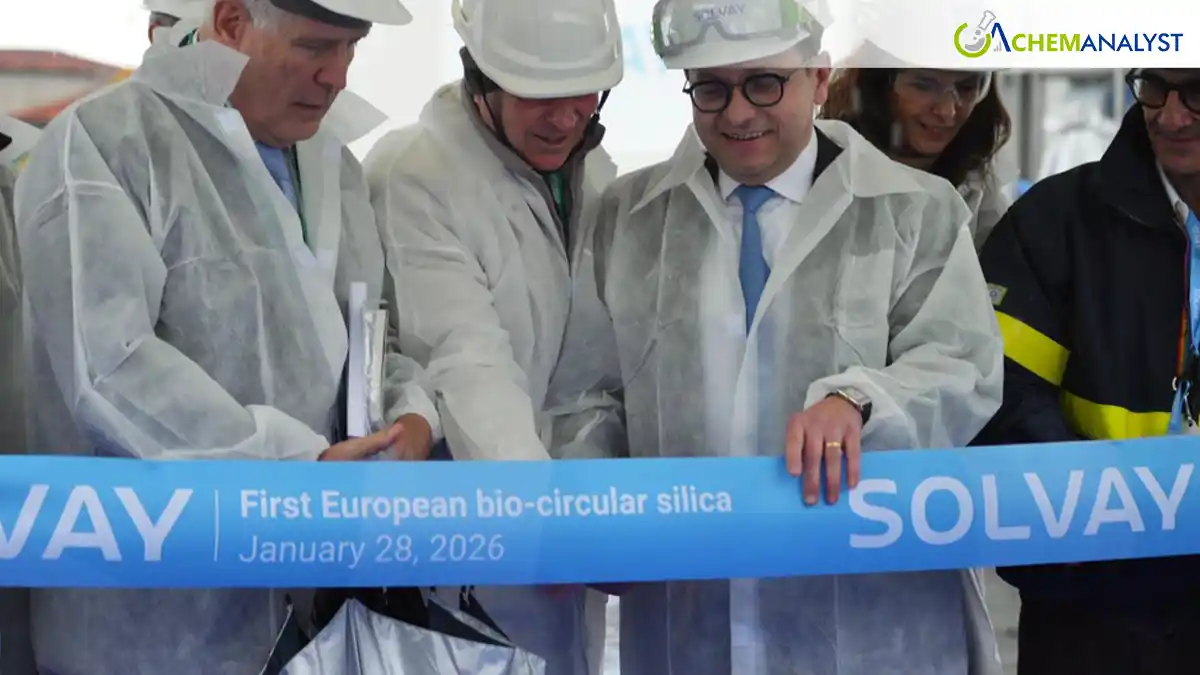
Solvay has officially inaugurated Europe’s first bio-circular silica production facility at its Livorno manufacturing site in Italy, marking a significant advancement in the region’s journey toward sustainable industrial practices. The launch represents a major step in aligning heavy industry with Europe’s long-term climate and circular economy ambitions, including the European Green Deal and the forthcoming Ecodesign for Sustainable Products Regulation (ESPR). At the same time, the investment reinforces Italy’s growing position as a strategic center for green innovation and sustainable manufacturing.
The newly commissioned facility produces highly dispersible silica (HDS) using bio-based sodium silicate sourced from rice husk ash—an agricultural residue generated as a byproduct of rice cultivation. By converting this waste stream into a high-performance industrial material, Solvay has successfully created a circular production model that reduces reliance on conventional raw materials while delivering measurable environmental benefits. Compared to traditional silica manufacturing routes, the innovative process cuts carbon dioxide emissions by approximately 35% per metric ton of silica produced.
Beyond emissions reduction, the project establishes a localized circular value chain that connects agriculture, industry, and surrounding communities. Rice husk ash, which might otherwise be discarded or underutilized, is now transformed into a valuable input for advanced materials used primarily in tire manufacturing. This approach not only reduces waste but also supports local agricultural economies and promotes resource efficiency across sectors.
Commenting on the milestone, Solvay CEO Philippe Kehren emphasized the strategic importance of acting early to support customers navigating upcoming regulatory changes. He noted that the Livorno facility demonstrates how circular economy principles can be translated into large-scale industrial operations, helping tire manufacturers prepare for stricter EU sustainability requirements while advancing their own environmental commitments. According to Kehren, the project reflects Solvay’s long-term vision of enabling sustainable progress for future generations.
The innovation has already attracted positive feedback from customers. Jana Striezel, Head of Purchasing at Continental Tires, highlighted the successful transformation of an agricultural byproduct into a high-performance material suitable for demanding tire applications. She stated that Continental is eager to increase its use of rice husk ash-based silica as a recycled material, citing strong performance results and alignment with the company’s ambitious sustainability roadmap focused on renewable and recycled inputs.
The Livorno inauguration forms a cornerstone of Solvay’s broader global circular silica strategy. Under this initiative, the company plans to transition its silica production sites worldwide to ISCC® PLUS-certified raw materials by 2026. While Livorno is the first site to utilize rice husk ash specifically, other facilities will adopt locally available industrial or bio-based waste streams, ensuring regionally tailored circular solutions.
By incorporating Solvay’s circular silica products, tire manufacturers can already achieve up to 15% recycled or renewable content in tire formulations—an important contribution toward industry targets of reaching 40% sustainable materials by 2030. According to An Nuyttens, President of Solvay’s Silica business, the Livorno site sets a new benchmark for circular innovation, with a clear objective to integrate circular materials across all silica production locations globally.
In addition to supporting circularity, the new facility strengthens Solvay’s leadership in silica solutions for energy-efficient tires. These materials play a critical role in reducing rolling resistance, lowering fuel consumption in conventional vehicles, and extending battery range in electric vehicles. The project also underscores Italy’s strategic importance within Solvay’s global sustainability roadmap, alongside ongoing investments in green hydrogen technologies and circular soda ash production.







Leave a Comment
Comments (0)