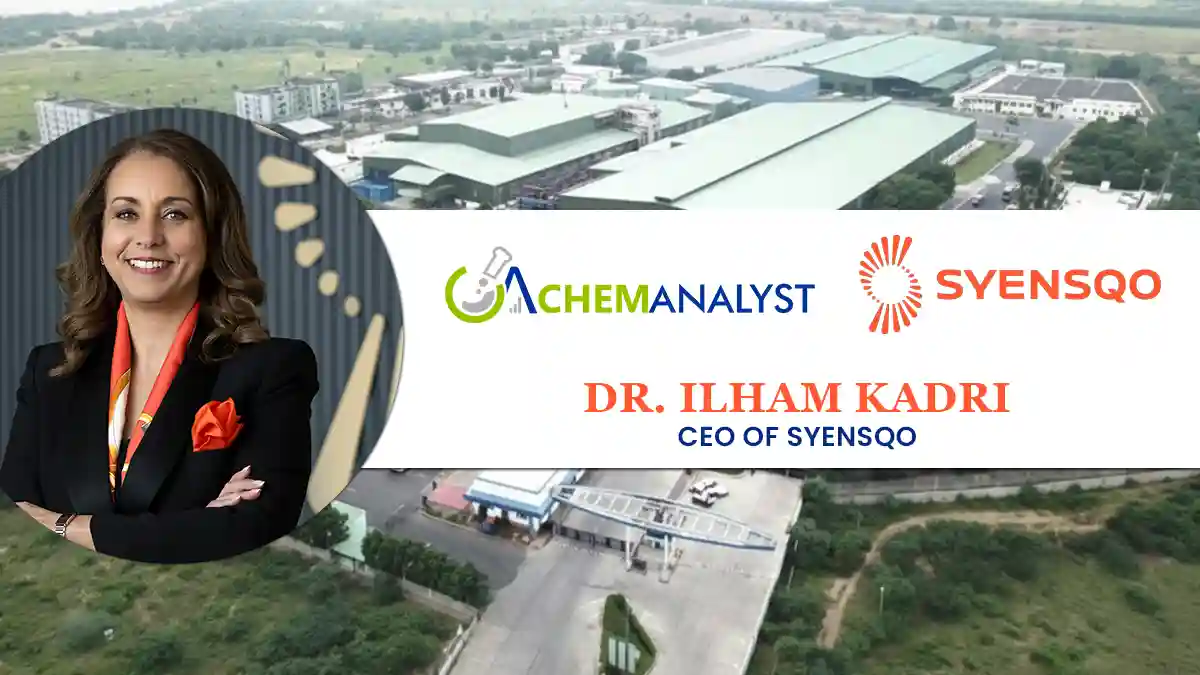
Syensqo, a global science and specialty materials company, is accelerating its evolution into an innovation-driven leader focused on advancing sustainable chemistry, clean mobility, and high-performance materials. With more than 13,000 associates across 30 countries, the company develops breakthrough solutions that improve everyday life—from safer Consumer Goods And Healthcare applications to advanced materials used in aerospace, electric vehicles, batteries, and smart electronics. Rooted in the scientific legacy of Ernest Solvay, Syensqo continues to unite leading researchers and innovators to push scientific boundaries and deliver technologies that support a more circular and sustainable economy. As global industries undergo rapid transformation, Syensqo is strengthening its portfolio around high-growth, high-margin segments such as renewable materials, biotechnology-enabled ingredients, lightweighting solutions, mining technologies, and electrification-ready Polymers. ChemAnalyst spoke with Dr. Ilham Kadri, CEO of Syensqo, about the company’s strategic transformation following its spin-off, the decision to divest its Oil & Gas Business Unit to SNF Group, and its sharpened focus on specialty markets aligned with electrification, circularity, and clean energy. Dr. Kadri shared insights into Syensqo’s innovation roadmap, sustainability investments, market dynamics across sectors such as defense, electronics, and healthcare, and the company’s efforts to build resilient supply chains amid global uncertainties.
Complete Interview with Dr. Ilham Kadri
Q: Please provide an overview of your professional journey and leadership experience across the specialty chemicals, materials science, and sustainability sectors. How have these experiences shaped your strategic vision at Syensqo in driving innovation, advancing specialty solutions, and creating sustainable value for customers in the new era of responsible chemistry?
Dr. Ilham Kadri: My entire career has been at the intersection of science, business, and sustainability — from leading global industrial operations to transforming specialty materials businesses. These experiences have strengthened my conviction that responsible chemistry is a powerful engine of innovation, competitiveness, and long-term value creation. At Syensqo, this conviction translates into a clear ambition: advance science to create breakthroughs that move humanity forward while reducing our environmental footprint. We have sharpened our focus on innovation, customer intimacy, and agility — and today more than 20% of our revenue comes from products introduced in the past five years, which shows how fast we reinvent our portfolio. Our R&I strategy is guided by sustainability and performance, accelerating ultra-high-purity materials for electronics, lightweighting solutions for aerospace, safer and more efficient healthcare polymers, and materials for electrification. Digitalization and AI are major accelerators, helping us design molecules faster, optimize manufacturing, and bring next-generation specialty solutions to market at record speed.
Q: Since Syensqo’s spin-off as an independent company, you have emphasized agility, customer intimacy, and innovation. How does the divestment strengthen these pillars, and what opportunities does it open for Syensqo to accelerate R&D investment in core segments like sustainable polymers, renewable materials, and advanced formulations?
Dr. Ilham Kadri: Independence has made Syensqo faster, more agile, and much closer to our customers. We simplified governance, empowered regional teams, and focused on two strong pillars, Materials, which now generate 70% of our EBITDA, and Consumer & Resources. The Oil and Gas divestment represents another important milestone. It sharpens our portfolio around differentiated, higher-margin businesses and frees up resources to accelerate innovation where we lead: sustainable polymers, renewable and bio-based materials, advanced formulations, mining solutions, and electrification-ready materials. It strengthens our ability to invest where science meets customer needs and where we can create the most sustainable value.
Q: Syensqo’s decision to divest its Oil & Gas Business Unit to SNF Group represents a major step in advancing your “pure play specialty” strategy. Could you elaborate on how this move aligns with Syensqo’s long-term portfolio transformation and strategic focus areas in high-growth specialty markets?
Dr. Ilham Kadri: Selling the Oil & Gas business to SNF Group is indeed a decisive step in our evolution and advances our pure-play specialty strategy. It aligns our portfolio with the structural trends shaping the future: electrification, lightweighting, healthcare, sustainable Agriculture, and advanced mobility.
SNF brings strong industrial logic: deep polymer expertise, scale, and a culture of operational excellence that will ensure continuity for customers and employees. For Syensqo, this move sharpens our focus on markets where we have differentiation, deep R&I capabilities, and structurally higher returns.
Q: The Oil & Gas Business generated around €400 million in 2024 sales, highlighting its significance within Syensqo’s portfolio. What factors—strategic, market-driven, or technological—convinced you that SNF Group was the right strategic owner to ensure the business’s continuity, growth, and employee well-being?
Dr. Ilham Kadri: The choice of SNF was guided by industrial logic and strategic alignment. SNF is a global leader in polyacrylamides, with the scale, portfolio, and market access needed to accelerate the long-term growth of the Oil & Gas business. Just as importantly, SNF shares our values: a strong focus on safety, sustainability, innovation, and employee development. The transaction ensures business continuity, and maintains trusted relationships with customers, while allowing Syensqo to concentrate on high-growth specialty markets where we bring unique technologies. With the right strategic owner, the agreement provides a positive outcome for our people and the business, thereby ensuring continuity for the customers of the Oil & Gas business.
Q: Syensqo has consistently emphasized sustainability as a growth engine rather than a compliance metric. How do you plan to reinvest proceeds from this divestment to strengthen sustainable value creation—whether through acquisitions, partnerships, or scaling breakthrough technologies in Green Hydrogen, bio-based materials, or low-carbon manufacturing?
Dr. Ilham Kadri: I strongly believe that sustainability is profitability. It protects business continuity, strengthens resilience, and creates long-term value for customers and shareholders. We are investing in organic projects, and in 2024, 5% of our sales were dedicated to Research and Innovation. We also increase capacity where our customers need it, and reward our investors. We will continue investing in the technologies that shape tomorrow’s sustainable economy. In green hydrogen, we are scaling our ionomers and membrane materials, which are essential to electrolyzers and fuel cells, and partnerships like Climate Impulse help us accelerate innovation in real-world conditions. In bio-based and natural chemistry, acquisitions such as JinYoung Bio and Azerys expand our capabilities in high-value natural ingredients and renewable carbon, complemented by our partnership, for instance with Botabio and the acquisition of our Boston Lab from Ginkgo Bioworks, which further strengthen our biotechnology and advanced R&I capabilities. We are also scaling circular and low-carbon materials, from non-fluorosurfactant fluoropolymers to recyclable composites and specialty polymers with recycled content.
Q: With the global energy transition accelerating, how does Syensqo intend to reposition its innovation pipeline to capture new opportunities in clean mobility, electrification, and circular chemistry while reducing exposure to traditional oilfield chemicals?
Dr. Ilham Kadri: Our innovation pipeline is already fully aligned with the energy transition, and we are directing our investments toward the high-growth value chains of clean mobility, advanced electrification, digitalization and circular chemistry. We are scaling the specialty materials that make EV Batteries, e-motors, power electronics, aerospace parts and renewable energy systems safer, lighter and more efficient, while advancing next-generation PVDF, ultra-high-purity polymers and bio-based, recyclable solutions.
A key enabler is our Renewable Materials and Biotechnology platform, which brings chemistry and biology together to convert renewable feedstocks into sustainable, biodegradable-by-design ingredients and materials. This supports our ambition to grow circular solutions to 18% of sales by 2030.
To accelerate this shift, we opened a world-class microbiology, (eco-)toxicology and biotechnology lab in Lyon, strengthening our testing capabilities and speeding time-to-market for next-generation bio-based solutions. Combined with Syensqo.AI and our expanding AI lab ecosystem, we can design molecules faster, optimize resources and scale breakthrough technologies at record speed.
In short, our innovation roadmap is firmly positioned to support the energy transition and help our customers move toward a circular, bio-based and electrified economy, while naturally reducing our exposure to traditional Oilfield Chemicals.
Q: In terms of demand, what global challenges do you see currently for the advanced mobility and defence, energy, electronics and healthcare markets, since they are the core business sectors of Syensqo?
Dr. Ilham Kadri: Demand remains uneven across our core markets due to macroeconomic and geopolitical uncertainty. The underlying demand for defense is and is expected to remain strong, while advanced air mobility is an evolving market segment that brings great opportunities for innovation and growth in the mid to long term. In energy, the shift toward renewables creates long-term growth, but short-term volatility persists due to tariffs and investment cycles. Electronics remains soft as customers digest inventories, with recovery expected in 2026. Healthcare continues its steady growth path, driven by innovation and increased access to advanced technologies. Despite short-term softness, the megatrends — lightweighting, electrification, sustainability — remain intact and support our long-term growth.
Q: In the past few years we have seen multiple conflicts across different countries. What change in demand have you seen in Syensqo’s defence business and who do you think is going to be the biggest market (regions/countries) of defence equipment in terms of consumption in coming years?
Dr. Ilham Kadri: Defense spending has increased as countries reinforce security and supply resilience. For Syensqo, this translates into growing demand for our advanced composites used in military aircraft, space systems, and next-generation air and defense platforms. The strongest momentum is in the United States and Europe, where budgets are expanding, and in other allied counties, where modernization programs are accelerating. Our exposure remains balanced across regions and fully compliant with all international regulations and export controls. Defense will remain a stable, high-value, long-term market for Syensqo.
Q: In 2025 (till now), what major challenges have Syensqo come across in terms of supply chain or if there are any other major challenges Syensqo faced?
Dr. Ilham Kadri: 2025 has been shaped by tariff uncertainty, global supply-chain disruptions, and softer-than-expected demand in several end markets. Electronics remained weak due to extended inventory adjustments; aerospace was affected by prolonged destocking at a major customer; and our mining business felt the impact of a temporary Copper Mine closure. Cost inflation in key raw materials and a stronger euro added further headwinds. Internally, we continued our multi-step reorganization to enhance agility and efficiency. These factors required disciplined execution, diversifying sourcing, raising reliability, advocacy measures, cost control, and close engagement with customers.
Q: In the current world, rare earth minerals seem to be playing the key role in geopolitical power shifts, and the lack of their availability has been affecting global businesses. How does Syensqo tackle such challenges?
Dr. Ilham Kadri: Please note that Syensqo does not purchase rare earth elements, but we do purchase critical minerals. Critical minerals are essential for many of the value chains we support, from batteries to semiconductors. We manage supply risk through diversified sourcing, region-for-region production models, long-term partnerships, and robust supplier engagement. Our mining solutions also help customers increase metal recovery and recycling, reducing reliance on virgin materials. Through collaboration and innovation, we aim to build more resilient and circular supply chains.
Q: Under the current geopolitical scenarios and economic uncertainties, what do you think the short term (6 Months) future of the global Crude oil market?
Dr. Ilham Kadri: In the short term, the crude market will remain volatile. With Brent and WTI hovering around 60 dollars a barrel, what we see today is a market that is more “managed” than fundamentally tight. Demand is still growing, but more slowly, and OPEC+ is using supply discipline to keep prices in this range rather than push for a new spike.
At these levels, producers can sustain existing output and selective, low-cost projects, but it’s not enough to trigger a new wave of large, long-cycle investments. So over the next six months, I expect prices to oscillate around today’s levels, unless a major geopolitical shock disrupts supply.
For Syensqo, and particularly as we exit Oil & Gas, this means staying prepared for price noise and short-term fluctuations, but not anticipating a structural upswing driven by new investment cycles.







Leave a Comment
Comments (0)