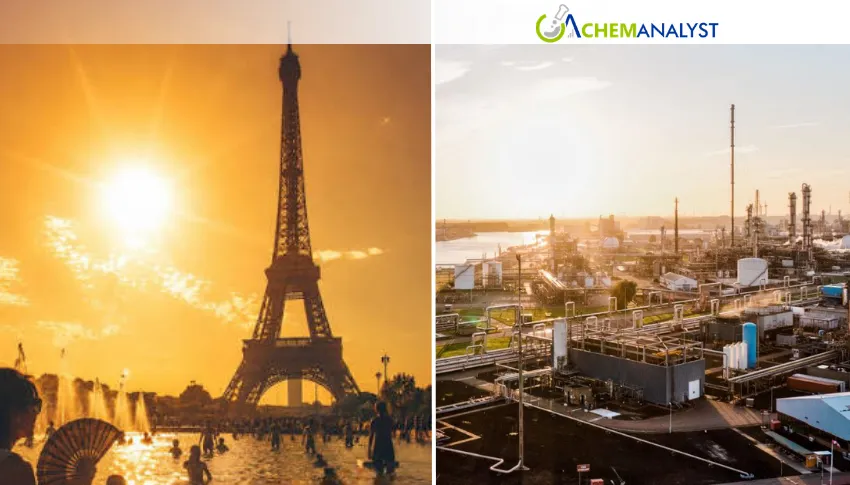
An intense early summer heatwave sweeping across Western and Central Europe is placing additional pressure on the region's energy-intensive chemical industry, as record-breaking temperatures disrupt energy supply, transportation networks, and industrial operations. Temperatures exceeding 40°C across France, Germany, Italy, Switzerland, Belgium, and parts of the UK have lowered river water levels, reduced nuclear power generation, and strained critical infrastructure, raising concerns over production costs and supply reliability for Europe's chemical sector.
One of the most immediate impacts has been on France's nuclear power generation, where elevated river temperatures have limited cooling water availability, forcing utility operator EDF to reduce reactor output by 7%. Lower electricity generation is expected to increase wholesale power prices, directly affecting chemical manufacturers that rely heavily on continuous electricity consumption, including producers of chlor-alkali chemicals, ammonia, methanol, fertilizers, polymers, and other petrochemical intermediates.
Transportation has also emerged as a growing concern. Water levels on the Rhine River, one of Europe's most important chemical logistics corridors, have fallen below operational thresholds near the Kaub chokepoint, restricting vessel loading capacity and increasing freight costs for raw materials and finished chemicals. Although river traffic continues, lower cargo volumes per vessel are expected to increase transportation costs and lengthen delivery times if dry weather persists. At the same time, rail networks across France, Belgium, Germany, and the UK have experienced service disruptions as prolonged daytime and nighttime heat affects infrastructure, creating additional logistical challenges for chemical supply chains.
The extreme temperatures are also increasing operational risks for petrochemical and refining facilities. Extended heat places mechanical stress on production equipment, reduces cooling efficiency, and raises maintenance requirements. While reports of production interruptions at several European chemical facilities remain unconfirmed, market participants continue to monitor operating rates closely as prolonged heat can reduce refinery throughput and petrochemical production efficiency.
Demand across the chemical sector is expected to remain uneven. The prolonged heatwave is likely to boost seasonal demand for polyethylene terephthalate (PET) resin as beverage manufacturers increase bottle production during the summer. However, this support is expected to be limited to the PET segment, while most other chemical markets may continue to face pressure from elevated energy costs, transportation disruptions, and cautious downstream demand.
Beyond the immediate market impact, the prolonged heatwave is reinforcing expectations for greater investment in climate adaptation and energy infrastructure. Growing demand for cooling systems, power-grid modernization, renewable energy, and energy-efficient industrial technologies are expected to support long-term investment across Europe's industrial sector. However, in the near term, the combination of reduced nuclear generation, lower Rhine water levels, transportation disruptions, and elevated operating costs is likely to keep Europe's energy-intensive chemical markets under pressure until weather conditions normalize.







 About ChemAnalyst
Leave a Comment
Comments (0)