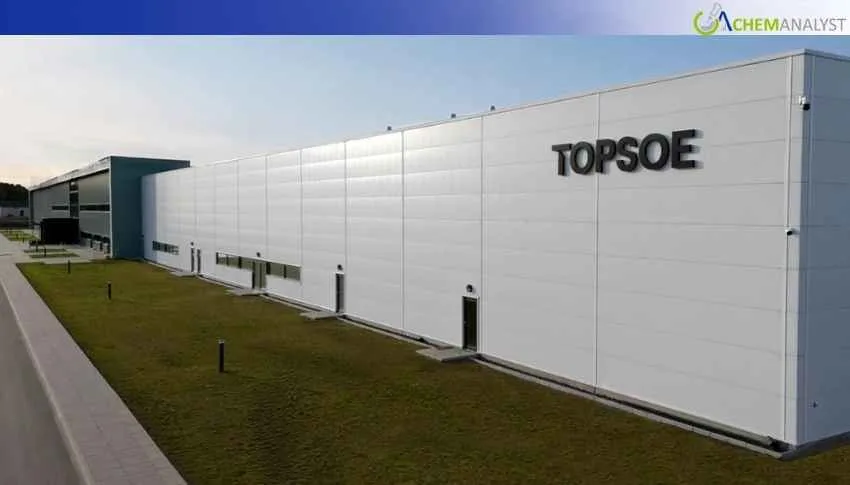
Topsoe and Maersk Training have announced a strategic collaboration aimed at defining and raising safety benchmarks across the rapidly expanding Power-to-X industry. As countries and companies accelerate investments in low-carbon fuels and energy carriers to meet global climate targets, the two organizations are emphasizing that safety must evolve at the same pace as technology deployment.
Power-to-X solutions, which convert renewable electricity into fuels and chemicals such as green hydrogen, e-methanol, and e-ammonia, are transitioning from pilot stages to large-scale industrial operations. While this growth is essential for decarbonization, it also introduces new operational risks linked to unfamiliar processes, high-energy systems, and evolving regulatory frameworks. Topsoe and Maersk Training believe that without robust, forward-looking safety frameworks, the industry risks repeating challenges seen in earlier industrial transitions, where technology advanced faster than workforce preparedness and safety standards.
The partnership draws on complementary strengths. Topsoe brings decades of experience in advanced energy technologies and deep technical understanding of Power-to-X processes, while Maersk Training contributes nearly half a century of expertise in training professionals who operate in complex, high-risk environments. Together, they aim to design safety programs that are not only compliant with existing regulations, but also realistic, practical, and adaptable to future developments.
Sundus Cordelia Ramli, Chief Commercial Officer for Power-to-X at Topsoe, highlighted the urgency of proactive action. She noted that the Power-to-X sector is scaling at a speed that often outpaces regulation, making industry-led safety leadership essential. By combining Topsoe’s technological insight with Maersk Training’s competency-based training methodologies, the collaboration seeks to ensure that safety is embedded from the earliest stages of industry development. The objective is to create a foundation built on competence, preparedness, and a genuine culture of care for people working on the front lines.
From Maersk Training’s perspective, the collaboration reflects a long-standing belief in the value of partnerships. Per Larsen, Head of Innovation and Product Management, emphasized that while Maersk Training has decades of experience in delivering safety training, working alongside technology leaders like Topsoe strengthens the relevance and effectiveness of training solutions. He stressed that the initiative goes beyond fulfilling formal requirements, focusing instead on equipping personnel with the right skills, decision-making abilities, and mindset to manage real-world risks.
Central to the collaboration is the development of realistic simulations, role-based and risk-focused learning modules, and competency-driven training pathways. These elements are designed to help organizations identify hazards early, build the right capabilities efficiently, and avoid duplication that can occur when multiple regulatory regimes, legacy training systems, or overlapping hazards intersect. By aligning training closely with actual operational roles and risks, the framework aims to deliver targeted learning that improves safety outcomes while remaining practical and scalable.
Ultimately, Topsoe and Maersk Training intend for their joint efforts to support a safer, more resilient Power-to-X industry. By addressing safety proactively rather than reactively, the partnership aims to help the sector grow responsibly, protecting people, assets, and the long-term credibility of Power-to-X technologies as a cornerstone of the global energy transition.







Leave a Comment
Comments (0)