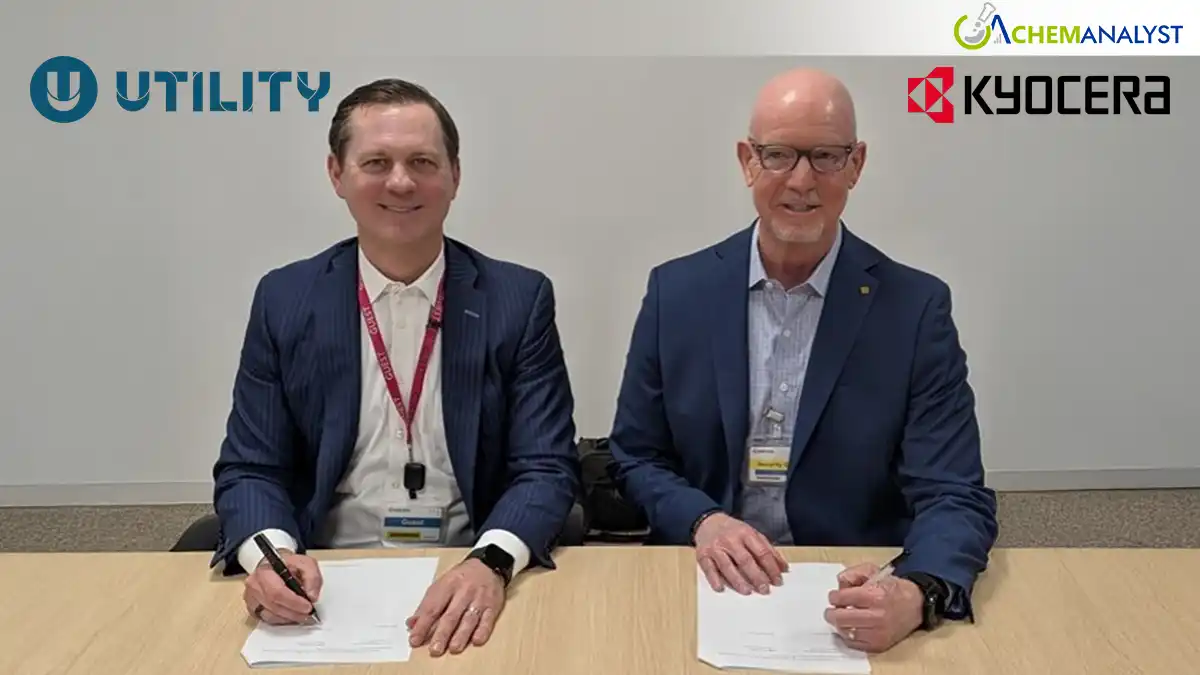
Utility Global, a U.S.-headquartered company focused on delivering economically viable solutions for industrial decarbonization, has announced a strategic manufacturing partnership with Kyocera International, Inc. The collaboration is aimed at scaling up the global production of Utility’s proprietary electrochemical cells, a critical component of its H2Gen® systems. By expanding manufacturing capacity and accelerating commercialization, the partnership seeks to support the rapid deployment of H2Gen technology across hard-to-abate industrial sectors such as steelmaking, oil refining, petrochemicals, and chemicals—industries that face significant challenges in reducing carbon emissions while maintaining cost competitiveness.
At the core of the agreement is the integration of Utility Global’s ceramic-metal electrochemical cell technology with Kyocera’s advanced materials expertise and extensive global manufacturing infrastructure. Kyocera, widely recognized for its leadership in engineered ceramic materials, brings decades of experience in precision manufacturing, quality assurance, and large-scale production. Together, the two companies plan to significantly increase electrochemical cell output, improve production efficiencies, and shorten time-to-market for H2Gen systems as global demand for cost-effective decarbonization solutions continues to grow.
Parker Meeks, President and Chief Executive Officer of Utility Global, described the collaboration as a major milestone for the company. He emphasized that Kyocera’s reputation as a world-class advanced materials manufacturer, combined with its global footprint, makes it an ideal partner to help Utility meet accelerating customer demand. By uniting Utility’s breakthrough materials science, ceramic-metal fabrication techniques, and coating know-how with Kyocera’s proven manufacturing excellence, the partnership is expected to enable faster and broader deployment of H2Gen technology in regions of strategic importance to Utility’s industrial customers.
The partnership framework includes the development of high-volume production lines, close collaboration on advanced materials engineering and manufacturing automation, and joint quality, reliability, and durability testing. These efforts are designed to meet the stringent operational requirements of heavy industry customers worldwide, many of whom are committed to lowering the carbon intensity of their products and operations—provided that emissions reductions do not undermine their core economics. Utility’s H2Gen technology directly addresses this concern by delivering decarbonization without imposing prohibitive costs.
As an initial step, Utility and Kyocera plan to establish a dedicated manufacturing hub at Kyocera’s Fine Ceramics facility in Hendersonville, North Carolina. Initial production capacity is expected to be operational by 2026. Beyond this first phase, the companies anticipate expanding manufacturing capabilities to additional global locations, aligning capacity growth with the increasing scale and geographic reach of Utility’s industrial decarbonization projects.
Jeff Osmun, Vice President of Kyocera International’s Fine Ceramics Group, noted that the partnership aligns closely with Kyocera’s long-standing philosophy of addressing societal challenges through business innovation. By leveraging its expertise in high-performance ceramic materials and components, Kyocera aims to support carbon neutralization efforts and contribute to the realization of a more sustainable global economy. Partnering with Utility Global, he added, represents a meaningful step toward that objective.
This manufacturing agreement builds on Utility Global’s recent commercial momentum and further reinforces its position as a disruptive force in industrial decarbonization. Utility offers customers two core value streams: clean hydrogen that can be used as a low-to-negative carbon energy source, fuel, or feedstock, and a high-purity carbon dioxide byproduct that can exceed 95% purity in refining and petrochemical applications. Together, these outputs have the potential to significantly reshape the economics and physical footprint of carbon capture, utilization, and storage (CCUS).
Utility’s patented H2Gen technology is particularly distinctive because it produces clean hydrogen from water by utilizing electrochemical energy contained in existing industrial off-gases, without requiring electricity. By eliminating dependence on new electrical power and grid infrastructure, H2Gen dramatically reduces hydrogen production costs while simultaneously generating a separate, high-purity CO2 stream. This compelling economic proposition has driven strong interest from heavy industry players worldwide, especially in the steel sector.
Steelmaking represents a major opportunity for impact, as blast furnace-based production accounts for more than 70% of global steel output and over 85% of the sector’s total emissions. Utility recently announced a project with ArcelorMittal in Brazil, where blast furnace off-gas will be used to decarbonize integrated steel production—highlighting the real-world applicability of H2Gen at industrial scale.
By partnering with established global manufacturers such as Kyocera, Utility Global is strengthening supply chain resilience, improving product reliability, and enabling faster, multi-continent project execution. The scalable manufacturing of H2Gen systems supports both smaller projects and large, modular industrial deployments, aligning well with global trends toward economically competitive decarbonization of heavy industry. With active customer projects spanning this full range, Utility’s modular H2Gen technology is positioned to play a significant role in the global transition to lower-carbon industrial production.







Leave a Comment
Comments (0)