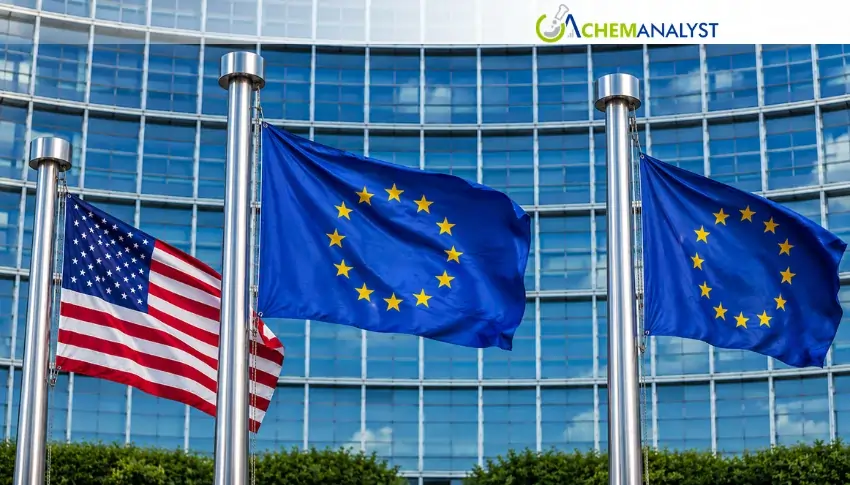
The European Union has formally cleared the way for duty-free entry of US chemicals into its market, locking in the tariff side of the EU–US trade framework through a regulation that takes virtually all American chemical chapters to a zero customs rate — even as European producers shipping the other way remain saddled with a 15% US levy.
The Regulation of the European Parliament and of the Council "on the adjustment of customs duties on imports of certain goods originating in the United States" (document PE-CONS 32/26), agreed in its consolidated form on 17 June 2026, implements the tariff commitments the EU made under the 21 August 2025 Joint Statement on a EU–US Framework on Reciprocal, Fair and Balanced Trade. Parliament fixed its position on 16 June; the Council closed out the legislative procedure with final adoption on 25 June. The measure enters into force the day after publication in the Official Journal and runs until 31 December 2029, subject to a built-in sunset and review.
For chemical procurement teams on both sides of the Atlantic, the headline is simple to state and harder to digest: Europe has unilaterally removed the last tariff friction on US-origin chemicals, while securing nothing symmetrical in return on its own chemical exports.
What actually changes at the EU border
Under Article 1, goods originating in the United States and falling under the Combined Nomenclature codes in Annex I enter the EU at a 0% customs duty. The annex is sweeping on the chemicals side. It captures, in full, CN Chapter 28 (inorganic chemicals), Chapter 30 (pharmaceuticals), Chapter 31 (fertilisers), Chapter 32 (tanning and dyeing extracts, pigments, paints, varnishes and inks), Chapter 34 (soaps, surfactants, lubricating preparations and waxes), Chapter 39 (plastics and articles thereof) and Chapter 40 (rubber and articles thereof). Mineral fuels and oils (Chapter 27), salt and sulphur (Chapter 25) and ores and slag (Chapter 26) are in as well, alongside prepared glues and adhesives (heading 3506) and enzymes (heading 3507).
Two chapters carry a deliberate "ex" carve-out. Chapter 29 (organic chemicals) goes to zero except mannitol (2905 43) and D-glucitol/sorbitol (2905 44). Chapter 38 (miscellaneous chemical products) goes to zero except textile and paper finishing agents (3809 10) and sorbitol classified under 3824 60. Essential oils and perfumery (Chapter 33) is liberalised except for the odoriferous-substance mixtures of subheading 3302 10 used in food and beverage manufacture.
Those exceptions are not oversights. They are the tell.
The quota carve-outs are the real signal
What Brussels pulled out of the blanket 0% list, it slotted into Annex III as managed tariff-rate quotas — a softer, capped form of access that lets the EU keep a hand on the tap. For the chemical sector, three quotas matter:
• Mannitol and sorbitol (2905 43 and 2905 44): a 0% in-quota rate, capped at 2,500 tonnes per 12-month period (order number 09.9018).
• Odoriferous substances (3302 10 29, aroma preparations for the drinks industry): 0% in-quota, capped at 1,400 tonnes (09.9019).
• Dextrins and other modified starches (3505 10): 0% in-quota, capped at 11,000 tonnes (09.9020).
The logic is protective. Polyols such as sorbitol and mannitol sit at the intersection of food, pharma excipient and specialty-chemical demand, and Europe hosts entrenched producers in exactly these starch-derivatives and polyol value chains. By metering US volumes through a quota rather than opening the gate completely, the EU preserves a competitive buffer for domestic suppliers while still nodding to the deal's liberalisation logic. Procurement teams sourcing US sorbitol, mannitol or modified starches should treat duty-free access as a finite allocation, not a standing entitlement — once the annual quota volume is exhausted, standard MFN duties reapply for the rest of the period.
The asymmetry procurement can't ignore
The strategic substance of this regulation is competitive, not arithmetic. EU import duties on most chemicals were already low — averaging around 1% under the 1994 Chemical Tariff Harmonization Agreement — so the absolute duty saving on a tonne of US-origin polyethylene, base inorganic or specialty intermediate is modest. The realignment that matters is relative.
European chemicals exported to the United States now carry a 15% all-inclusive tariff, up from roughly 1% before the 2025 escalation. US chemicals landing in Europe carry 0%. The US is the European sector's single largest export market — on the order of €40 billion a year — so the one-way nature of the arrangement compounds a competitiveness gap that European producers were already feeling through high energy costs and soft domestic demand.
Layer the duty change onto the underlying feedstock picture and the direction of travel sharpens. US petrochemical producers run on advantaged shale-derived ethane economics; removing the final tariff friction on their exports into the EU lowers their landed cost at precisely the moment European crackers are fighting margin compression. For EU buyers, that can mean keener pricing and a wider US supplier bench for polymers, intermediates and base chemicals. For EU producers, it sharpens import-substitution risk in their home market. ChemAnalyst's read is that the near-term effect shows up less as a step-change in headline commodity prices and more as gradual landed-cost parity that pulls incremental US tonnes into European ports.
Steel and aluminium: the one-way street stays one-way
The deal's most conspicuous imbalance is in metals. Annex I takes EU duties on iron and steel (Chapters 72 and 73) and aluminium (Chapter 76) to zero — but the Joint Statement never extended the 15% ceiling to these sectors, so the United States continues to apply 50% Section 232 tariffs on EU steel and aluminium and their derivatives. The regulation answers with leverage rather than retaliation: Article 3 empowers the Commission to suspend the 0% concession on Chapters 72, 73 and 76 if, on 31 December 2026, the US is still charging above 15% on EU steel and aluminium derivative products, with a status report due to Parliament and Council by 1 December 2026. Buyers of metal drums, IBCs, process equipment and packaging on transatlantic routes should track that December checkpoint closely.
Guardrails: the zero is not unconditional
Two mechanisms keep the door able to swing shut. Article 3 lets the Commission suspend the duty cuts and quotas, in whole or in part, if Washington fails to implement the Joint Statement, undermines its objectives, discriminates against EU operators, or even where there is sufficient indication it will do so — explicitly including the unresolved question of how the US treats EU exports following the temporary import surcharge imposed in February 2026. Article 4 adds a safeguard: if duty-free imports or quota volumes surge enough to cause or threaten serious injury to EU industry — and the definition of "Union industry" expressly covers chemical and industrial producers — the Commission can re-impose duties. Three or more member states, or the affected industry itself, can trigger an investigation.
The practical takeaway for sourcing strategy: the 0% rate is real today, but it is policy-contingent and reversible, with the Commission empowered to act swiftly on substantiated complaints.
What to watch
The Commission must report on trade volumes and values every three months starting six months after entry into force, with a comprehensive assessment — including the impact on customs revenue and on SMEs — due by 30 June 2029 and a possible proposal to extend beyond the 31 December 2029 sunset. For chemical markets, the live indicators are clear: the December 2026 steel-and-aluminium decision point, the take-up rate against the sorbitol/mannitol, aroma-chemical and dextrin quotas, and any sign that surging US polymer or intermediate volumes prompt a safeguard filing from European producers.
For now, the message to chemical buyers is that the EU has made US-origin material cheaper to import and easier to qualify into the supply base — while the cost of selling European chemistry into America stays exactly where the 2025 tariffs left it.







Leave a Comment
Comments (0)