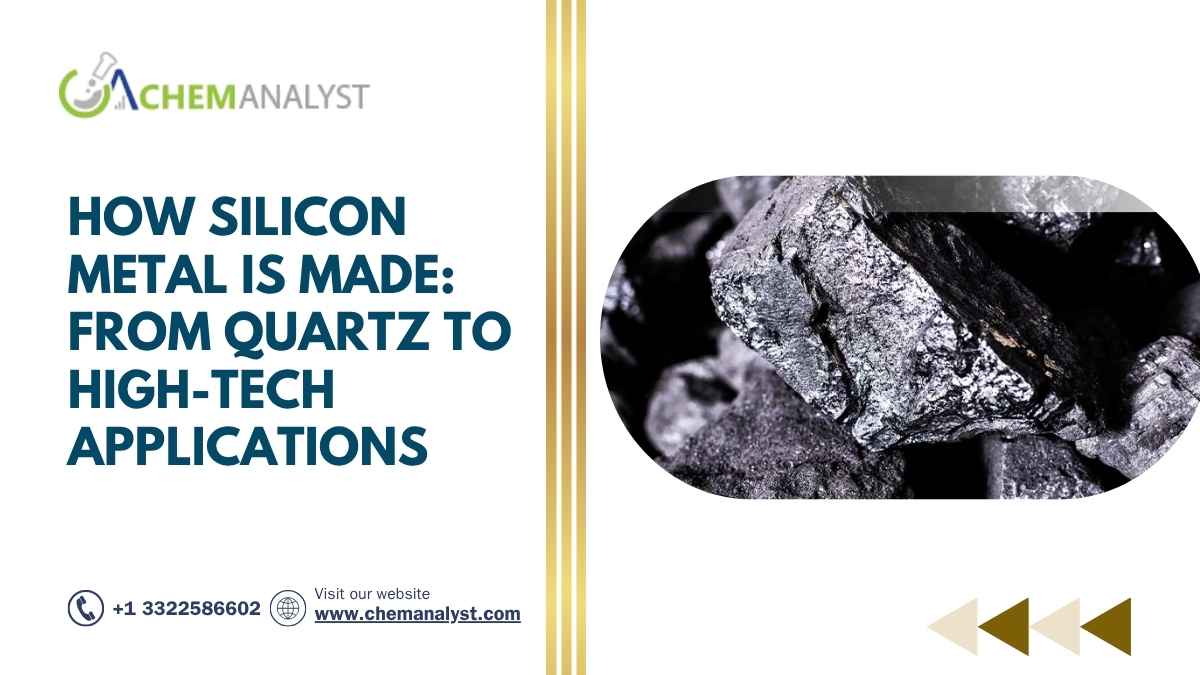
Silicon metal is essential for aluminum alloys, silicones, solar panels, and electronics. Its energy-intensive production consumes 11–13 kWh/kg and emits up to 5 tons CO2/ton. Enhancing furnace efficiency, cutting emissions, and scaling output are key industry priorities.
https://www.chemanalyst.com/Pricing-data/aluminium-alloy-ingot-1358Introduction:
Silicon metal is a critical industrial material, finding its way into modern technologies ranging from aluminum alloys and silicones to solar panels and, indirectly, semiconductor devices. Most of the world’s silicon metal (roughly 45%) is alloyed into aluminum and about 35% is used to make silicone. Smaller but growing shares go into solar photovoltaic cells and electronics. Because silicon metal is used in such high-tech fields, understanding its production process is vital. Production drives both cost (due to high energy use) and environmental impact: today’s furnaces consume on the order of 11–13 kWh of electricity per kilogram of silicon and emit roughly 4.7–5 tons of CO2 per ton of silicon. Improving furnace efficiency, reducing emissions, and scaling capacity are therefore key industrial challenges.
Overview of the Production Process
• Slicon metal is typically made in large, submerged arc furnaces (SAFs). These furnaces run continuously: raw materials are continually charged from the top, and molten silicon and slag are tapped (drained) in periodic batches. In practice, furnaces often use self-baking graphite electrodes that burn off and are replaced as needed. Charging (“feeding”) is continuous, but tapping and emptying the furnace happens in intermittent steps.
• Inside the furnace, high temperatures (≈1800–2000 °C) drive the carbothermic reduction of quartz (SiO2). In a simplified reaction, solid quartz mixed with carbon (e.g. coke) yields molten silicon and carbon monoxide gas: SiO2 + 2C → Si + 2CO. (In reality, intermediate steps produce SiO gas and silicon carbide (SiC) that eventually convert to silicon.) The intense electric arc provides heat, causing SiO2 to dissociate. The silicon collects at the furnace bottom and is later tapped off.
• Modern SAFs are quite efficient. Some report silicon yields up to ~90% of the theoretical maximum. However, not all the silica is converted to silicon. A significant fraction (~8–15%) of the feedstock exits as silica fume (microsilica dust) when escaping gases (CO/SiO) reoxidize outside the furnace. In practice, a typical silicon plant produces on the order of 200–400 kg of silica fume per tonne of silicon metal. This very fine amorphous SiO2 (85–98% SiO2) is captured by filters and often recycled (e.g. as cement additive).

Raw Materials and Input Requirements
Critical inputs for silicon metal production include:
• Quartz (SiO2): High-purity silica (often quartzite or sand) is the silicon source. Quartz should be very clean (minimal impurities) to maximize silicon yield and quality. Quartz is abundant worldwide and resources are plentiful, but only high-grade silica (typically >98% SiO2) is suitable.
• Carbon Reductants: A mix of carbon materials provides the chemical reducing power. Common reductants include anthracite and petroleum coke, as well as charcoal or woodchips. These serve both as reactants and heat sources. Plant-based carbon (biocarbon) such as charcoal or wood charcoal is often blended in (on the order of 10–20% of the carbon) to improve charge reactivity and permeability. (In practice, manufacturers choose proportions based on local cost and availability.)
• Carbon Electrodes: Large graphite electrodes conduct electricity into the furnace. Typically three vertical electrodes extend into the charge; they burn (oxidize) over time and must be replenished. Carbon electrodes are specially made (graphite or electrographite) to carry the high currents and withstand the >2000 °C temperatures.
• Additives: In some processes small amounts of other materials may be added. For example, woodchips act as a binder in the charge. Fluxing agents (like limestone or CaF2) are more common in ferroalloy furnaces than pure silicon, but trace minerals may be used to aid slag fluidity.
• Energy: Electricity is a major “input.” A typical SAF requires on the order of 10–13 MWh of electric energy per tonne of silicon (equivalent to ~11–13 kWh/kg). The power drives the arc that melts and reduces the charge.
Major Production Routes
• Traditional Carbothermic Reduction (SAF): Nearly all silicon metal today is made by carbothermic reduction in electric submerged-arc furnaces. These furnaces use a mixture of quartz and carbon under an electric arc to produce silicon (and CO/CO2). No catalyst is used – the high heat alone drives the reaction.
• Regional Preferences: China is by far the largest producer, accounting for roughly 80% of global silicon metal output in recent years. Chinese plants typically use large SAF units fueled by a mix of coal, coke and wood-based reductants. Brazil is another notable producer (producing around 190 thousand tonnes in 2024), often using plantation charcoal as a renewable carbon source. The U.S. production is much smaller (~40 thousand tonnes in 2024) spread over just five facilities. European plants (e.g. in Norway) use hydroelectric power and forest charcoal, while many producers worldwide strive to secure high-quality quartz supplies and low-cost electricity.
• Green Alternatives: Researchers and companies are developing lower-carbon routes. One approach is to substitute biocarbon (e.g. charcoal from wood or agricultural residues) for fossil carbon; this can greatly reduce net CO2 emissions because the biomass absorbed CO2 while growing. Another trend is to power furnaces with renewable electricity (wind, hydro) instead of grid coal. More radical methods are under study: for example, metallothermic reduction (using very reactive metals like magnesium to reduce SiO2) or direct electrolysis in molten salts (similar to the Hall-Héroult process for aluminum). So far, these greener processes are mostly at pilot or research stage, but several firms are trialing low-carbon silicon.

Equipment and Technology Used
Production relies on specialized submerged arc furnaces (SAFs). These are typically large, steel-refractory vessels (dozens of meters tall) equipped with three vertical carbon electrodes. An electric arc strikes between the electrode tips and the charge, melting the quartz-carbon mixture. Temperatures exceed 2000 °C in the furnace hearth. As the raw mix descends and reacts, molten silicon (and slag) collect at the bottom and are tapped out through a port. Typical furnace capacities range from roughly 6–10 MVA (megavolt-amperes) up to 60 MVA or more. A modern plant may install 30–40 MW (≈50–60 MVA) furnaces for high output.
Energy input is very high: on average ≈11–13 kWh of electricity per kilogram of silicon. As a result, companies invest in process control systems to optimize efficiency. Advanced control systems regulate electrode height (to maintain the arc), feed rates of raw materials, and gas flow. Innovations include digital monitoring (temperature, voltage, current) and automation to minimize human intervention. Some furnaces employ oxygen enrichment (injected air) to boost combustion and reduce heat loss. New refractory materials (carbon- or magnesia-based linings) extend furnace life. In short, modern SAFs are finely tuned machines: each electrode column (consisting of 5–6 graphite segments) is precisely positioned, with power supply and exhaust gas systems engineered for stable, high-yield operation.
Environmental and Safety Considerations
Silicon smelting has a significant emissions profile. Carbothermic reaction produces both carbon monoxide and carbon dioxide. While CO can be combusted inside the plant (forming CO2), the net CO2 output is still on the order of 4.7–5.0 tons per ton of silicon produced. Particulate emissions are also a concern: the finest particles are the collected silica fume (amorphous SiO2) formed when volatile silicon monoxide condenses. Plants capture dust with baghouse filters and electrostatic precipitators; the captured silica fume (micro-silica) is usually recycled as a cement/concrete additive. (Typical silicon smelting produces ~200–400 kg of silica fume per tonne of silicon.)
Waste management includes handling spent electrodes and furnace bricks. Any scrap silicon (such as silicon-rich slag or tap returns) is often remelted, and electrode dust (carbon residue) may be recycled in the furnace or disposed. Water pollution is minimal (silicon smelting is largely a dry process), but workers must manage heat and ensure safe tapping (combustible CO gas can flash).
Regulatory pressure is rising. In the EU, silicon metal is now listed as a critical raw material under the EU’s Critical Raw Materials Act, reflecting its importance in clean tech. The EU Emissions Trading System (ETS) effectively caps greenhouse emissions from energy-intensive industries (including ferroalloy smelting). In China, national policies (e.g. the Carbon Peaking action plan) impose strict energy-efficiency and emission limits on metal producers. These regulations are pushing producers to adopt low-carbon fuels and upgrades. Overall, controlling CO2 and particulate emissions (through biocarbon use, energy efficiency, and end-of-pipe filters) is an active area of development in silicon plants.
Conclusion and Future Innovations
The silicon metal industry is evolving. Key R&D trends focus on decarbonization of the smelting process: already, many plants are incorporating biocarbon reductants or capturing furnace off-gas heat. Researchers are also exploring breakthrough methods like hydrogen-based reduction or electrochemical production (which could eliminate carbon entirely). Digital technologies are coming in too: for example, advanced sensors and AI-driven control systems promise to optimize furnace operation in real time, improving yield and cutting energy use. As demand grows (especially for solar-grade silicon), manufacturers will continue to innovate, balancing scalability with sustainability. In the near future, we expect to see more low-carbon silicon smelters, novel reductants, and smarter furnaces that together make silicon metal production cleaner and more cost-effective for the high-tech world.





 About ChemAnalyst