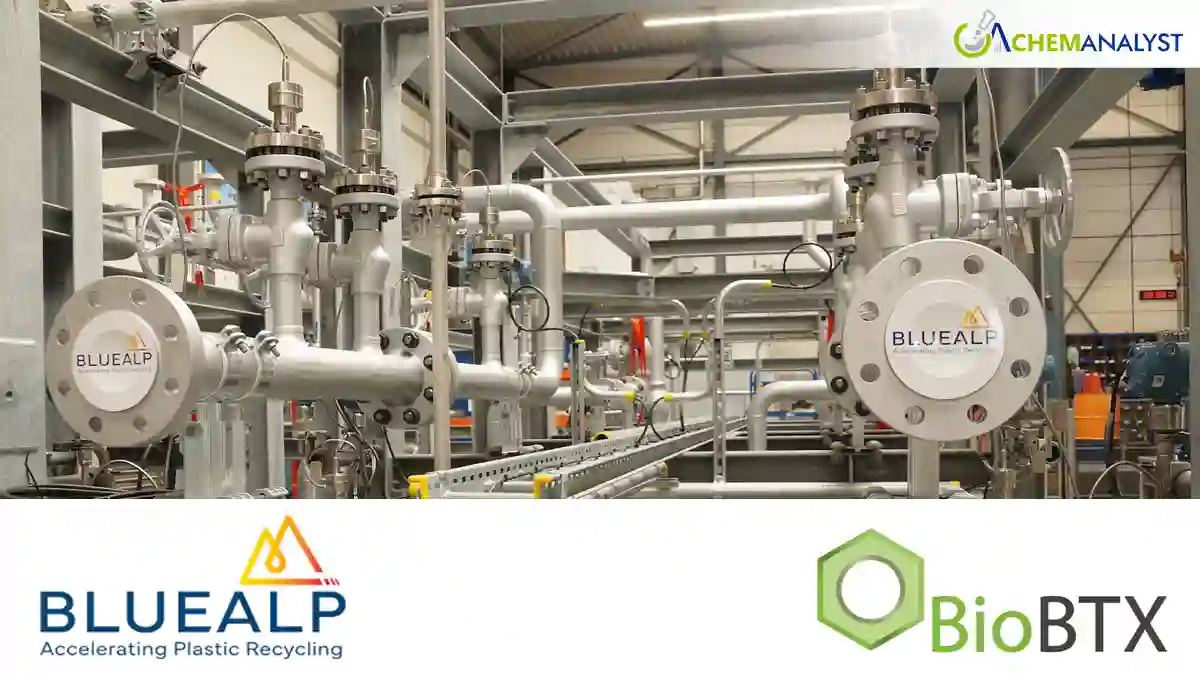
Dutch technology companies BlueAlp and BioBTX have announced a strategic partnership aimed at advancing the production of circular aromatics from hard-to-recycle plastic waste. As part of this collaboration, BlueAlp has been selected as the official technology partner for BioBTX’s upcoming plant in Delfzijl, the Netherlands. The project is designed to combine the strengths of both companies’ technologies to transform mixed post-consumer plastic waste into high-value circular aromatic chemicals.
The new facility in Delfzijl will focus on processing plastic waste that is typically difficult to recycle through conventional mechanical methods. These mixed plastic streams often end up in landfills or are incinerated, contributing to environmental pollution and the loss of valuable carbon resources. By integrating BlueAlp’s pyrolysis process with BioBTX’s proprietary catalytic conversion technology, the companies aim to create a sustainable and scalable solution for converting waste plastics into valuable chemical feedstocks.
BlueAlp’s patented pyrolysis technology works by gradually heating mixed plastic waste in the absence of oxygen, breaking it down into gas-phase vapours. This thermal process allows the company to efficiently handle post-consumer mixed plastics that are otherwise unsuitable for recycling. The resulting vapours are then passed to BioBTX’s innovative catalytic process, where they are converted into circular aromatics such as benzene, toluene, and xylene (BTX).
These aromatics are essential building blocks used across several industries, including automotive manufacturing, packaging, coatings, and advanced materials. Traditionally, they are produced from fossil-based sources such as crude oil and natural gas. By creating these chemicals from plastic waste instead, the partnership supports a more circular economy and reduces dependence on virgin fossil resources.
Following a comprehensive technology assessment, BioBTX selected BlueAlp due to the maturity and reliability of its continuous pyrolysis process. BlueAlp’s technology has achieved Technology Readiness Level 9 (TRL 9), indicating that it has already been proven in operational industrial environments. This was a key factor in BioBTX’s decision to move forward with the collaboration.
As part of the agreement, BlueAlp will provide BioBTX with a license for its pyrolysis technology and will oversee the detailed engineering, design, and fabrication of the pyrolysis unit. This unit will become an integral part of the larger BioBTX facility in Delfzijl. The plant is expected to handle around 20 kilotonnes per year (kta) of mixed plastic waste, making it a significant industrial-scale project for circular chemistry.
The pyrolysis unit is currently under fabrication at BlueAlp’s headquarters in Eindhoven. The modular components are scheduled to be transported to the Delfzijl site starting in December 2026, where they will be assembled and integrated into the full BioBTX plant.
Ton Vries, CEO of BioBTX, stated that BlueAlp was chosen after an extensive evaluation because of its proven process and high technology maturity. He emphasized that combining BlueAlp’s pyrolysis technology with BioBTX’s Integrated Cascading Catalytic Pyrolysis (ICCP) process creates a highly effective solution for the future of circular chemicals. According to him, this partnership has the potential to significantly reshape the circular chemical industry.
Valentijn de Neve, CEO of BlueAlp, described the collaboration as a major milestone for the company. He noted that working with BioBTX strengthens BlueAlp’s role in the circular aromatics market by providing a direct pathway toward producing sustainable BTX chemicals. He also praised BioBTX’s innovation and the commitment of its team.
Both companies share a strong vision of accelerating the transition toward a circular chemical industry. The Delfzijl plant is expected to become the first industrial-scale facility of its kind using BioBTX’s ICCP technology and operated directly by the company. It represents an important step in demonstrating how plastic waste can be transformed into valuable raw materials for the future.
This partnership marks significant progress in scaling sustainable solutions for plastic waste management while reducing the industry’s reliance on fossil-based aromatics.








 About ChemAnalyst
Leave a Comment
Comments (0)