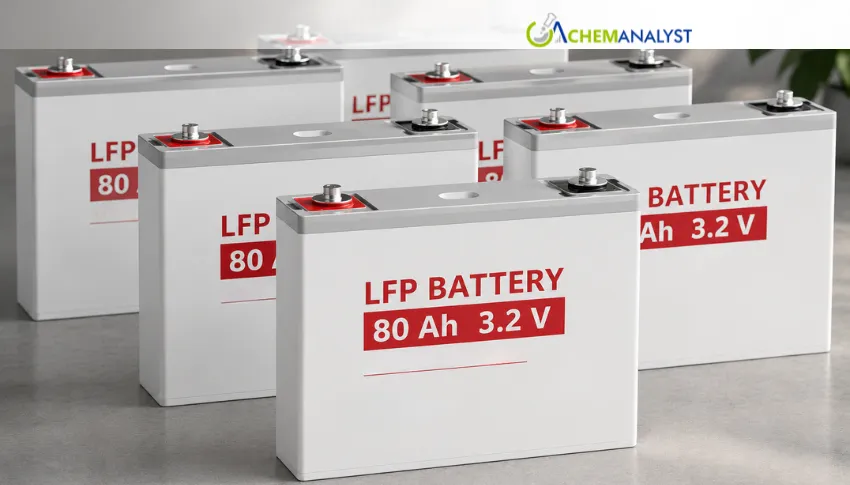
Europe can build LFP cells, but not the cathode material inside them, and not at the leading specification. China's July 2025 licensing regime requires MOFCOM approval for every export of LFP cathode preparation technology. That approval has never been suspended — leaving non-Chinese plants able to assemble cells from imported cathode powder while frontier-grade production stays inside China.
For three years, the question facing Europe's battery buildout was whether the money would arrive. It largely has. What has not arrived is permission — specifically, Chinese permission to move the cathode technology that makes those factories economic.
On 15 July 2025, China's Ministry of Commerce and Ministry of Science and Technology amended the national Catalogue of Technologies Subject to Export Prohibitions and Restrictions, moving lithium iron phosphate (LFP) and lithium manganese iron phosphate (LMFP) cathode preparation technology — along with lithium carbonate and lithium hydroxide preparation technology — into the "restricted" category. Restricted does not mean banned. It means every export contract needs prior MOFCOM approval through a two-step process: a preliminary licence before the contract can be signed, then a formal licence before the technology moves. The contract has no legal effect until the second is granted.
On 9 October 2025, MOFCOM and the General Administration of Customs went further with Announcement No. 58, adding finished lithium batteries, cathode active materials, artificial graphite anode materials and associated production equipment to the dual-use control list, effective 8 November. On 7 November, following the Trump–Xi meeting in Busan, Beijing suspended that package until 10 November 2026.
The July technology restrictions were never suspended. They remain in force today.
Why didn't the November suspension change anything?
Coverage in late 2025 treated the suspension as de-escalation, and narrowly it was: controls on physical goods — cells, cathode powder, graphite anode material — came off. But the measure that actually constrains factory-building in the West stayed on.
Cathode powder can be shipped. Cathode know-how cannot, not without a licence granted at MOFCOM's discretion. That distinction determines whether a plant outside China is a manufacturing asset or an assembly endpoint.
The scope is granular. The controls define LFP by performance threshold rather than by name: compacted density at or above 2.5 g/cm³ and specific capacity at or above 156 mAh/g — the third- and fourth-generation grades used in mid-market EVs and grid storage. The July amendment also tightened the compaction density test condition from 300 MPa to 220 MPa, widening the range captured.
The result is a tiered system. Lower-specification chemistry licenses outward relatively freely; the best grades stay home. Western plants can build LFP capacity, but not frontier LFP capacity.
Why can't Europe simply source cathode elsewhere?
Export controls only bite where substitution is hard. Here it is very hard. China produces an estimated 95 to 98 percent of the world's LFP cathode active material and holds effectively all the process know-how for making LFP cells at scale. Across the four key battery components — cathode, anode, separator, electrolyte — Europe and North America together hold somewhere between five and ten percent of global capacity on current trends.
This is not a case where an alternative supplier exists at higher cost. For advanced LFP, none exists at any cost.
Which European plants are affected?
Three sit closest to the line.
CATL's Debrecen facility in Hungary has completed its first cell plant and installed its equipment, with module assembly running on a new 5 GWh line since 6 May 2026. Cell production awaits permits. Meanwhile Mercedes-Benz sources cells for its new electric van from China rather than Hungary — a completed factory still functioning as a downstream node while value-added steps remain offshore.
The CATL–Stellantis joint venture at Zaragoza, Spain is most exposed: a €4.1 billion LFP plant targeted at up to 50 GWh, built as a 50-50 JV with the technology holder. Licensing sits at the centre of that commercial structure, not its edge. Construction began November 2025, completing March 2028.
PowerCo's Sagunto plant near Valencia starts with LFP, preseries cells expected autumn 2026 and series production pushed to July 2027.
For each, the question is not whether cells get made, but which generation of chemistry they use — and therefore whether the resulting cost per kWh competes with imports.
What does this mean for phosphoric acid and iron sulfate demand?
For chemical producers and buyers, the regime has a counterintuitive effect: it suppresses European demand for battery precursor chemicals even as European cell capacity rises.
A gigafactory importing finished LFP cathode powder consumes no purified phosphoric acid, no battery-grade iron sulfate and no lithium carbonate in-region. The phosphorus, iron and lithium are already embedded in the powder when it clears customs. Localised demand materialises only if cathode active material production itself moves to Europe — precisely the step the technology controls are designed to slow.
The arithmetic is not trivial. A single 25 GWh LFP line consumes roughly 37,000 tonnes per year of purified phosphoric acid on a 100 percent P2O5 basis, around 21,000 tonnes of contained iron units and 14,000 tonnes of lithium carbonate. Europe's battery-grade phosphate market remains formative, with regional production only beginning against heavy import reliance.
Both acids trace back to sulphur via sulphuric acid — a chain already under scrutiny given shipping risk through the Strait of Hormuz. Graphite offers a precedent: when China restricted natural graphite exports in October 2023, shipments spiked ahead of implementation then slowed sharply for two to three months, with licensing applied case by case and approval times varying by destination.
What happens next?
The suspension of the October 2025 goods controls expires on 10 November 2026. Whether Beijing lets it lapse, extends it or reinstates the measures is the most consequential regulatory event for non-Chinese battery manufacturing in the coming year.
Buyers exposed to cathode, anode or electrolyte inputs should assume the July technology restrictions persist regardless, and treat pre-positioned inventory and qualified secondary sources as insurance rather than working capital inefficiency. The graphite precedent suggests that if reinstatement comes, the market will see it in shipment data before it sees it in an announcement.







 About ChemAnalyst
Leave a Comment
Comments (0)