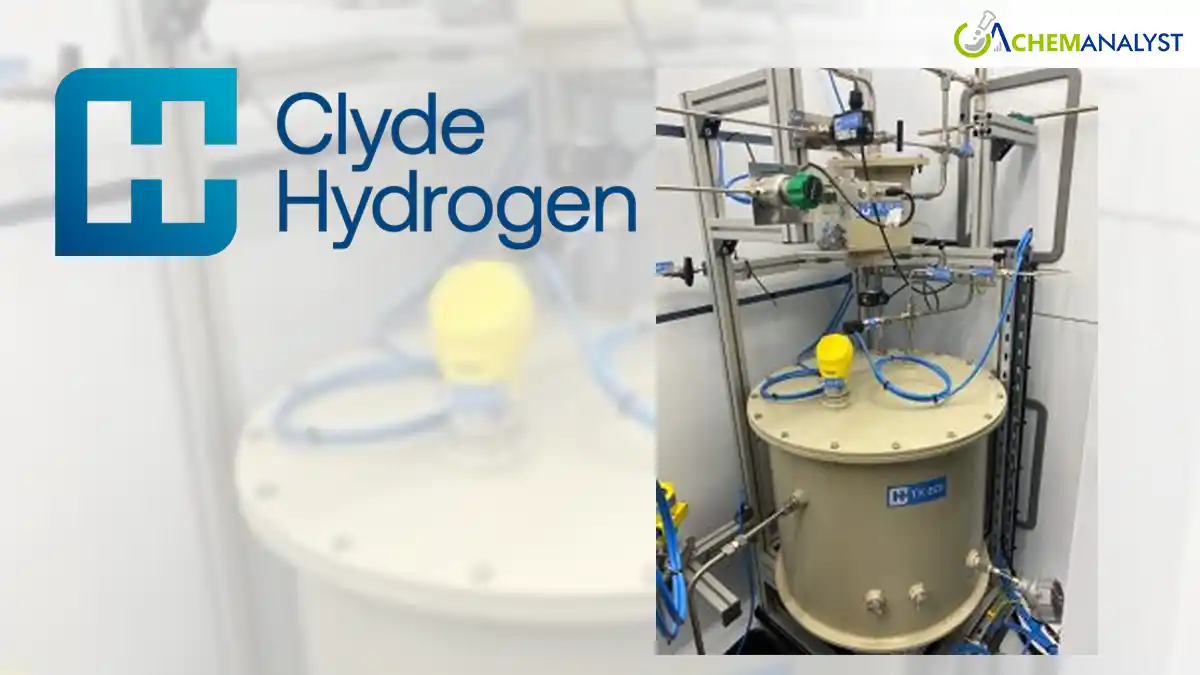
Clyde Hydrogen Systems (Clyde Hydrogen), an emerging Scottish clean-energy innovator, has reached a major technological and commercial milestone by successfully producing hydrogen from its first fully integrated prototype system. This achievement represents a decisive validation of the company’s core technology and marks a significant step forward in its mission to reshape the future of green hydrogen production and storage.
The newly completed prototype demonstrates Clyde Hydrogen’s proprietary decoupled electrolysis process, a fundamentally different approach to hydrogen generation compared with conventional electrolysers. Unlike traditional systems, which simultaneously produce hydrogen and oxygen under high pressure and in gaseous form, Clyde Hydrogen’s process separates the steps of hydrogen generation and storage. This decoupling is designed to make hydrogen production substantially safer, simpler, and more cost-effective, while also improving compatibility with renewable energy sources such as wind and solar power.
One of the most compelling advantages of Clyde Hydrogen’s system is its ability to connect directly to intermittent renewable electricity and store hydrogen in a non-gaseous form. This feature directly addresses some of the most persistent challenges facing the hydrogen economy, including safety concerns around high-pressure gas storage, infrastructure complexity, and the lack of viable long-duration energy storage solutions. By enabling hydrogen to be produced, stored, and later released when needed, the technology offers a practical pathway for balancing renewable energy supply and demand over extended periods.
The prototype build follows an important technical breakthrough achieved last year, when Clyde Hydrogen successfully produced hydrogen at high pressure using its decoupled electrolysis method for the first time. With the integrated system now operational, the company is shifting its focus toward scaling the technology into a commercial demonstrator. Clyde Hydrogen has set an ambitious target of launching its first market-ready product by 2028, positioning itself as a key player in the next generation of green hydrogen systems.
Clyde Hydrogen originated as a spin-out from the University of Glasgow’s School of Chemistry, internationally recognised for its leadership in electrochemistry research. Drawing on this strong academic foundation, the company believes its technology has the potential to redefine the architecture of reliable, low-carbon hydrogen production. To support its next phase of development, Clyde Hydrogen is seeking up to £5 million in seed funding, with the round expected to close by the end of the second quarter. The capital will be used to finalise the first commercial product and expand the team in response to growing interest from industry stakeholders.
The company is already supported by pre-seed investment from Zinc, the University of Glasgow, and Dale Vince’s Ecotricity, alongside grant funding from the Scottish Government’s Hydrogen Innovation Scheme and the Net Zero Technology Centre. In 2025, Clyde Hydrogen further strengthened its commercial outlook by signing a memorandum of understanding with PlusZero, a Hebrides-based green hydrogen producer, to demonstrate the technology outside laboratory conditions for the first time.
Commenting on the achievement, James Peck, CEO of Clyde Hydrogen, described the integrated prototype as a defining moment for the company. He highlighted its importance in proving to investors and customers that the technology is real, scalable, and capable of transforming how hydrogen is produced and used, while also emphasising the company’s intention to identify strategic partners for real-world deployment.
Professor Mark Symes, co-inventor of the technology, reflected on the journey from early laboratory experiments to a fully engineered system. He noted that reaching this stage represents a pivotal turning point and expressed confidence that Clyde Hydrogen’s approach will ultimately prove revolutionary for the green hydrogen sector.







Leave a Comment
Comments (0)